Photometric Fields

Roman's Photometric Touchstone fields are used to characterize the photometric performance and repeatability of the Wide Field Instrument (WFI). This article describes the properties of the fields and the observing strategies employed during the prime mission.
Introduction
The Photometric Touchstone Fields are used to provide the basis for high‑precision, repeatable relative photometric calibration. The selected Photometric Touchstone fields will be observed repeatedly by Roman during the 5-year primary mission in order to continuously verify and update Roman WFI calibration. Observations in these fields will be used to characterize the photometric resoponse over the full field-of-view The observations in these fields are critical to meet Roman's prime mission calibration requirements and directly contribute to the following requirements: (1) relative photometric uniformity of 5 mmag over the entire WFI field of view; (2) sub‑field uniformity of 2 mmag over an individual WFI detector; (3) chromatic calibration of bandpass‑induced variations to 2 mmag accuracy across the field of view; (4) temporal monitoring of sensitivity variations to 5 mmag throughout the mission; (5) absolute calibration to 10 mmag, if suitable standards are identified.
The community process to select the fields recommended that the Large Magellanic Cloud (LMC) Astrometric Field was suitable for these purposes due to the optimal combination of stellar density, source brightness range, and being in the Roman Continuous Viewing Zone (CVZ) as well as the availability of multiple data sets from observations performed with HST and JWST. However, the stellar sources in the LMC Astrometric Field are primarily red giants and span a limited color range. To address this concern, a second Photometric Touchstone field was also selected within the Kepler prime mission survey field that includes the open cluster NGC6811.
Large Magellanic Cloud Photometric Field
The LMC field was selected as Roman’s primary Photometric Touchstone field because:
- it has a high and uniform stellar density in the brightness range needed for precise photometric flat‑fielding;
- it resides entirely within the Roman CVZ, enabling frequent revisits throughout the mission;
- it has extensive historic calibration data, including JWST Astrometric Calibration Field exposures and HST ACS/WFC3 imaging, which support cross‑mission calibration consistency;
- it has a low number of bright foreground stars, reducing the risk of detector saturation during calibration exposures.
As shown in the Figure of Stellar Density and Properties, the LMC field is dominated by upper red-giant branch and red-clump stars, spanning a relatively narrow color range (roughly, J–K from 0.5–1.2 mag), which limits the usefulness for calibrating field-dependent chromatic effects arising from WFI filter bandpass variations. This motivated the selection of a second field.
Figure of Stellar Density and Properties in the LMC Field
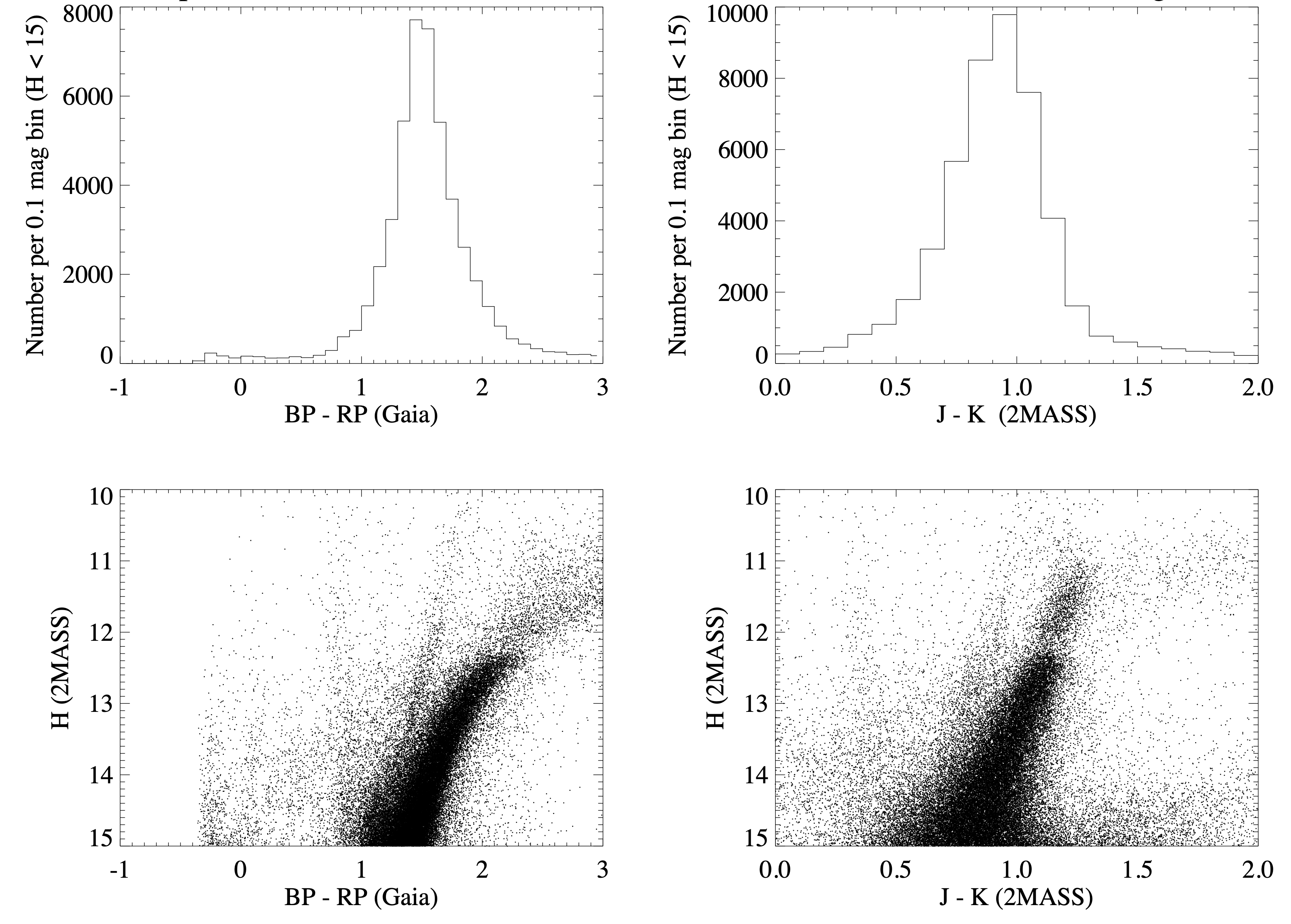
Properties of the sources in the LMC Photometric Touchstone Field. The top panels shows a marginal distribution of source color in the Gaia (left) and 2MASS (right) catalogs. The lower panels show color-magnitude diagrams (CMDs) of the field from Gaia (left) and 2MASS (right). Figure from the Wide Field Instrument Calibration Touchstone Field Recommendations (Williams 2025).
Kepler Prime Survey Photometric Field
A secondary field was identified that supplements the LMC stellar-color range with bluer stars. The secondary field is located on the open cluster NGC6811 within Kepler Prime Survey Mission Field and its location is shown in the Placement of the Kepler Photometric Touchstone Field. This field was selected because:
- it has a large population of blue stars, providing a broader spectral‑energy‑distribution (SED) range;
- its stellar colors complement the red LMC stellar population, enabling the calibration of chromatic photometric terms from detector bandpass variations;
- it lies in the Roman CVZ, allowing repeated calibrations with appropriate dither strategies.
The source densities and color-magnitude diagrams for the field are given in the Figure of Stellar Density and Properties of the Kepler Survey Field. Together, the LMC and Kepler fields deliver a combined color range of more than one magnitude (J–K from 0.2 to 1.3 magnitudes), adequate for quantifying and correcting field‑dependent color terms.
Placement of the Kepler Photometric Touchstone Field
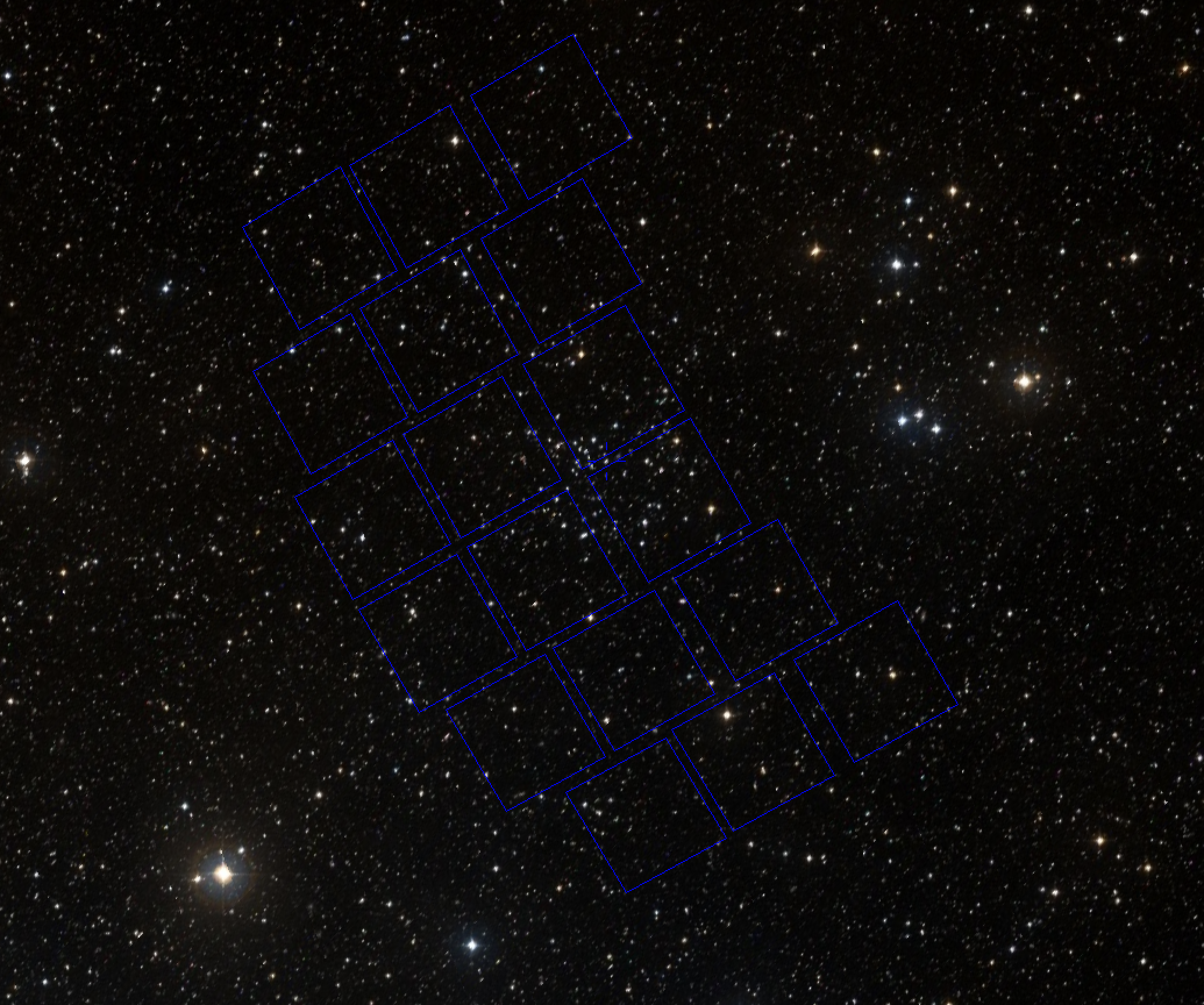
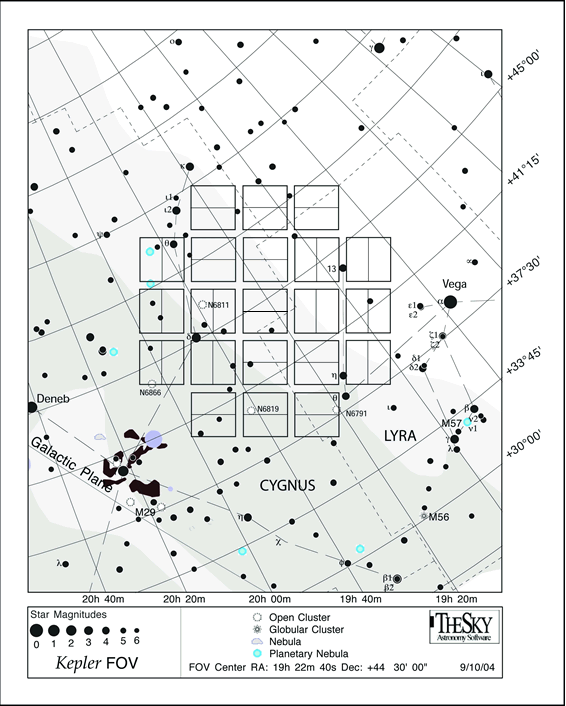
Figure of Stellar Density and Properties of the Kepler Survey Field
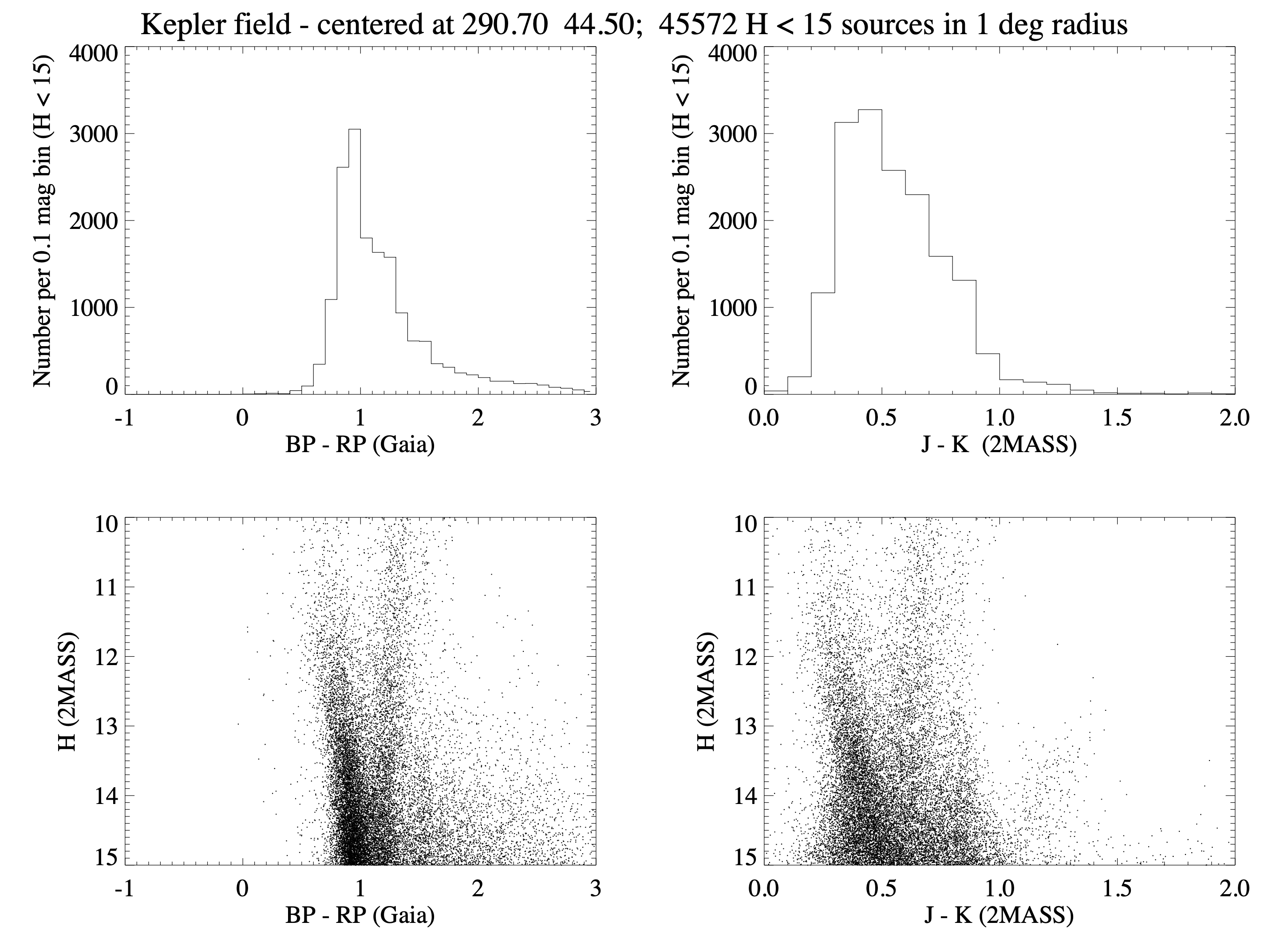
Properties of the sources in the Kepler Photometric Touchstone Field using a one degree radius from the field center. The top panels shows a marginal distribution of source color in the Gaia (left) and 2MASS (right) catalogs. The lower panels show color-magnitude diagrams (CMDs) of the field from Gaia (left) and 2MASS (right). Figure from the Wide Field Instrument Calibration Touchstone Field Recommendations (Williams 2025).
Photometric Touchstone Observing Strategy
The observing strategy for the Photometric Touchstone Fields consists of:
- Small dithers (SUB4) will be used to average over sub-pixel response and to help constrain the point-spread function (PSF);
Large dithers (custom mosaic) will be used to image stars across the different WFI detectors and derive detector‑to‑detector large-scale flat fields that are crucial for achieving millimag‑level uniformity over the WFI field of view.
At each pointing, the fields are observed in each of Roman's imaging filters with exposure times of approximately 60 seconds (see Imaging MultiAccum Tables).
Because the LMC field is also used as an Astrometry Touchstone field, the LMC Observing Plan includes additional dithers to meet the required astrometric solution accuracy as described in the Astrometic Field article.
For additional questions not answered in this article, please contact the Roman Help Desk.
References
- Anderson, J., Fall, M., and the Astrometric Working Group, "The JWST Calibration Field: Absolute Astrometry and Proper Motions with GAIA and a Second HST Epoch", JWST Technical Report
- "Touchstone Field Report" presentation at the Roman Community Forum on February 26, 2025 by S. Casertano on behalf of the Calibration Working Group
- "Nancy Grace Roman Space Telescope: Wide Field Instrument Calibration Touchstone Field Recommendations" delivered March 31, 2025 by Williams et al. on behalf of the Calibration Working Group