Program Information

The Program Information form contains the descriptive information about the program, including the Title, Abstract, and Program ID. These fields help provide context for the Survey Plan defined in the program, and investigators are encouraged to provide complete responses. Icons with a red X indicate errors in APT, but can also simply indicate required fields for which relevant data have not yet been entered. Warnings in APT are also discussed in this video produced for JWST.
Where to Enter Program Information
Most program information is entered on the Program Information form. Investigator information for Principal Investigator and Co-Investigator is entered and updated on the APT Investigator Information form, where you may search for investigators by name.
For draft GI programs, the Investigator Information form is not available. Investigator information is added when the draft program is submitted via the Roman Telescope Proposal System (RTPS)
Figure of the Program Information form in APT
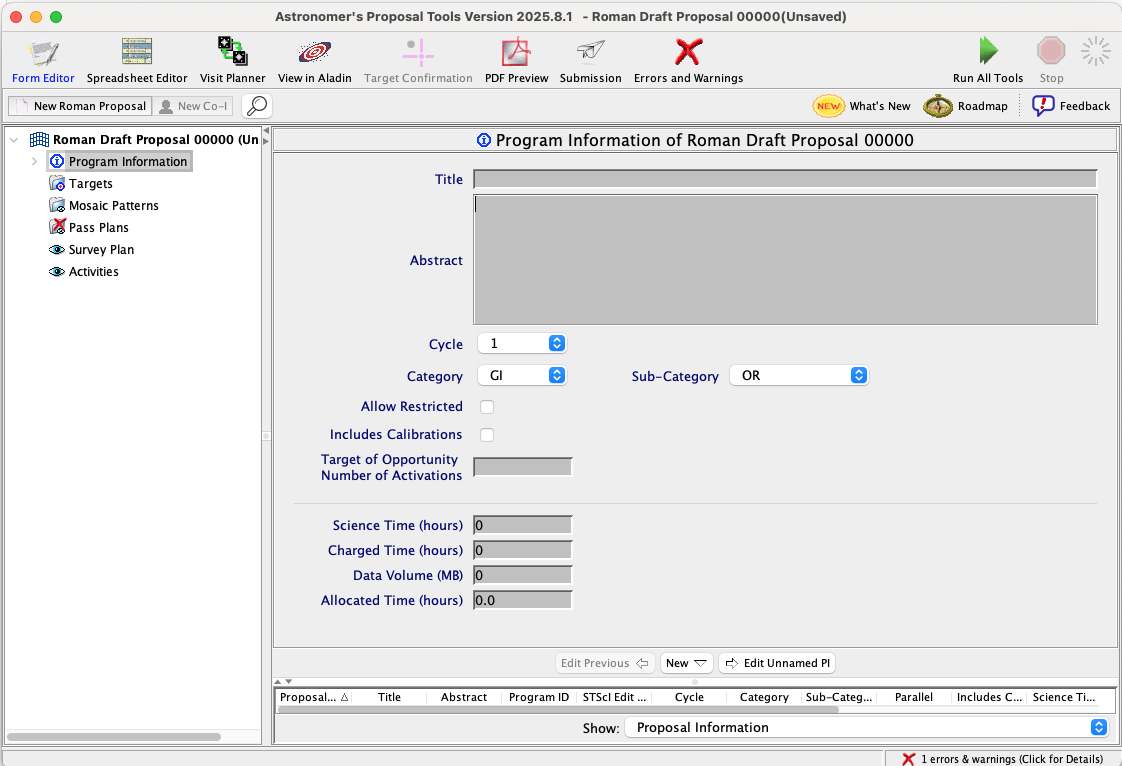
The Program Information form is shown for a Draft GI (General Investigator) program.
Certain parameters on this form are disabled or hidden for Draft programs in the GI (General Investigator) category. This information will be entered into the Roman Telescope Proposal System (RTPS) when the draft APT program is submitted with the rest of the proposing information.
- Disabled (not editable): Title, Abstract.
- Hidden: Program ID, STScI Edit Number, Observing Description, PI, and CoI.
These parameters are displayed in approved APT programs. To create a new Draft program from an existing Approved program, click the Reset to Draft button.
Title
(not editable for Draft GI programs)
A title for the program. The title must be in ASCII text with no quotation marks, and not more than 200 characters.
Abstract
(not editable for Draft GI programs)
A concise abstract that describes the program, including the main science goals and the justification for requesting observations or funding. The Abstract must be in standard ASCII and should be no longer than 1700 characters. This is enforced by an APT error.
Program ID
PROGRAM ID
(not available for Draft GI programs)
Enter the PROGRAM ID of the approved program (if not already entered by your Program Coordinator). PROGRAM ID is used only for approved programs (see Submission). The allowed range is 1-18445 .
Program status in APT (Draft or Approved) is shown on the Program Information form:
- When a new program is created, PROGRAM ID is empty, and the program is labeled "Draft."
- After PROGRAM ID is entered, the program is labeled "Approved."
To reset a program to Draft, remove the PROGRAM ID . The program is once again labeled "Draft."
STScI Edit Number
(not available for Draft GI programs)
A number which is incremented for approved programs whenever the file is updated by STScI staff.
Cycle
The cycle number for the program.
Cycle 0 is reserved for commissioning programs. Information about Cycle 1 can be found in the Call for Proposals documentation maintained by the Science Support Center (SSC) at IPAC.
Reset to Draft
You can use Reset to Draft to create a new Draft Program from an existing Approved Program. Click the Reset to Draft button to change the status of an Approved program to Draft. Many parameters that are available or editable in Approved programs cannot be updated in Draft programs. See Draft GI Programs.
Category
CATEGORY = GI (default), CCS , CAL , ENG , COM , NASA , CGI
Select one Category. Definitions and the allowed Sub-Categories for each Category are shown in the Table of Category Definitions.
Changes to the technical details and other specifications presented here are expected as a part of commissioning and early operations.
Table of Category Definitions
| Category | Definition | Availability | Allowed Sub-Categories** |
|---|---|---|---|
| GI | General Investigator | All users | OR, DR, CR, TR, AR, CAL |
| CCS | Core Community Survey | All users | GBTD, HLTD, HLWA |
| NASA | Observing conducted at the direction of NASA | All users | none |
| CGI | CGI Technology Demonstration | Internal use only | none |
| CAL* | Calibration | Internal use only | CGI, WFI, WFSC |
| ENG* | Engineering | Internal use only | CGI, WFI, WFSC, MU, SK, SC |
| COM* | Observatory Commissioning | Internal use only | CGI, WFI, WFSC, MU, SK, SC |
* When CAL, ENG, or COM is selected, restricted features in APT are enabled, which means Allow Restricted is selected and cannot be changed.
** Sub-Categories are defined in the Table of Sub-Category Definitions.
Sub-Category
CATEGORY = OR (default), DR , CR , TR , AR , CAL , GBTD , HLTD , HLWA , CGI , WFI , WFSC , MU , SK , SC
Select one sub-category. Definitions are shown in the Table of Sub-Category Definitions. Allowed sub-categories depend on the selected CATEGORY as shown in the Table of Category Definitions.
Changes to the technical details and other specifications presented here are expected as a part of commissioning and early operations.
Table of Sub-Category Definitions
| Sub-Category | Definition |
|---|---|
| OR | Observational Research |
| DR | Discretionary Research |
| CR | Community Research |
| TR | Theory Research |
| AR | Archival Research |
| CAL | Calibration Research |
| GBTD | Galactic Bulge Time Domain Survey |
| HLTD | High Latitude Time Domain Survey |
| HLWA | High Latitude Wide Area Survey |
| CGI | Coronagraph Instrument |
| WFI | Wide Field Instrument |
| WFSC | Wavefront Sensing and Control |
| MU | Momentum Unload |
| SK | Stationkeeping |
| SC | Spacecraft |
Parallel
PARALLEL
(available only for CATEGORY = CAL , ENG , or COM )
Select this checkbox to indicate this program is to be executed in parallel with a Coronagraph program (see Parallel Coronagraph-WFI Programs).
Ground in the Loop
GROUND IN THE LOOP = YES , NO
(available only when PARALLEL is selected)
Select Yes to specify that the program must be matched with a Ground in the Loop (GITL) CGI prime observation (see Parallel Coronagraph-WFI Programs).
Allow Restricted
ALLOW RESTRICTED
Select this checkbox to enable restricted features. This option is saved with the program.
- When CATEGORY = CAL, COM, or ENG, ALLOW RESTRICTED is selected and cannot be changed.
-
ALLOW RESTRICTED
should not be selected if
CATEGORY
= GI or CCS. (
 APT provides a warning).
Includes Calibrations
INCLUDES CALIBRATIONS
Select this checkbox to indicate that at least one observation in the program includes a Calibration Requirement.
- For Category = CAL, the checkbox is selected by default and cannot be changed
- For Category = ENG, the checkbox is selected by default but may be changed by the user
- For all other categories - the checkbox is not selected by default but may be changed by the user.
Target of Opportunity Number of Activations
TARGET OF OPPORTUNITY NUMBER OF ACTIVATIONS
Enter the total number of Target of Opportunity Activations requested for all observations in the program.
Available only when a Target of Opportunity special requirement has been specified for one or more observations in the proposal. Required when available.
Science Time (hours)
SCIENCE TIME
Total science time in hours calculated for all survey steps in the program, not including overhead time. Not editable.
Charged Time (hours)
CHARGED TIME
Total time of execution for all survey steps in the program (in hours). Includes both science time and overheads. Not editable. See Visit Timing & Overhead Estimation.
Data Volume (MB)
DATA VOLUME
Total data volume in megabytes calculated for all survey steps in the program. Not editable.
Allocated Time (hours)
ALLOCATED TIME
Total time allocated for an approved program by ROTAC (Roman Observations Time Allocation Committee). This time is set to 0 for Draft programs.
Explain Unschedulable
Enter an explanation for any Survey Steps reported as unschedulable by the Visit Planner. Required for Draft programs that have any unschedulable Survey Steps.
Observing Description
OBSERVING DESCRIPTION
(not available for Draft GI programs)
Enter a description of the observations requested in this program, indicating targets, observing strategies, and any special requirements. OBSERVING DESCRIPTION is located on the Program Description form.
PI (Principal Investigator)
(not available for Draft GI programs)
The Principal Investigator for the program. Each program must have one PI. Any other investigators may be added as Co-Investigators (CoI). PI is located on the PI form.
A Co-Principal Investigator (Co-PI) option is also available as a check box on the CoI form, allowing two or more proposers to share the scientific responsibility of the project. Other individuals who are actively involved in the proposal should be listed as Co-Investigators (CoIs).
The terms Principal Investigator and Co-Investigator are adopted from the HST and JWST missions and are subject to change to better represent how the astronomical community will interface with the Roman mission.
CoI (Co-Investigator)
(not available for Draft GI programs)
A Co-Investigator for the program. Other individuals who are actively involved in the proposal should be listed as Co-Investigators (CoIs). CoI is located on the CoI form.
To add a CoI, right-click the PI in the left pane. then click New CoI.
If a proposal has a non-U.S. PI and one or more U.S. CoIs, then you must select the US Admin CoI box (in the PI tab), then select one of the U.S. CoIs. This indicates which U.S. CoI will be the Administrative PI for overseeing the grant funding for U.S. investigators. For proposals with category COM, CAL, or ENG, a U.S. CoI is not required.
If one of the CoIs (or another individual) is to serve as the contact for a proposal, then the Technical Contact keyword box should be checked. The Technical Contact is the person the Principal Investigator has designated to receive all (non-budgetary) questions/information on the proposal and to be the official voice for the team. More than one CoI may be designated as the Technical Contact. Once designated, only the Technical Contact may make Change Requests in an approved proposal so that conflicting requests are not made.
For additional questions not answered in this article, please contact the Roman Help Desk.