WFI Optical Elements

The Wide Field Instrument (WFI) includes a set of optical elements used for both imaging and dispersive (spectroscopic) observations. These elements are housed in the element wheel assembly with: Grism, F213, F062, F106, F129, Prism, F158, F184, F146, F087, and Dark. The properties of these elements are described in this article.
Element Wheel Assembly
The Wide Field Instrument (WFI) optical element wheel houses a set of eight imaging filters, two spectral dispersers, and one blank position. Together, these are referred to as optical elements (often shortened to elements). The Figure of the Element Wheel Assembly with the Optical Elements Labelled shows the Element Wheel Assembly and ordering of the optical elements.
The properties of the optical elements are summarized below in Table of Properties for Imaging Elements (imaging) and the Table of Properties for Dispersive Elements (spectroscopy). Definitions of the columns used in the Table of Properties for Imaging Elements are provided in the Bandpass Column Definitions section.
The blank position is not described in detail, as it is used only infrequently for specific internal calibration modes. This position is referred to as DARK in both the Astronomer's Proposal Tool (APT) and WFI data products. In APT, the DARK element is typically excluded from the list of selectable optical elements, except for certain observing specifications (see the Calibration Requirements article in the Roman APT User Guide for examples).
Figure of the Element Wheel with the Optical Elements Labelled
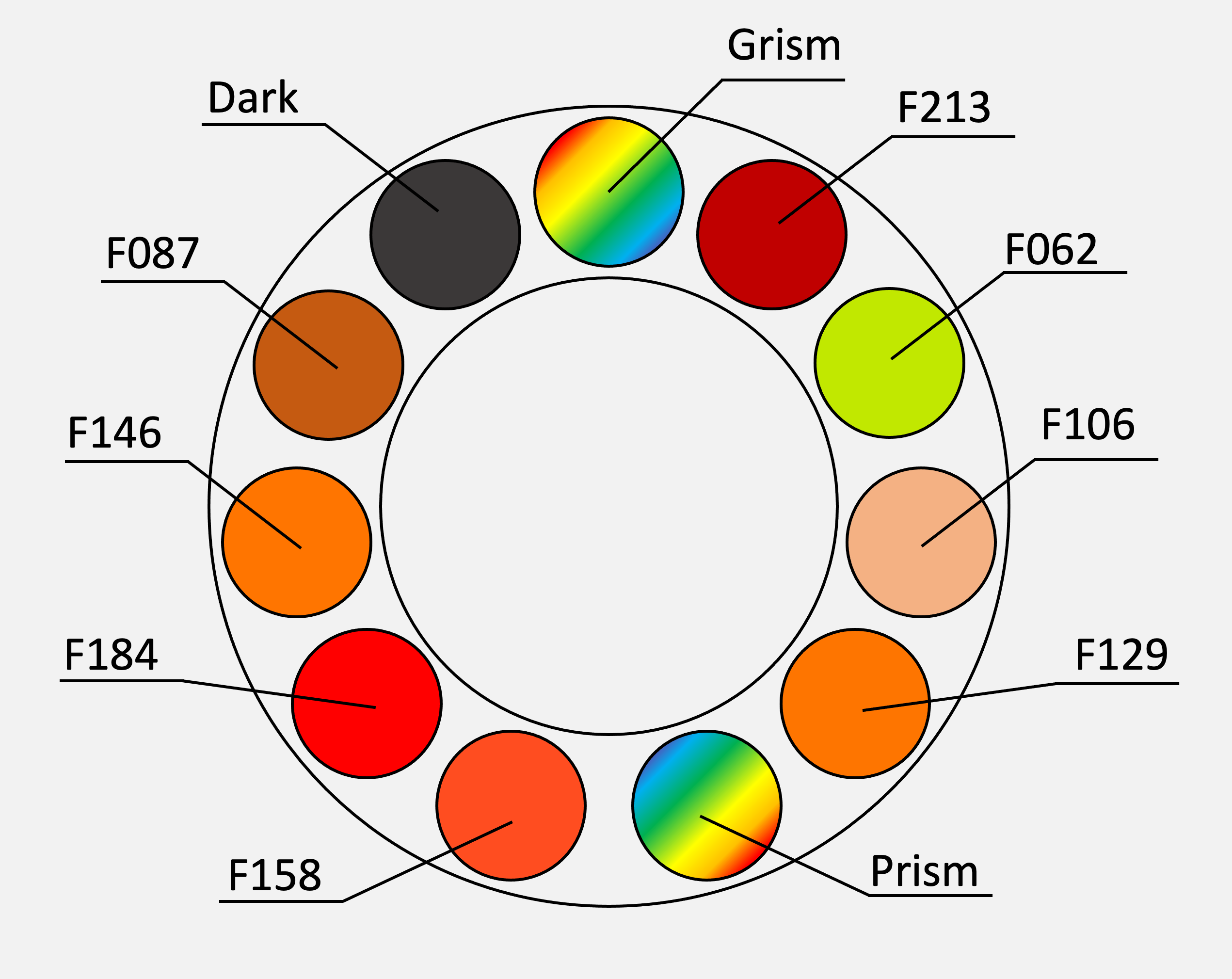
Schematic of the Element Wheel with each the optical elements labelled. From the top position and going clockwise the elements are: Grism, F213, F062, F106, F129, Prism, F158, F184, F146, F087, and Dark. The detailed properties of these elements are presented in this article.
Imaging Elements
The Table of Properties for Imaging Elements lists the detailed properties of each imaging element, while the Figure of Properties for Imaging Elements shows the throughput curves (effective area) for each element.
Additional information is available in the Roman Space Telescope Technical Information Repository v1.2 (July 2025). For imaging mode, the following directories are particularly relevant
/data/WideFieldInstrument/Imaging/FiltersSummary- overall filter parameters/data/WideFieldInstrument/Imaging/Sensitivity- sensitivity estimates/data/WideFieldInstrument/Imaging/EffectiveAreas- effective area tables for each detector position in the focal plane for each element
Analogous filters from other systems are provided for informational purposes only. The WFI optical elements do not correspond exactly to these filters, and users should take care to understand the differences between the WFI photometric system and other photometric systems.
Figure of Properties for Imaging Elements
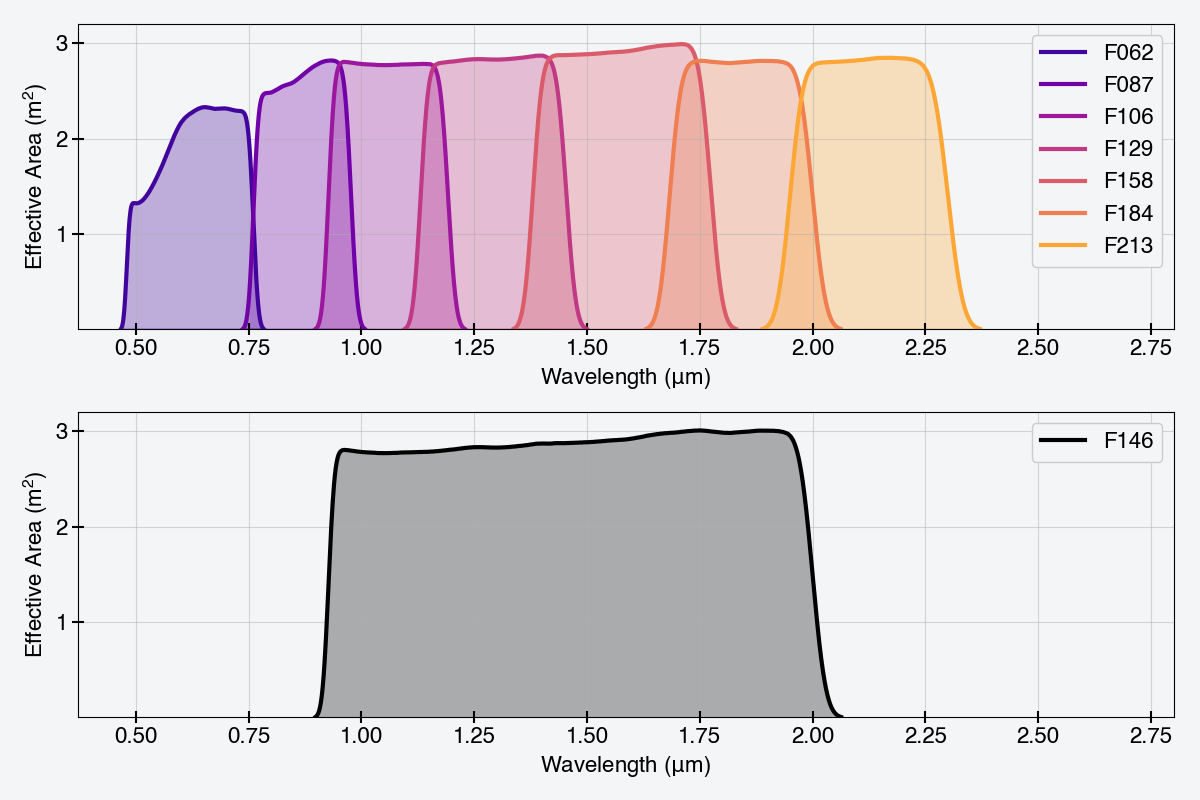
Effective area curves for the each imaging filter. The upper panel shows the seven broad-band filters, while the lower panel shows the wide filter. The effective area curves represent the total system throughput for a typical detector multiplied by the collecting area. All optical element figures use identical axis limits for reference.
Dispersive Elements
The Table of Properties for Dispersive Elements contains the optical properties of the prism and grism, while Figure of Properties for Dispersive Elements displays the effective area curves of the grism first order and of the prism. Throughput information for other orders is not available at this time, but may be provided in the future.
The Roman Space Telescope Technical Information Repository v1.2 (July 2025) contains additional information. For the spectroscopic mode:
/data/WideFieldInstrument/Spectroscopy/PrismGrismSummary- overall parameters/data/WideFieldInstrument/Spectroscopy/Sensitivity- sensitivity estimates/data/WideFieldInstrument/Spectroscopy/EffectiveAreas- effective area tables for each detector position in the focal plane for each element
Table of Properties for Dispersive Elements
Optical Element | Minimum Wavelength | Maximum Wavelength | Center Wavelength | Width | R |
|---|---|---|---|---|---|
| Grism | 1.0 | 1.93 | 1.465 | 0.930 | 461 |
| Prism | 0.75 | 1.80 | 1.275 | 1.05 | 80 – 180 |
Release Tag
The information in this table corresponds to the Roman Space Telescope Technical Information Repository v1.2 (July 2025).
Figure of Properties for Dispersive Elements
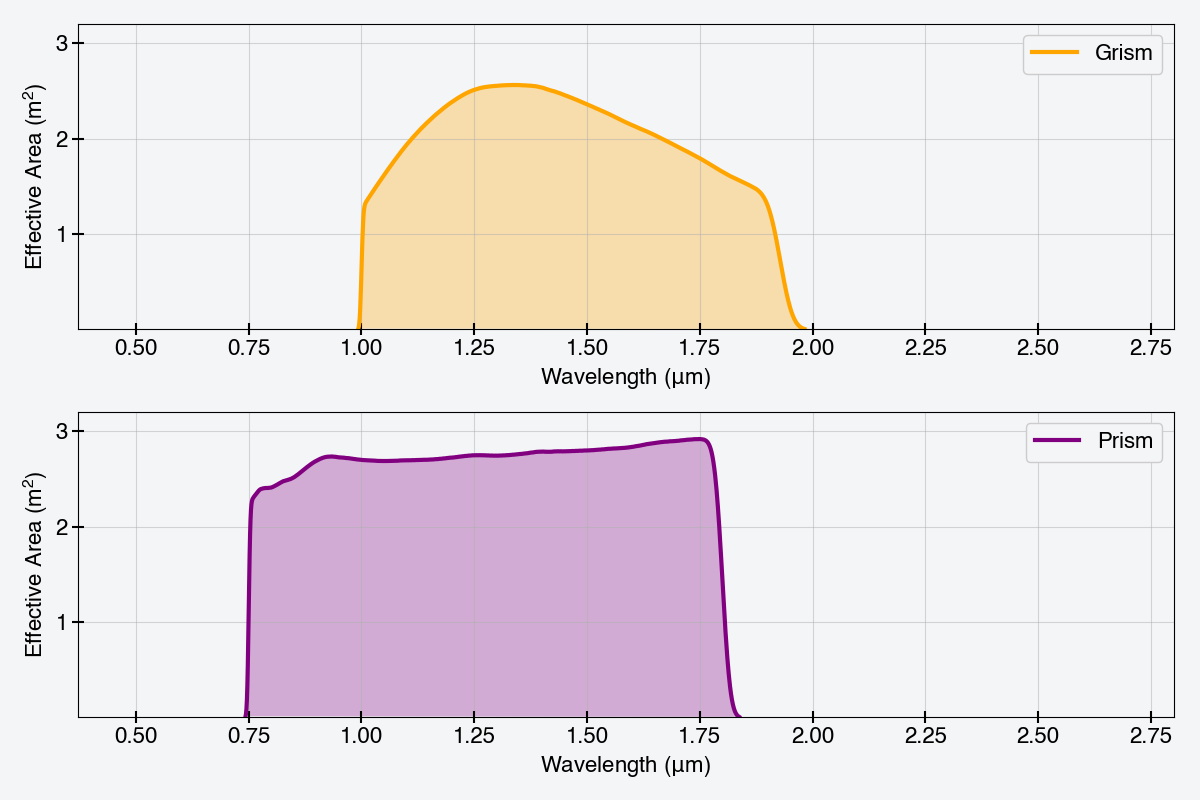
Effective area curves of the grism first order and of the prism. The effective area curves represent the total system throughput for a typical detector multiplied by the collecting area. The axis limits in all figures of optical elements are identical for reference.
Using the Bandpasses with synphot
The columns in Table of Properties for Imaging Elements can be computed using synphot (STScI Development Team, 2018); more information about synphot can be found in the Synphot for Roman article.
Table of Properties for Imaging Elements
Optical Element | Mean Wavelength | Pivot Wavelength | Bandpass Width (µm) | Bandpass FWHM (µm) | Bandpass RMS (µm) | Equivalent Width (µm) | Analogous Ground |
|---|---|---|---|---|---|---|---|
| F062 | 0.6340 | 0.6291 | 0.0788 | 0.1856 | 0.0773 | 0.1243 | R |
| F087 | 0.8719 | 0.8696 | 0.0633 | 0.1490 | 0.0632 | 0.1272 | z |
| F106 | 1.0595 | 1.0567 | 0.0774 | 0.1823 | 0.0777 | 0.1632 | Y |
| F129 | 1.2936 | 1.2901 | 0.0942 | 0.2219 | 0.0945 | 0.2022 | J |
| F158 | 1.5791 | 1.5749 | 0.1152 | 0.2712 | 0.1154 | 0.2549 | H |
| F184 | 1.8418 | 1.8394 | 0.0939 | 0.2210 | 0.0940 | 0.1966 | H/K |
| F213 | 2.1255 | 2.1230 | 0.1038 | 0.2443 | 0.1039 | 0.2181 | Ks |
| F146 | 1.4724 | 1.4378 | 0.3052 | 0.7188 | 0.3104 | 0.6854 |
Work is still on-going to align this content with the data provided in Roman Space Telescope Technical Information Repository v1.2 (July 2025).
The columns in the table are defined in the documentation as the following equations. In the equations below, P_\lambda refers to the dimensionless bandpass throughput at a given wavelength \lambda. The mean wavelength (synphot.bandpass.avgwave()) is the average wavelength as defined in Koornneef et al. (1986):
| \lambda_0 = \dfrac{\int P_\lambda \lambda\ \mathrm{d}\lambda}{\int P_\lambda\ \mathrm{d}\lambda}. |
The pivot wavelength (synphot.bandpass.pivot()) is defined as:
| \lambda_{\mathrm{pivot}} = \left[\dfrac{\int P_\lambda \lambda\ \mathrm{d}\lambda}{\displaystyle\int\left(\dfrac{P_\lambda}{\lambda}\right)\ \mathrm{d}\lambda}\right]^{1/2}. |
The bandpass width (synphot.bandpass.photbw()) is computed as:
| \mathrm{bw} = \bar{\lambda}\ \left[\dfrac{\displaystyle\int\left(\dfrac{P_\lambda}{\lambda}\right)\ln\left(\dfrac{\lambda}{\bar{\lambda}}\right)\ \mathrm{d}\lambda} {\displaystyle\int\left(\dfrac{P_\lambda}{\lambda}\right)\ \mathrm{d}\lambda}\right]^{1/2}, |
where \bar{\lambda} is the mean log wavelength (synphot.bandpass.barlam()) from Schneider, Gunn, and Hoessel (1983):
| \bar{\lambda} = \exp\ \left[\dfrac{\displaystyle\int\left(\dfrac{P_\lambda}{\lambda}\right)\ln(\lambda)^2\ \mathrm{d}\lambda} {\displaystyle\int\left(\dfrac{P_\lambda}{\lambda}\right)\ \mathrm{d}\lambda}\right]. |
The bandpass full-width half-max (FWHM; synphot.bandpass.fwhm()) is defined as:
| \mathrm{fwhm} = \mathrm{bw}\ \left[8\log(2)\right]^{1/2}, |
where bw is the bandpass width defined above.
The bandpass root mean square (RMS) width (synphot.bandpass.rmswidth()) is computed following the definition by Koornneef et al. (1986):
| \lambda_{\mathrm{rms}} = \left[ \dfrac{\int P_\lambda\left(\lambda - \lambda_0\right)^2\ \mathrm{d}\lambda}{\int P_\lambda\ \mathrm{d}\lambda}\right]^{1/2}, |
where \lambda_0 is the bandpass average wavelength defined above.
The bandpass equivalent width (synphot.bandpass.equivwidth()) is defined as:
| \mathrm{eqw} = \int P_\lambda\ \mathrm{d}\lambda. |
For additional questions not answered in this article, please contact the Roman Help Desk.
References
- "Synthetic photometry and the calibration of the Hubble Space Telescope.", Koornneef, J. et al. 1986
- "CCD photometry of Abell clusters. I. Magnitudes and redshifts for 84 brightest cluster galaxies.", Schneider, D. P., Gunn, J. E., and Hoessel, J. G. 1983
- STScI Development Team 2018, Astrophysics Source Code Library. ascl:1811.001 https://ascl.net/1811.001