Assessing Background Levels for WFI Observations

Total background levels are an important consideration in the design of certain WFI Observations.
The Roman Science Operations Center (SOC) offers several simulation tools to assess the impact of background levels on observations. This article describes the background model used by these tools and presents a workflow for evaluating an observation’s sensitivity to background levels using the Roman Wide Field Instrument (WFI) Exposure Time Calculator (ETC). We further discuss the use of the BACKGROUND LIMITED Special Requirement in Astronomer's Proposal Tool (APT) and its implications for the schedulability of observations.
The Roman Background Models
The Roman WFI ETC uses astronomical background models generated by the Background Model Generator (Reach 2000). The Background Model Generator was originally developed by the Spitzer Science Center to model the diffuse background emission from 3.6 to 160 microns. The Background Model Generator is based on observations from the Cosmic Background Explorer (COBE) Diffuse InfraRed Background (DIRBE), which measured the sky brightness at 1.25, 2.2, 3.5, 4.9, 12, 25, and 60 microns with a spatial resolution of 0.7°. These models provide estimates of the sky brightness for proposal planning. The Background Model Generator was used by the James Webb Space Telescope (JWST) and its proposal planning tools (e.g. JWST ETC and JWST Backgrounds Tool), and its predictions were found to be robust based on early JWST observations (Rigby et al. 2023). The capabilities of the Background Model Generator were expanded to serve Roman. Specifically, the COBE/DIRBE data were extrapolated from 1.25 microns down to 0.4 microns to better match the wavelength range covered by the WFI optical elements. Pending confirmation from commissioning observations, the extrapolated model below 1.25 microns is anchored to recent background photometric measurements obtained with the JWST/NIRCam short-wavelength channel (Sunnquist et al. 2024).
An example Roman background model is shown in the Example Figure of the Roman Background Model. The total background (black curve) is the sum of three components:
- Astrophysical emission from zodiacal dust (Zodi, orange)
- Astrophysical emission from galactic ISM and stars (ISM, blue)
- Thermal self-emission of the observatory (Thermal, green)
The two astrophysical components are provided by the Background Model Generator, while the thermal self-emission component is provided by Goddard Space Flight Center (GSFC). Currently, the thermal self-emission term is derived from data collected during WFI Ground Testing Campaigns. The relative contribution from each component to the total background depends on the observed wavelength, the location on the sky, and the sun-telescope angle. Within Roman's wavelength range, the dominant background component is the scattered light from Zodiacal dust.
Note
This article reflects the current understanding of the thermal self-emission background based on ground testing. It is expected to be revised as additional testing and validation are completed during early operations.
Example Figure of the Roman Background Model
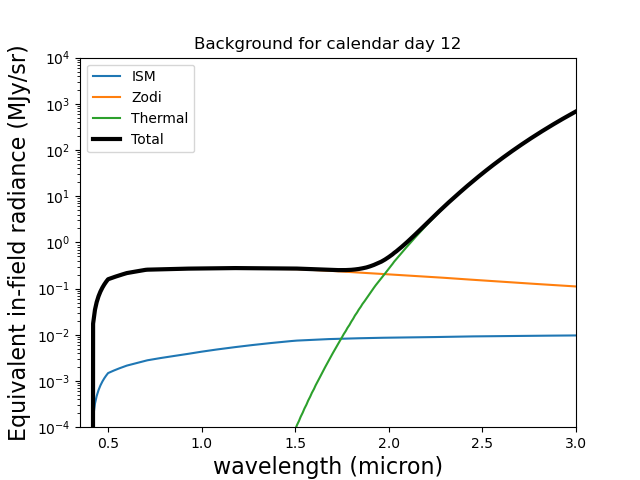
The total background intensity spectrum (thick black) at RA = 10:08:22.7344 and Dec = -06:43:6.24 on calendar Day 12 (where Jan 1st corresponds to Day 0). The three background components, emission from Galactic ISM and stars (ISM, blue), zodiacal dust (Zodi, orange), and thermal self-emission of the observatory (thermal, green), are also shown individually to demonstrate where these components dominate the total background. The Roman Background Models required extrapolation from the shortest wavelength in COBE/DIRBE at 1.25 microns to the short wavelength cutoff for Roman at 0.4 microns.
Background Models in the Roman WFI ETC
Calculations from the Roman WFI ETC can be accessed in several ways: through the WFI ETC Web Interface, via the ETC Engine, Pandeia , and within the Roman Interactive Sensitivity Tool, RIST . Users unfamiliar with these interfaces are advised to review the Roman Exposure Time Calculator section of the Simulation Tools Handbook.
WFI ETC Web Interface
The WFI ETC Web Interface computes background levels for a given celestial position and observation date, both of which are entered on the Backgrounds tab in the Web ETC. The Figure of the Backgrounds Tab in the Web ETC shows the two inputs for this interface: the target position and the background configuration. The background configuration can be specified in two ways:
- Specific observing date - if a user provides a specific observing date, the ETC estimates the background level for that date.
- If no specific observing date is provided, the ETC uses the target position to determine when the target lies within Roman’s field of regard and constructs a distribution of background levels over that time interval, evaluated at a reference wavelength of 0.63 microns. The Low, Medium, and High options refer to the 10th, 50th, and 90th percentiles of the background distribution for the specified position.
Alternatively, user may select None to exclude background contributions.
Details of the computed background model can be found in the Background section under the Reports pane. Users may also download the background model as a FITS file in the Downloads tab under the Reports pane.
Figure of the Backgrounds Tab in the Web ETC
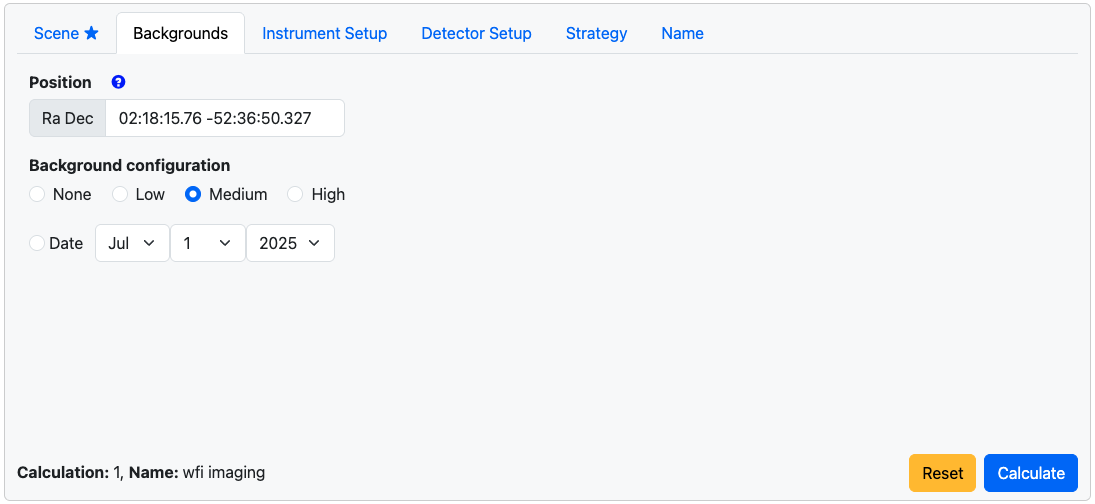
A screenshot from the ETC Web Interface showing the Backgrounds tab. Users can select the background for a given position, and the background level or a date if known. The background levels correspond to the 10th, 50th, and 90th percentile of all calculated, for the selected position over the period of visibility.
Pandeia Engine & Roman Interactive Sensitivity Tool (RIST)
The ETC engine, Pandeia , and the Roman Interactive Sensitivity Tool, RIST , use background levels that are pre-computed with the Roman Background Tool (RBT) at a set of fixed sky locations representative of the three Core Community Surveys. Specifically, backgrounds are precomputed for six locations in the High Latitude Wide Area Survey (HLWAS), one location for the High Latitude Time Domain Survey (HLTDS), and one location for the Galactic Bulge Time Domain Survey (GBTDS). The rationale for selecting these background locations is described below, and their coordinates are provided in the Table of the Pre-Determined Backgrounds.
HLWAS Backgounds: The six HLWAS background locations correspond to the centers of the survey footprints for the two Medium-Tier fields and the four Wide-Tier fields. For each location, three background levels are provided, corresponding to the 10th, 50th, and 90th percentile. Because HLWAS observations are required to be executed under low-background conditions (see Section on Background Limited Observations), the visibility period over which these percentiles are computed is restricted to the days of the year for which the background level is less than 50% above the minimum background for that location.
- HLTDS Backgrounds: The single HLTDS background is centered on the Euclid Wide Field South region (RA=04:14:24, Dec= -47:36:00), and only the 50th-percentile background level is provided. Although the HLTDS targets two additional regions, these fields lie very close to the ecliptic poles and therefore exhibit background levels that are similar across all three locations. Moreover, because these regions are far from the ecliptic plane, their background levels show minimal seasonal variation, as the Sun–telescope angle remains nearly constant throughout Roman’s one-year orbit. The 10th- and 90th-percentile background levels differ by less than 10% in absolute background value from the 50th percentile.
GBTDS Backgrounds: The GBTDS background location is chosen at the center of the microlensing field, defined by the strip of five consecutive mosaic tiles strip (RA=17:52:4.76 Dec=-29:18:46.9). At this location, the ETC provides three background levels corresponding to the 10th, 50th, and 90th percentiles of the background distribution.
Table of Pre-Determined Backgrounds
| Precomputed Background | Coordinates (J2000) | Levels Available | ||
|---|---|---|---|---|
| R.A. | Dec. | RIST | Pandeia | |
| 17:52:4.76 | -29:18:46.9 | Medium | Low, Medium, High |
| 04:14:24 | -47:36:00 | Medium | Medium |
| 10:08:22.7344 | -06:43:6.24 | Medium | Low, Medium, High |
| 02:31:52.5000 | -25:50:34.08 | Medium | Low, Medium, High |
| 11:56:18.5157 | -08:14:52.33 | Medium | Low, Medium, High |
| 08:45:56.2500 | -03:57:50.75 | Medium | Low, Medium, High |
| 00:06:40.7813 | -12:23:48.34 | Medium | Low, Medium, High |
| 04:58:28.5938 | 29:06:11.53 | Medium | Low, Medium, High |
Background-Limited Observations
An observation is considered background limited if seasonal variations in the background produce a 25% change in signal-to-noise while the target is accessible for Roman observations. This criterion corresponds to a 50% variation in the background level over the target's visibility period. In such cases, the observation may use the BACKGROUND LIMITED Special Requirement in APT to limit its visibility windows. When this requirement is applied, the observation is scheduled only when the background level is less than 150% of the minimum background for that location. As a result, the achieved signal-to-noise of the executed observation will remain within 25% of the maximum achievable signal-to-noise at that location.
Assessing the Need for a Background Special Requirement
The WFI ETC Web Interface implements the full Roman Background Model and can be used to assess the impact of seasonal background variability on an observation. A simple method for estimating this seasonal variability is to compare the signal-to-noise ratio (SNR) at the tails of the background distribution (e.g., 10th and 90th percentiles). A more precise assessment, such as evaluating background levels on specific observing dates, can be performed using the Roman Background Tool. Screenshots illustrating this variability assessment using the ETC Web Interface are provided in Figure of Seasonal Background Variability Estimates in the Web ETC Interface.
Workflow for Assessing Background variability in the WFI ETC Web Interface:
- In the Calculations pane, select the calculation corresponding to the observation to be evaluated.
- Click on the Backgrounds tab on the right.
- Enter the target’s right ascension and declination.
- Select Low background (10th percentile) and click Calculate (shown in the low-background example).
- Copy the calculation using the Copy/Delete drop-down menu at the top of the workbook.
- Select the copied calculation, change the background level to High (90th percentile), and click Calculate (shown in high background example).
- Compute the fractional change in SNR, X, where
X = [SNR(low bkg) − SNR(high bkg)] / SNR(low bkg) - Interpret the result:
- If X ≥ 0.25, the SNR varies by more than 25% due to seasonal background changes. In this case, the BACKGROUND LIMITED Special Requirement in the Astronomer's Proposal Tool (APT) may be used to reduce the impact of background variability.
- If X < 0.25, the observation is not significantly sensitive to background variability, and no background-related Special Requirement is needed
Impact of Background Limited Special Requirement
When the
BACKGROUND LIMITED
Special Requirement is specified in APT, the SOC restricts scheduling of the affected observations to days on which the background level is less than 1.5 times the minimum background within the target's visibility period. This constraint ensures that, for background-limited targets, the achieved SNR remains within 25% of the best possible value.
However, applying the
BACKGROUND LIMITED
special requirement reduces the available scheduling opportunities for the observations. In some cases, the resulting visibility windows may be relatively narrow and could pose a risk to successful scheduling. Users should therefore apply the
BACKGROUND LIMITED
special requirement only when it is scientifically justified and clearly explain the motivation for its use in the proposal.
Figure of Seasonal Background Variability Estimates in the Web ETC Interface
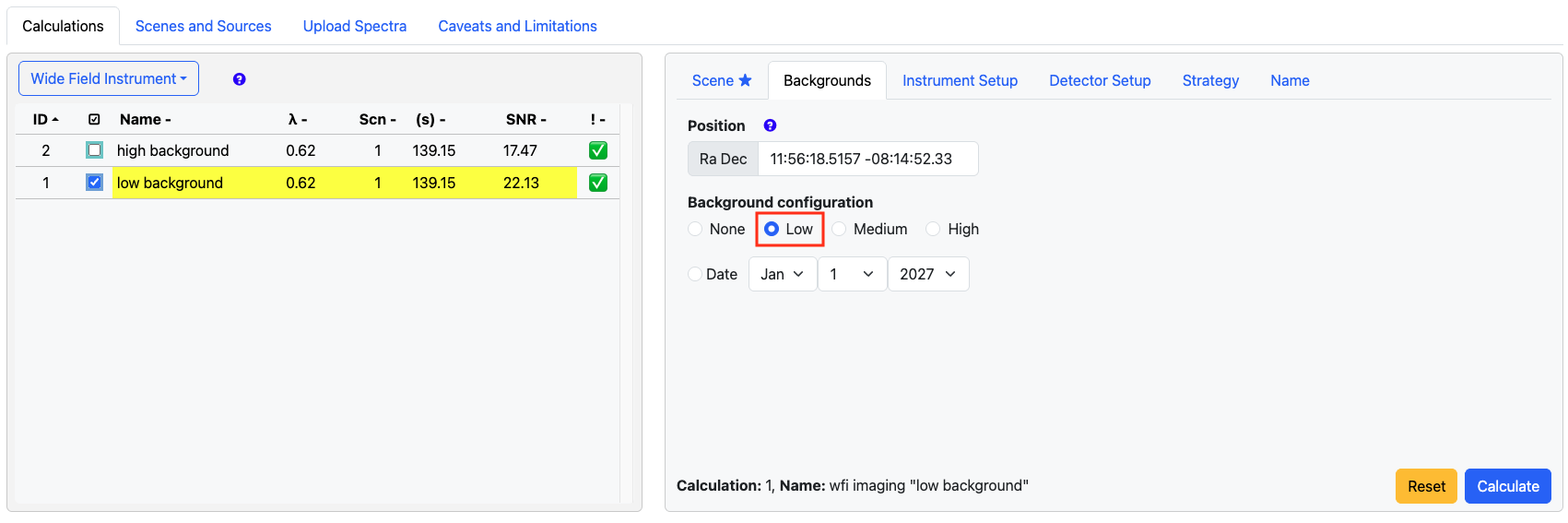
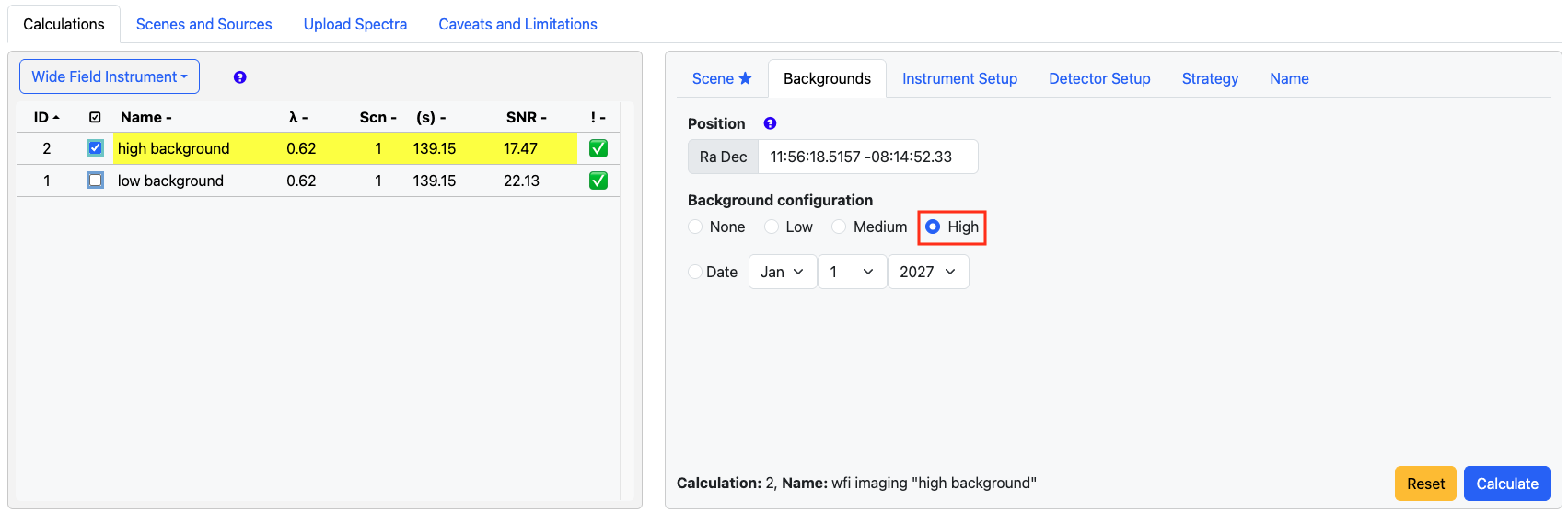
An ETC screenshot illustrating the workflow used to determine whether an observation is sensitive to the background variability. In the upper panel, the RA and Dec have been set (step 3) and the background level is set to Low (step 4). In the bottom panel, the copied calculation of Calc ID 1 appear as Calc ID 2 and the background level is set to High (step 6). Using the resulting SNRs, users can compute for the fractional change in the SNR, X.
If X > 0.25, the the
BACKGROUND LIMITED
Special Requirement should be selected Astronomer's Proposal Tool (APT).
Standalone Background Tool
At any given time, Roman has access to the spherical segment of the sky defined by its field of regard, as illustrated in the WFI Quick Reference article's Figures of the Field of Regard and Slew + Settle Times for Roman. The is constrained to a pitch angle range of 54-126° from the Sun line, allows 360° of yaw about the Sun line, and permits ±15° of roll about the line of sight relative to the nominal roll angle. Targets near the ecliptic plane will experience higher scattered-light (zodiacal) background and larger seasonal variations, because the Sun-telescope angle changes significantly over the year. In contrast, targets near the ecliptic poles experience nearly constant Sun–telescope angles throughout the orbit and therefore exhibit much smaller seasonal background variations. In addition, proximity to bright astronomical structures — such as the Milky Way disk or the Magellanic Clouds — increases the level of diffuse, unresolved background emission.
To support the community in further exploring the impact of spatial and temporal background variability on their observations, the Roman SOC has developed the Roman Background Tool, RBT . The RBT provides users with access to the Roman background models by displaying background levels as function of time, location and wavelength. The RBT is available through the Roman Research Nexus. For more information, please review the Roman Background Tool article.
For additional questions not answered in this article, please contact the Roman Help Desk.
References
- "SIRTF background estimation: methods and implementation", SIRTF Science Center Memo, Reach 2000
- "How Dark the Sky: The JWST Backgrounds", Rigby et al. 2023
- "Analyzing Sky Background Levels in NIRCam Observations: Trends and Model Comparisons Through the First Two Years of Science Operations", Sunnquist et al. 2024