Galactic Plane Survey

Roman's Galactic Plane Survey (GPS) will provide wide area imaging of the Milky Way's disk and obtain time-series photometry or deep imaging and spectroscopy in select fields. This community-defined General Astrophysics Survey will be observed during the first two years of Roman's primary five-year mission.
The GPS is a General Astrophysics Survey recommended for early, community definition by a committee that synthesized input from the broader science community (Sanderson et al., 2024). The GPS will deliver the highest-angular-resolution panoramic map of the Milky Way to date, covering ~35% of the Galactic plane at near-infrared wavelengths to reveal stars within and behind high-extinction regions. It is anticipated to reach over an order of magnitude deeper than any previous infrared survey of the Galactic plane, to yield a catalog of ~20 billion sources, an order of magnitude larger than previous surveys, and to measure proper motions for billions of Milky Way stars (The Roman GPS Definition Committee, 2025; hereafter GPSDC Report). Science enabled by the GPS includes investigations into Galactic structure and dynamics, star formation, the interstellar medium, dust, star clusters, evolved stars, low-mass stars, and brown dwarfs. A time-domain component further expands the scientific scope, enabling the identification and characterization of compact binaries, free-floating planets, and eruptive and pulsational variables.
The survey design was defined through a community process. The GPSDC Report details the motivations for the GPS implementation, the trade space considered, and the anticipated science investigations.
This article summarizes the major scientific drivers and describes the survey implementation in the Astronomer’s Proposal Tool (APT) for Roman.
Technical Implementation to be Finalized
The detailed scheduling of Roman’s observations will depend on the start of science operations, the selection of General Astrophysics Surveys, and target choices and timing within the coronagraph allocation. This page will be updated as more information becomes available.
GPS Overview
The GPS observing strategy consists of three components: a wide-field element, a time-domain element, and a deep-field and spectroscopic element. Their footprints are shown in the Figure of the Galactic Plane Survey. A summary of planned observations within each element is provided in the Overview Table of the GPS Observations, with an optical element breakdown in the Summary Statistics for GPS Optical Elements. Brief descriptions follow, with further details in dedicated sections.
- The wide-field element requires the majority of the observing time. It will image nearly 700 deg2 of the Galactic plane, with higher latitude extensions covering the Galactic bulge, the Serpens South star-forming region, and Carina. Most of the area will be imaged in four filters (F129, F158, F184, F213). In regions with typical inner-plane extinction, the GPS will detect M0 dwarf stars to the Galactic center, solar-type stars to ~20 kpc, and red-clump giant stars to ~190 kpc (GPSDC Report).
- The time-domain element will observe six selected fields covering a total of ~19 deg2. Cadences will vary by field and over time, with inter-epoch intervals ranging from ~11 minutes to weeks. Time-series data will be obtained in one filter (four fields) or two filters (two fields), with supporting imaging in additional filters for five of the fields. These cadences are designed to enable studies of variability in young stellar objects, discover populations of compact binaries, and characterize variable sources across diverse Galactic environments.
- The deep-field and spectroscopic element will observe 15 Roman pointings with additional filters, longer exposures, and slitless spectroscopy. These pointings will be observed in all seven of Roman's broad-band filters (does not include the F146 wide filter), as well as with the Prism and Grism. Where not crowding-limited, these deeper data are expected to yield ~40% more detected sources per field relative to the wide-field element strategy, provide full spectral-energy-distribution (SED) information, and test the performance of slitless spectroscopy over a broad range of source density and diffuse emission (GPSDC Report).
The GPS is allocated up to 700 hours, including exposure times and overheads (internal slews, filter changes, settle times). Within this allocation, ~77% is devoted to the wide-field observations, ~19% to the time-domain observations, and ~4% to the deep-field and spectroscopic observations. GPS observations are planned to be obtained within the first two years of the five-year primary mission.
Figure of the Galactic Plane Survey

Overview of the three elements of the GPS: the wide-field region outlined in white, time-domain fields in cyan, and deep/spectroscopic targets in yellow. Background map based on Gaia optical star counts (click on the image to enlarge). Credits: GPSDC report.
Overview Table of the GPS Observations
| Overview of the Roman Galactic Plane Survey Observations(†) | ||||||||
|---|---|---|---|---|---|---|---|---|
| Field Name | Hours(*) | Percent(*) | Area (deg2) | lmin / lmax | bmin /bmax | lcen | bcen | Optical elements (Cadence)** |
| Wide-field Element | 540.65 | 77.2% | 691.15 | |||||
| Disk | 382.18 | 54.6% | 468.40 | -67.00 / 50.10 | -2.00 / 2.00 | - | - | F129, F158, F184, F213 |
| Disk - Carina extension | 44.43 | 6.3% | 54.00 | -79.00 / -67.00 | -2.50 / 2.00 | - | - | F129, F158, F184, F213 |
| Bulge b+ | 52.27 | 7.5% | 80.00 | -10.00 / 10.00 | 2.00 / 6.00 | - | - | F129, F158, F213 |
| Bulge b- | 51.94 | 7.4% | 80.00 | -10.00 / 10.00 | -6.00 / -2.00 | - | - | F129, F158, F213 |
| Serpens South | 9.83 | 1.4% | 8.75 | 26.50 / 30.00 | 2.00 / 4.50 | - | - | F106, F129, F158, F184, F213 |
| Time-domain Element | 129.52 | 18.5% | 19.06 | |||||
| Carina | 11.89 | 1.7% | 2.06 | -73.77 / -71.19 | -1.05 / -0.25 | - | - | F213 (min) + F062, F087, F106, F129 |
| NGC 6334/NGC 6357 | 11.89 | 1.7% | 2.06 | -9.15 / -6.57 | 0.35 / 1.15 | - | - | F213 (min) + F062, F087, F106, F129 |
| Galactic Center Q4 | 39.04 | 5.6% | 2.06 | -2.80 / -0.22 | -0.53 / 0.28 | - | - | F213 (min/hrs/wks) + F129 (wks) + F062, F087, F106 |
| Galactic Center Q1 | 30.04 | 5.6% | 2.06 | 0.06 / 2.64 | -0.53 / 0.28 | - | - | F213 (min/hrs/wks) + F129 (wks) + F062, F087, F106 |
| Serpens South/W40 | 14.86 | 2.1% | 8.75 | 26.50 / 30.00 | 2.00 / 4.50 | - | - | F213 (hrs) (note F106, F129, F158, F184, F213 are observed in the Wide-Field Element) |
| W43 | 12.80 | 1.8% | 2.06 | 29.31 / 31.89 | -0.49 / 0.31 | - | - | F184 (min) + F062, F087, F106, F129, F213 |
| 30.80 | 4.4% | 4.80 | ||||||
| NGC 3324 (in the Carina Nebula) | 1.79 | 0.3% | 0.28 | - | - | -73.80 | -0.20 | All filters, grism, prism |
| Acrux | 1.79 | 0.3% | 0.28 | - | - | -59.75 | -0.29 | All filters, grism, prism |
| NGC 5269/NGC 5281 | 1.79 | 0.3% | 0.28 | - | - | -50.86 | -0.55 | All filters, grism, prism |
| Window 319.5-0.2 | 1.79 | 0.3% | 0.28 | - | - | -40.50 | -0.21 | All filters, grism, prism |
| G333 | 1.79 | 0.3% | 0.28 | - | - | -27.00 | -0.48 | All filters, grism, prism |
| ASCC85 | 1.79 | 0.3% | 0.28 | - | - | -20.17 | -0.32 | All filters, grism, prism |
| Teutsch 84 | 1.79 | 0.3% | 0.28 | - | - | -15.56 | -0.46 | All filters, grism, prism |
| NGC 6357 (Lobster Nebula) | 1.79 | 0.3% | 0.28 | - | - | -6.86 | 0.85 | All filters, grism, prism |
| Window 355.0-0.3 | 1.79 | 0.3% | 0.28 | - | - | -5.21 | -0.37 | All filters, grism, prism |
| VVV-CL001 & UKS1 | 1.79 | 0.3% | 0.28 | - | - | 5.20 | -0.77 | All filters, grism, prism |
| M17 (Omega Nebula) | 1.79 | 0.3% | 0.28 | - | - | 15.04 | -0.73 | All filters, grism, prism |
| Trumpler 35 | 1.79 | 0.3% | 0.28 | - | - | 28.21 | -0.06 | All filters, grism, prism |
| W40 | 5.74 | 0.8% | 0.28 | - | - | 28.83 | 3.54 | Very deep F129, F158, F213, prism |
| W44 | 1.79 | 0.3% | 0.28 | - | - | 34.70 | -0.40 | All filters, grism, prism |
| W51 | 1.79 | 0.3% | 0.28 | - | - | 49.40 | -0.20 | All filters, grism, prism |
Total | 700.97 | 100.1% | ||||||
(†) See also Table 4.1 of the GPSDC report. (*) Minor implementation changes may affect the area coverage and time allocation of the survey elements. (**) “All filters” does not include F146 (wide), the Grism, or the Prism. Wide-Field Element: Filters shown in bold are recommended for the first epoch. Time-Domain Element: “FILTER (cadence) + others” means all listed filters are taken to the standard depth, and observations in FILTER are repeated at the stated cadence; in the time-domain element observations, F129 and F213 are separated by >1 year to probe variability. (***) Single-pointing observations at 4× the standard time (yielding ~0.75 mag deeper depth). If Grism/Prism cannot be executed, 0.4 hr per field will be reassigned to longer integrations. Pointing centers may be adjusted after a roll angle is assigned to the observations. | ||||||||
Summary Statistics for GPS Optical Elements
| Optical Element (1) | Number of sources (2) | Saturation (3) (Vega mag) | Depth (4) (Vega mag) | Area (deg2) | Fields |
|---|---|---|---|---|---|
| F213 (Ks) | 14 B | 12.38 | 21.18 | 691.2 | Disk + Bulge + Serpens South + Time-Domain + Deep/Spectroscopic |
| F184 (H/Ks) | 11 B | 12.78 | 21.73 | 531.2 | Disk + Serpens South + Time-Domain + Deep/Spectroscopic |
| F158 (H) | 20 B | 13.78 | 22.64 | 691.2 | Disk + Bulge + Serpens South + Time-Domain + Deep/Spectroscopic |
| F129 (J) | 14 B | 14.30 | 23.07 | 691.2 | lDisk + Bulge + Serpens South + Time-Domain + Deep/Spectroscopic |
| F106 (Y) | 68 M | 14.75 | 23.44 | 23.5 | Serpens South + Time-Domain + Deep/Spectroscopic |
| F087 (Z) | 21 M | 14.93 | 23.56 | 14.8 | Time-Domain + Deep/Spectroscopic |
| F062 (R) | 3 M | 15.59 | 24.28 | 14.8 | Time-Domain + Deep/Spectroscopic |
| Prism R = 80—180 | - | 7.5—10.5 | - | 4.8 | Deep/Spectroscopic + W40 |
| Grism R = 481 𝜆/1 𝜇m | - | 5.0—8.0 | - | 4.5 | Deep/Spectroscopic |
(1) From the WFI performance webpage (v1.1, Jan 2025). (2) See GPSDC report Section 3.3 for a description of how the number of sources was estimated. (3) Magnitude at which saturation will occur during the second resultant; saturation in first resultant will occur for sources slightly more than one mag brighter. (4) Depth for single-frame photometry. WFI observations will have between 1 and 4 observations per sky position, and deep fields go 0.75 mag deeper. (5) See Schlafly et al. (2016). (6) Vega Zero mag calculated from m(AB)-m(Vega) in Durbin et al. (2025) except for F062 from Lancaster et al. (2022). | |||||
Wide-Field Element
Field Selection
The wide-field element images 691 contiguous deg2 of the Milky Way. The footprint spans 129° in Galactic longitude, asymmetric about the Galactic Center, and typically 4° in Galactic latitude, symmetric about the Galactic mid-plane. In addition to this core area, the footprint includes targeted latitude extensions to ensure coverage of key regions: the Serpens South star-forming complex, the Galactic bulge and bar, and the warped gas and stellar disk in the Carina "tangency" direction (see the Overview Table of the GPS Observations). This configuration is designed to deliver uniform measurements of stellar populations and star-formation properties across the Galactic disk, covering nearly all of the inner disk and probing the majority of ongoing star formation in the Milky Way (see Figure of the Implementation of the GPS Wide-Field Element Observations).
Observation Specifications
The observing plan employs a four-filter baseline (F129, F158, F184, and F213) across most of the footprint to obtain the multi-band data needed to break temperature–extinction degeneracies and support a broad range of science. Two regions of the wide-field element use tailored filter sets that differ from the baseline:
- Extended latitude coverage of the bulge and bar: The galactic latitude extensions (2^\circ\,|\;b\;|\,6^\circ), which cover lower extinction regions of the Galactic bulge and bar, are imaged in only three filters (F129, F158, and F213). This allows the available observing time to be distributed over a greater range of Galactic latitudes.
- Serpens South extension: This star-forming complex is observed in five filters, with F106 added to the four-filter baseline (F106, F129, F158, F184, and F213), facilitating the detection and characterization of young stellar object SEDs.
Maximizing sky coverage, and thus sample sizes, was a primary design driver, even at the expense of depth. Detailed considerations underlying the footprint and filter choices are provided in the GPSDC Report.
Survey Area and Location
Total area: 691 deg2, contiguous.
Geometry: ≈129° in longitude; typically ±2° in latitude about the plane, with targeted latitude extensions for Serpens South, the bulge/bar, and Carina.
Exposure Specifications
Exposure time: ~60 seconds, using MA table
IM_60_6_S(5 unequally spaced resultants).
Mosaic and Dither Strategy
The footprint is divided into region targets, seven in the disk and eight in the bulge (see Figure of the GPS Wide-Field Element Observation Region Targets).
Each region target is divided into non overlapping, contiguous, square 1 × 2 mosaics. Each pointing is dithered two times using the
LINEGAP2_1strategy.Each region target can typically be completed in < 2 days, increasing schedulability.
Special Requirements
The wide-field observations will be taken over two epochs, with a different subset of the filters observed in each epoch: there are no observations in the same filter in two epochs within the wide-field element. One epoch will be obtained as early as is feasible in Year 1 of Roman’s primary mission and a second epoch as late as is feasible in Year 2. See Overview Table of the GPS Observations for the filter usage by epoch and Scheduling of the Observations for more details.
Figure of the Implementation of the GPS Wide-Field Element Observations
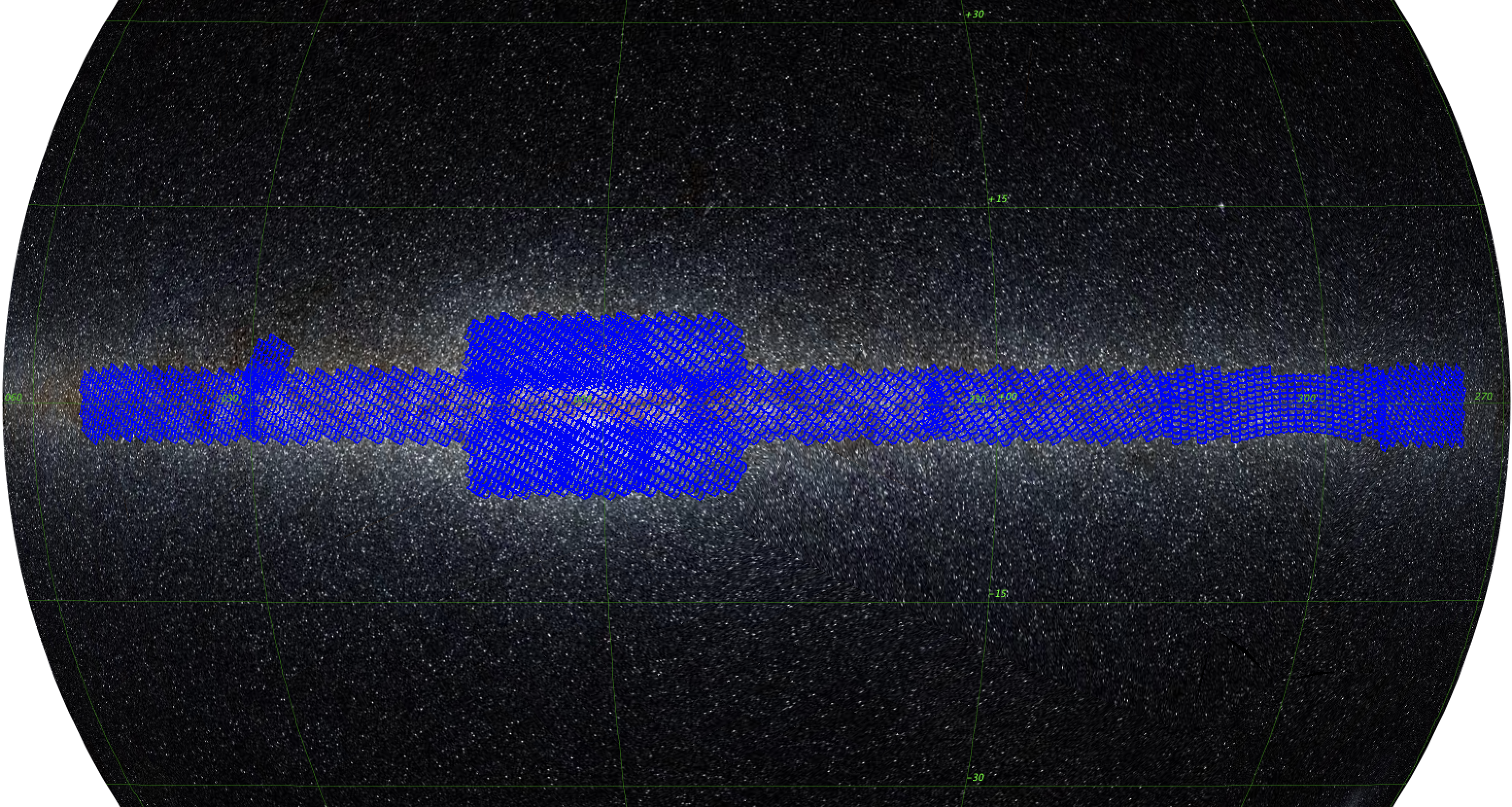
APT/Aladin view of the current implementation of the GPS wide-field element observations, in Galactic coordinates, superimposed on a 2MASS sky image. The surveyed area is divided into distinct region targets. The orientation of the pointings in each region target is only indicative. Once observations are in the scheduling system and the position angle of the telescope is known, the overlapping tiles at the boundaries between different region targets, as seen in this implementation, can be removed to improve efficiency.
Figure of the GPS Wide-Field Element Observation Region Targets
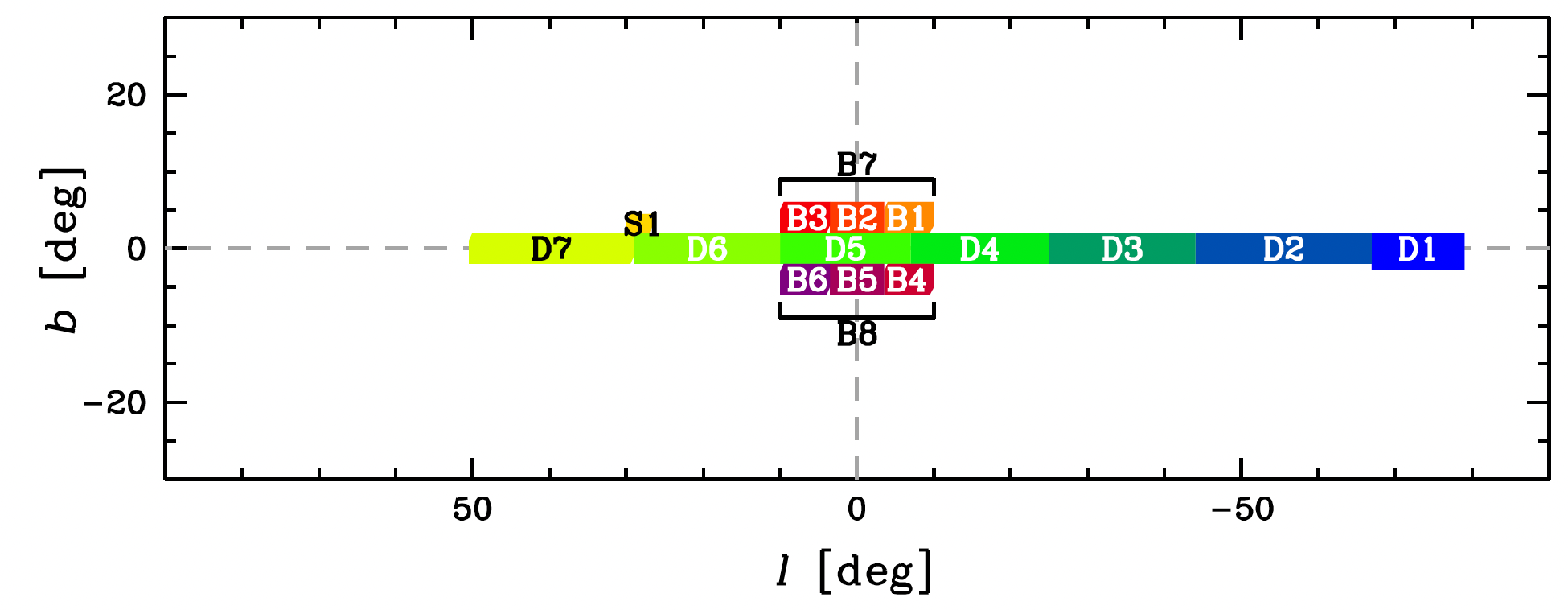
The GPS wide-field element survey is divided into region targets to ease schedulability. Their extent and location are shown here in Galactic coordinates. Disk region targets are labelled D1 to D7. Bulge region targets are labelled B1 to B6 for first-epoch observations (2 filters) and 7 and 8 for second-epoch observations (1 filter only, allowing larger regions). Serpens South has its own region target, labelled as S1.
Time-Domain Element
Field Selection
Six sub-regions of the wide-field survey area were selected for time-domain observations. These fields provide full coverage of the Nuclear Stellar Disk and Central Molecular Zone (via fields on either side of the Galactic Bulge Time Domain Survey's (GBTDS) Galactic Center pointing), three star formation complexes (Carina, NGC 6334/NGC 6357, and W43), and the full Serpens South/W40 Galactic latitude extension of the wide-field survey area. The Serpens South/W40 time-domain field covers nearly nine deg2, while the other five time-domain fields each cover approximately two deg2. The two deg2 area is sufficiently large that the Carina and W43 star formation complexes subtend only part of the field, yielding both "on-target" and "off-target" regions and enabling the characterization of background and foreground populations.
All fields are contained within the wide-field survey area. The W43 field overlaps with the Subaru Galactic Plane survey, and the Carina, NGC 6334/NGC 6357, and two Galactic Center fields overlap with the Rubin Observatory’s Legacy Survey of Space and Time.
Observation Specifications
Cadence and multi-epoch filter choices are field-dependent; see the Overview Table of the GPS Observations for a concise summary. With the exception of Serpens South/W40, all fields receive additional supporting imaging in all broad-band filters except F146 (wide), plus a second epoch in F129 (and, in W43, a second epoch in F184). Taken together, these observations probe stellar variability with baselines from minutes to years, characterize high-cadence variable sources in different environments, and identify variable sources in one of the nearest massive star-forming regions. The increasing hourly cadence in the Serpens South/W40 field will constrain the variability of young stellar objects, and the larger area and increased depth will enable detection of other classes of variable sources, such as stellar flaring.
Survey Area and Location
Two locations bracketing the Galactic Center; three star-formation complexes (Carina, NGC 6334/NGC 6357, W43); and Serpens South/W40. All fields lie within the wide-field survey area.
Areas: Serpens South/W40 ~9 deg²; each of the other five fields ~2 deg²
Exposure Specifications
Exposure time: ~60 seconds, using
IM_60_6_S(five unequally spaced resultants).
Mosaic and Dither Strategy
- Fields with fast-cadence observations (all except Serpens South/W40): Fast (minutes) cadence observations are executed over an area tiled as 6×1 adjacent, non-overlapping pointings, observed back-to-back for ~8.1 hours. This duration preserves a constant position angle during the sequence (the telescope position angle changes by ~1° per day). If a field also includes medium (hours) and low (weeks) cadences, those observations are defined over region targets that fully enclose the 6×1 fast-cadence pointings, ensuring the entire field is covered regardless of telescope position angle. Each region is divided into non-overlapping, contiguous, square 1×2 mosaics (as in the wide-field element observations). Each pointing is dithered twice using the
LINEGAP2_1strategy. Serpens South/W40 field: The time-domain footprint is identical to the Serpens South wide-field element extension. It uses the same region target, which is divided into non-overlapping, contiguous, square 1×2 mosaics. Each pointing is dithered twice using
LINEGAP2_1.
Special Requirements
The cadence of the time-domain observations, and the filters used for multiple epochs, are field-dependent:
- Carina: Minutes-scale cadence in F213 (high-cadence back-to-back observations totaling ~8.1 hours).
- NGC 6334/NGC 6357: Minutes-scale cadence in F213 (high-cadence back-to-back observations totaling ~8.1 hours).
- Galactic Center (two fields): Multiple cadences with minutes (F213), hours (F213; cadence increases over time), and weeks (F129 and F213).
- Serpens South/W40: Hours-scale cadence in F213 (cadence increases over time), enabling identification of variable sources in a nearby massive star-forming region.
- W43: Minutes-scale cadence in F184 (high-cadence back-to-back observations totaling ~8.1 hours). The filter was selected to test whether there is increased sensitivity to stellar accretion (due to the Pa-𝜶 line).
Note: Five time-domain fields (all except Serpens South/W40) have ~11-minute high-cadence observations executed back-to-back for a total of ~8.1 hours.
A graphical representation of the cadence of the three types of time-domain observations (fast/minutes, medium/hours, low/weeks) is shown in the Illustration of the Three Types of Cadence for the GPS.
Figure of the Time Domain fields around the Galactic Center

Location of the two GPS Time-domain fields (cyan) flanking the Galactic Bulge Time Domain Survey (GBTDS) pointing on the Galactic center. The GBTDS field is indicated in white for the fall season and black for the spring season. Panchromatic images will be obtained for the two GPS regions, each measuring 2.55 x 0.8 square degrees, centered on the galactic coordinates marked on the image. Note that these GPS observations (scheduled for the fall Bulge season) are offset in Galactic latitude from the GBTDS Galactic center field to provide more complete coverage of the Central Molecular Zone and Nuclear Stellar Disk. The composed Spitzer MIPS+IRAC image in the background (6 x 2 square degrees) shows the star formation in the direction of the Central Molecular Zone. The white grid lines indicate degrees of latitude and longitude, while archival HST imaging footprints are shown in yellow.
Illustration of the Three Types of Cadence for the GPS
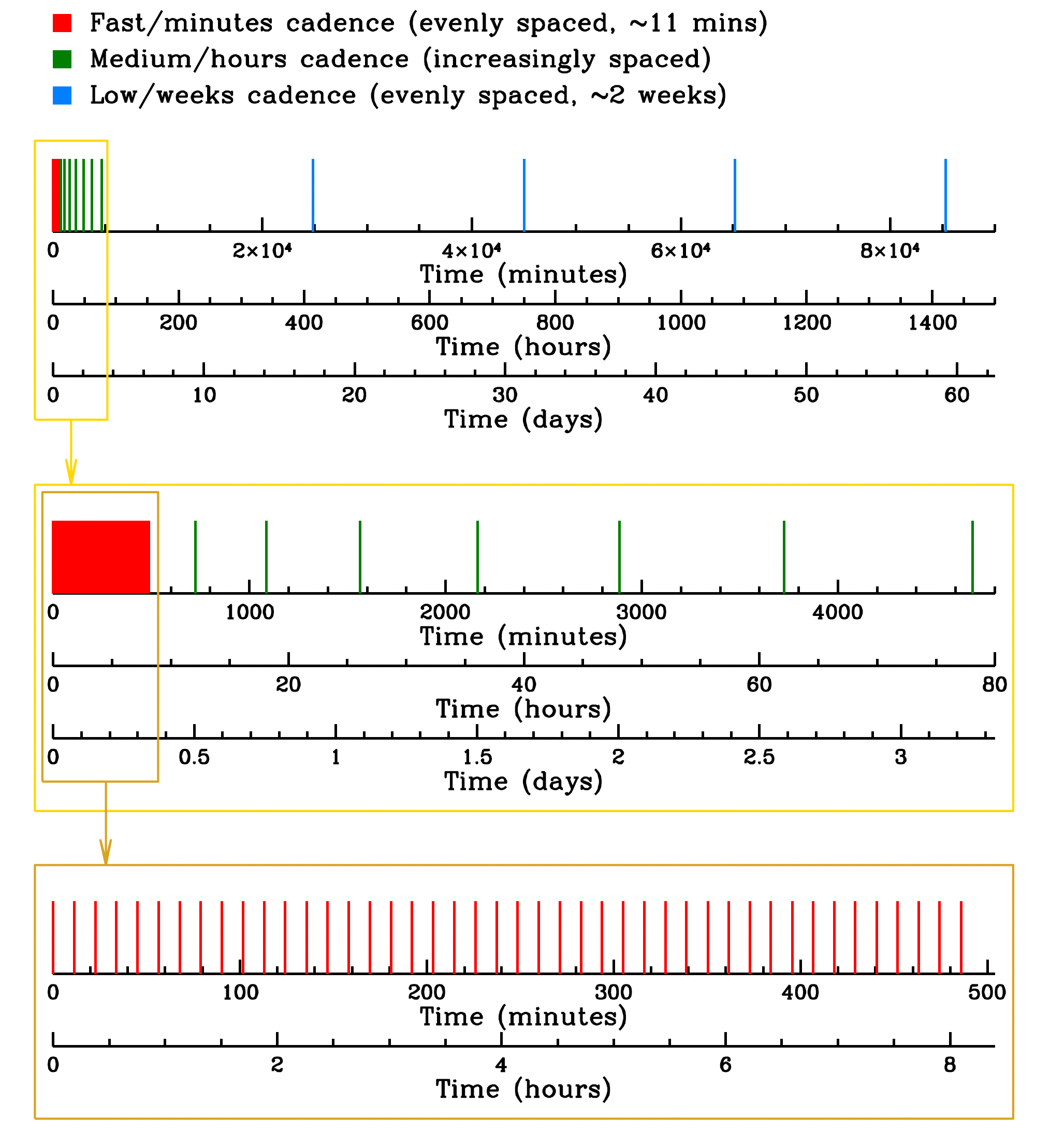
Illustration of the three types of cadence used in the GPS. The top section shows all three types (fast/minutes in red, medium/hours in green, and low/weeks in blue) on the same time scale, expressed in minutes, hours and days. The fast and medium cadence observations are zoomed-in in the central section, and the fast cadence observations are further zoomed-in in the bottom section, for clarity. Some time-domain fields, like those around the Galactic Center, have all three types of cadence, while others have either only fast/minutes cadence (e.g., Carina) or medium/hours cadence (e.g., Serpens South/W40), see also the Overview Table of the GPS Observations.
Deep-Field and Spectroscopic Element
Field Selection
Fifteen individual Roman pointings will be observed with deep multi-band imaging and two-orient slitless spectroscopy. These pointings are distributed across the full range of Galactic longitude covered by the wide-field element. They span a wide range of extinction, diffuse emission, and stellar populations, with more than an order of magnitude range in predicted stellar density. In addition to sampling diverse Galactic environments, the pointings collectively include a number of interesting objects (see the Example of Deep-Field and Spectroscopic targets and Overview Table of the GPS Observations), such as massive star formation regions, open clusters, globular clusters, the large supernova remnant W44, IR extinction windows, and a large stellar wind bow shock (Alpha Crux).
One field, towards the nearby, young star-forming region W40, will be observed to a greater depth than the others in F129, F158, F213, and with the Prism, to test the value of very deep photometry and spectroscopy in young star-forming regions, including the potential for identification of low-mass brown dwarfs and free-floating planets, and characterization of the low end of the initial mass function.
Observation Specifications
Survey Area and Location
Fifteen individual Roman pointings spanning the full Galactic-longitude range of the wide-field element. A complete list of pointings and optical elements is provided in the Overview Table of the GPS Observations; targets include massive star-formation regions, open clusters, globular clusters, W44, IR extinction windows, the Alpha Crux bow shock, and W40 (deeper field: F129, F158, F213 + Prism).
Exposure Specifications
- All fields except W40: Imaging exposure time of ~60 seconds, using
IM_60_6_S(five unequally spaced resultants). Spectroscopic exposure time of ~300 s, usingSP_300_16(sixteen unequally spaced resultants). - W40: Imaging exposure time of ~1000 seconds, using
IM_1000_16(sixteen unequally spaced resultants). Spectroscopic exposure time of ~1000 s, usingSP_1000_16(sixteen unequally spaced resultants).
Mosaic and Dither Strategy
- All fields except W40: Individual Roman pointings. Imaging pointings are dithered eight times using
BOXGAP8_1; spectroscopic pointings are not dithered. - W40: Individual Roman pointings. Imaging and spectroscopic pointings are dithered four times using
BOXGAP4_1.
Special Requirements
The imaging component consists of a single visit, scheduled in the second half of Year 2 of Roman’s five-year primary mission, together with the first-orient spectroscopic observations (no absolute constraint on the position angle). The second orient for spectroscopy will be offset by 6 to 10 degrees in position angle, to allow for decontamination of sources.
Example of Deep-Field and Spectroscopic Targets
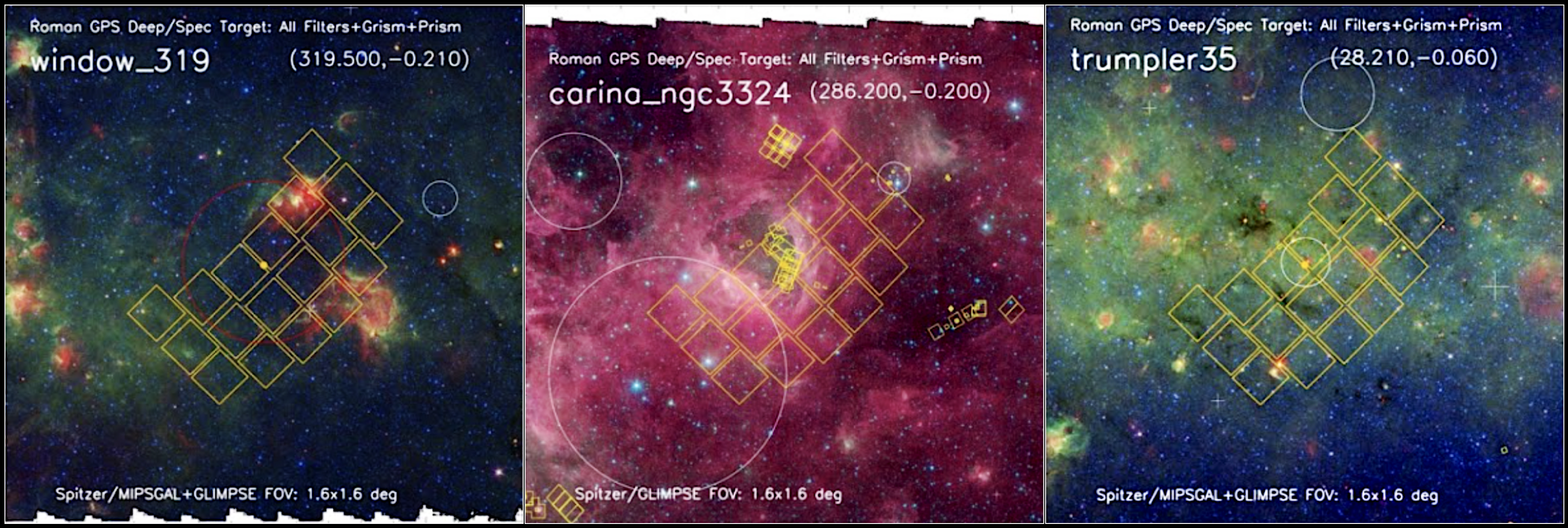
Examples of Deep/Spectroscopic observations superimposed on Spitzer+GLIMPSE+MIPSGAL backgrounds. HST pointings (shown in yellow and white circles) show the direction of open clusters from the catalog of Hunt & Reffert (2023). From left to right: Window 319, Carina & NGC 3324, and Trumpler 35. Credits: GPSDC report.
Scheduling of the Observations
The GPS observations are intended to be executed during the first two years of Roman's five-year primary mission. The GPSDC Report recommends obtaining the first two filters of the wide-field element (F129 and F213) as early as possible, and the remaining filters as late as possible, within the time frame over which the GPS is schedulable. This approach enables cross-band proper motion measurements and provides an equivalent of the J-Ks color for source classification early in the survey. It also allows later F129 and F213 observations in the time-domain fields to be combined with the early wide-field data to constrain longer-term variability on ~1–1.5 year timescales.
The centermost regions of the wide-field observations share visibility windows with the Galactic Bulge Time Domain Core Community Survey, which will require the vast majority of those windows during its first three seasons. The Roman Observations Time Allocation Committee's (ROTAC) Final Report and Recommendations (ROTAC, 2025) recommended to reserve two days during the GBTDS' first (high-cadence) season to enable early observations of the central region targets of the Galactic disk and bulge using the first two filters of the GPS' wide-field element. The sizes of these specific central region targets were designed to fit within this two-day window. The GPS will obtain the additional filters in the central Galactic regions during one of the GBTDS' low-cadence seasons.
The time-domain, deep, and spectroscopic observations are anticipated to be observed in approximately the latter half of Roman's second year. This coincides with the GBTDS' low-cadence observations of the Galactic bulge, and results in less constrained scheduling windows for the GPS.
As noted above, spectroscopic observations of the 15 targets in the deep and spectroscopic element (see Overview Table of the GPS Observations for the full list) will use two orients. There is no absolute constraint on the first orient, but the second orient must be separated from the first by 25° to 30°. The exact pointing locations of these 15 targets are subject to change; once observations are scheduled and the telescope orient is known, pointings may be adjusted slightly to better fit objects of interest within the field of view of Roman’s Wide-field Instrument.
Scheduling to be Finalized
The detailed scheduling of Roman's observations will depend on both Roman's actual launch date and the details of the approved Cycle 1 General Astrophysics Surveys and thus will not be finalized until after launch. This page will be updated as more information becomes available.
Although the community-defined surveys are fully specified, the exact scheduling of observations has yet to be finalized. The timing depends on several factors, including the start of Roman’s science operations, the selection of General Astrophysics Surveys, and target choices and timing within the coronagraph instrument allocation. Even so, much is already understood about how Roman observations will be scheduled. A summary is available in the observation plan for the first two years article.
Future Evaluation of the Survey Implementation
Implementation of the GPS will be reassessed after Roman’s on-orbit performance is characterized and initial survey data are in hand. The GPS Definition Committee identified several areas to be evaluated at that stage, including the performance of the two-point dither strategy and the feasibility of crowded spectroscopic observations; these are described in Section 5 of the GPS Definition Committee’s report. Any resulting recommended changes will be reviewed by a committee of community members with broad scientific expertise relevant to the goals of the GPS and must be approved by the NASA Project Science Office.
Additional Resources
To explore the community-defined surveys and their scientific capabilities in more detail, please see Additional Resources for Community-defined Surveys.
For additional questions not answered in this article, please contact the Roman Help Desk.
References
"Recommendations for Early Definition Science with the Nancy Grace Roman Space Telescope," Sanderson et al., arxiv.org:2404.14342, 2024. doi:10.48550/arXiv.2404.14342
- "Roman Observations Time Allocation Committee: Final Report and Recommendations", Roman Observations Time Allocation Committee and Core Community Survey Definition Committees, arXiv:2505.10574, 2025. doi:10.48550/arXiv.2505.10574.
- "Roman Galactic Plane Survey Definition Committee Report", Roman Galactic Plane Survey Definition Committee, arxiv:2511.07494, 2025. doi:10.48550/arXiv.2511.07494.
- "The Optical-infrared Extinction Curve and Its Variation in the Milky Way", Schafly et al., arxiv.org:1602.03928, 2016. doi:10.48550/arXiv.1602.03928
- "NIR Filter Transformations Across the HR Diagram: JWST, Roman, and Euclid", Durbin et al. 2025, AJ, 170, 4, 232. doi:10.3847/1538-3881/adfddb
- "Walter: A Tool for Predicting Resolved Stellar Population Observations with Applications to the Roman Space Telescope", Lancaster et al. 2022, AJ, 164, 4, 142. doi:10.3847/1538-3881/ac8a95