Galactic Bulge Time-Domain Survey

Roman's Galactic Bulge Time Domain Survey (GBTDS) will obtain high-cadence, high-precision time-series photometry over 1.7 deg2 in the Milky Way's bulge. The observations will be obtained throughout Roman's five-year primary mission.
The Galactic Bulge Time Domain Survey (GBTDS) will monitor six fields in the Milky Way's bulge, covering a total area of 1.7 deg2. During Roman’s five-year primary mission, the GBTDS will obtain imaging at either 12-minute cadence (high-cadence seasons) or five-day cadence (low-cadence seasons) whenever the bulge is visible. As one of Roman's Core Community Surveys, the GBTDS is central to meeting the mission's science requirements: by using microlensing, it will enable demographic studies of exoplanets comparable to those in our solar system in both mass and orbital distance. The GBTDS is also anticipated to discover over 100,000 transiting exoplanets. Beyond exoplanets, the GBTDS will discover stellar mass black holes via microlensing and astrometry, enable asteroseismology of several hundred thousand red giants, monitor the supermassive black hole at the Milky Way's center, and enable studies of neutron stars, white dwarfs, and high energy X-ray binaries. The Figure of the Galactic Bulge Time Domain Survey provides an overview of the GBTDS.
The survey was designed through a community process. The Roman Observations Time Allocation Committee's (ROTAC) Final Report (hereafter “ROTAC, 2025”) discusses the rationale for the chosen implementation, expected source yields, and an overview of anticipated science investigations.
This article summarizes the major scientific drivers and describes the survey implementation in the Astronomer’s Proposal Tool (APT) for Roman.
Technical Implementation to be Finalized
The detailed scheduling of Roman’s observations will depend on the start of science operations, the selection of General Astrophysics Surveys, and target choices and timing within the coronagraph allocation. This page will be updated as more information becomes available.
Figure of Galactic Bulge Time Domain Survey
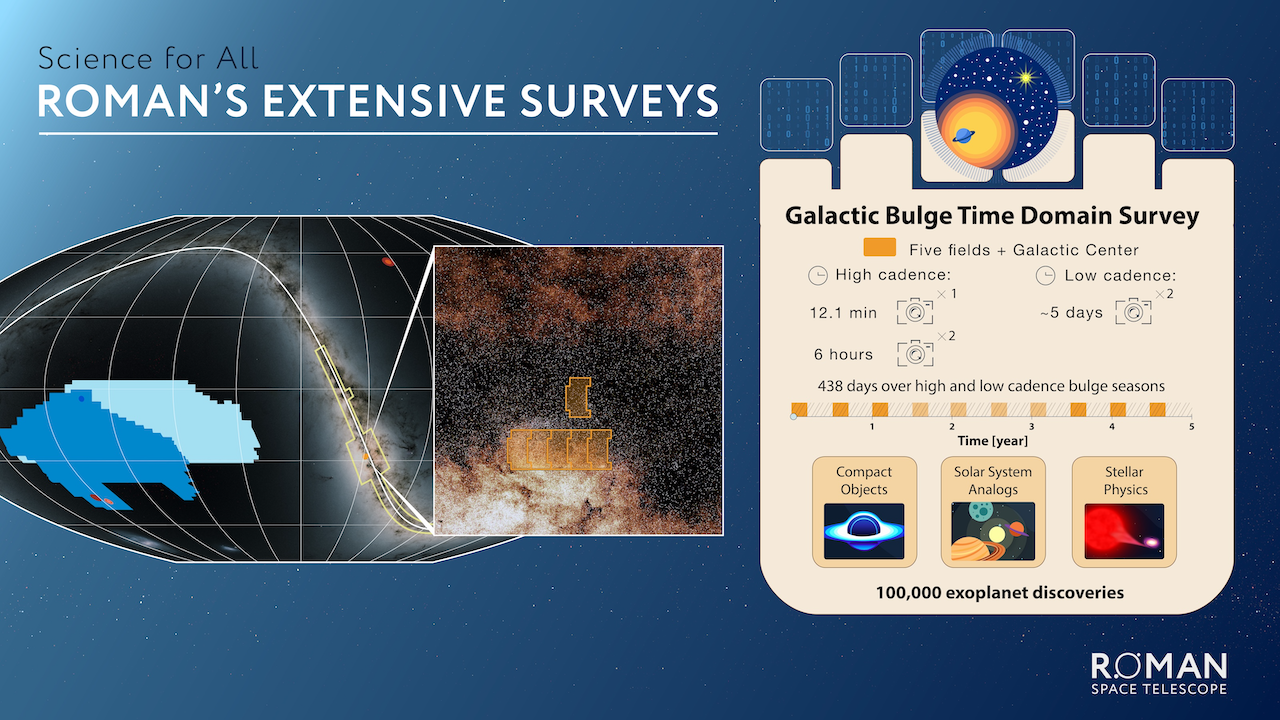
Summary figure showing Roman's GBTDS fields (highlighted in orange) on an optical image of the Galactic Bulge.
Image Composition: J. Olmsted, J. Kang, and C. Nieves (STScI). Background sky image: ESA/Gaia/DPAC. Acknowledgement: Javier Sanchez (STScI).
GBTDS Overview
An overview of the GBTDS is shown in the Figure of the Galactic Bulge Time Domain Survey. Any given location in the Milky Way’s bulge is observable with Roman for approximately 72 days twice per year; each span is a "season." The season is therefore the fundamental organizational unit of the survey. There are ten galactic bulge seasons available within Roman’s five-year primary mission. The survey covers six WFI fields: five contiguous fields selected for low foreground extinction and one field at the Galactic Center. A detailed description of these fields is provided in GBTDS Field Locations.
The GBTDS consists of two primary survey components, the High-Cadence Seasons and the Low-Cadence Seasons, each of which includes Photometric and Spectroscopic Snapshots within every bulge season. The relationships among these elements are illustrated in the Schematic Showing the GBTDS Components. Within each season, the Photometric Snapshots (multiband imaging) probe long-term stellar variability and stellar population properties, while the Spectroscopic Snapshots (grism) enable measurements of stellar atmospheric parameters, including temperatures, metallicities, and radial velocities.
- High-Cadence Seasons occur at the beginning and end of Roman’s five-year mission (six bulge seasons total). The full survey area is imaged in F146 approximately every 12 minutes for ~70.5 days. The long temporal baseline between the first and last high-cadence season maximizes science return, enabling exoplanet microlensing characterization, discovery of longer-period transiting exoplanets, and asteroseismic studies. Each high-cadence season includes three Photometric Snapshots and three Spectroscopic Snapshots, obtained at the beginning, middle, and end of the season.
- Low-Cadence Seasons occur during the middle years of the mission (four bulge seasons). Microlensing monitoring is arranged in short observing cycles built from the same 12-minute six-tile pattern used in the high-cadence seasons, and these cycles repeat every five days across each season. Each low-cadence season includes three Photometric Snapshots and three Spectroscopic Snapshots at the beginning, middle, and end of the season.
The GBTDS is allocated 438 observing days, including exposure times and overheads (slews, filter changes, and settle times). The majority of this time (~97%) is dedicated to high-cadence microlensing monitoring. Key specifications for each component are summarized in the GBTDS Overview Table.
Schematic Showing the GBTDS Components
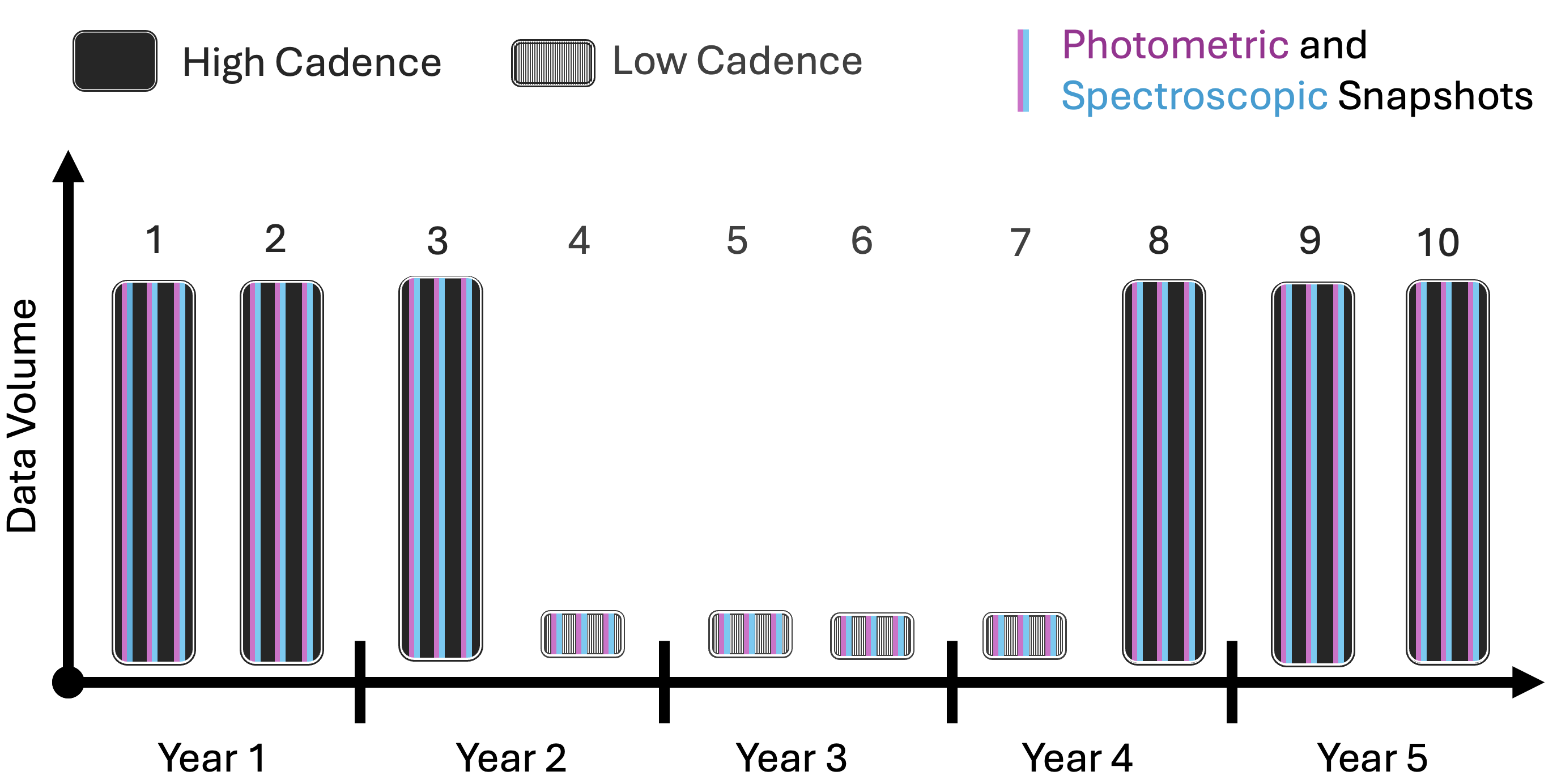
Schematic representation of the GBTDS showing the timing of the components as described in the GBTDS Overview and detailed in the GBTDS Overview Table.
GBTDS Overview Table
| Survey Component | # Seasons | Optical Element | Epochs per Season (~) | Observation Cadence (Within a Season) | Exposure time per epoch | # Dithers per epoch | MA Table |
|---|---|---|---|---|---|---|---|
| High-Cadence Seasons | 6 | F146 | 8390 | 12.1 minutes | 66 | 1 | IM_66_6_V2 |
| F087 | 282 | 6 hours | 66 | 1 | IM_66_6_V2 | ||
| F213 | 282 | 6 hours | 66 | 1 | IM_66_6_V2 | ||
Photometric Snapshot | |||||||
F062 | 3 | ~35 days | 1,138 | 4 | IM_284_14 | ||
F106 | 272 | 2 | IM_135_8 | ||||
F129 | 170 | 2 | IM_85_7 | ||||
F158 | 132 | 2 | IM_66_6_V2 | ||||
F184 | 132 | 2 | IM_66_6_V2 | ||||
Spectroscopic Snapshots | |||||||
GRISM | 3 | ~35 days | 1,491 | 5 | SP_300_16 | ||
| 4 | F146 | 14 | 5 days (short cycles of 12.1 m) | 66 | 1 | IM_66_6_V2 |
| F087 | 14 | 5 days | 66 | 1 | IM_66_6_V2 | ||
| F213 | 14 | 5 days | 66 | 1 | IM_66_6_V2 | ||
Photometric Snapshot | |||||||
F062 | 3 | ~35 days | 1,138 | 4 | IM_284_14 | ||
F106 | 272 | 2 | IM_135_8 | ||||
F129 | 170 | 2 | IM_85_7 | ||||
F158 | 132 | 2 | IM_66_6_V2 | ||||
F184 | 132 | 2 | IM_66_6_V2 | ||||
| Spectroscopic Snapshots | |||||||
| GRISM | 3 | ~35 days | 1,491 | 5 | SP_300_16 | ||
GBTDS Field Locations
The GBTDS will monitor five contiguous fields at Galactic coordinates (l ~ 0.5°, b ~ −1.4°), plus one field centered on the Galactic center, covering a total area of 1.7 deg2. The Figure of the Galactic Bulge Time Domain Survey provides an overview of the field locations on the sky. The number and placement of the contiguous fields were determined by quantitatively balancing observational constraints and scientific yields. Survey area, imaging cadence, stellar density, and dust extinction all affect microlensing yields, transiting detection yields, and asteroseismic detections and measurements. The Galactic center field was selected in response to strong community interest given the breadth of science it enables. It includes three young massive star clusters, Arches, Quintuplet and the Young Nuclear Cluster, as well as SgrA*. The field locations are identical for both the high- and low-cadence seasons to preserve photometric and astrometric baselines and maintain a consistent target sample. The motivations behind the final survey footprint are described in detail in the GBTDS Definition Committee's report (Appendix C.3; ROTAC, 2025).
The Galactic Bulge is visible to Roman every six months: a "Spring" season roughly from February to April and an "Autumn" season roughly from August through October. Because of the six-month separation, the spacecraft orientation differs by 180° between seasons. Accordingly, the WFI footprint is rotated by 180° degrees at the same coordinates for the Spring (Position Angle ~90°) and Autumn (Position Angle ~270°) mosaics. The Spring and Autumn seasons therefore require inverted, 180°-rotated mosaic patterns, designed for similar coverage. These are referred to as the "Spring" and "Autumn" mosaics based on Northern hemisphere seasons.
Each mosaic contains six tiles: five contiguous tiles and one offset on the Galactic Center. A Fixed Target is specified at the center of the five contiguous tiles as the reference point for aligning the seasonal mosaics. The Figure of the GBTDS Field Locations shows the Spring and Autumn mosaics projected on the sky.
Figure of GBTDS Field Locations
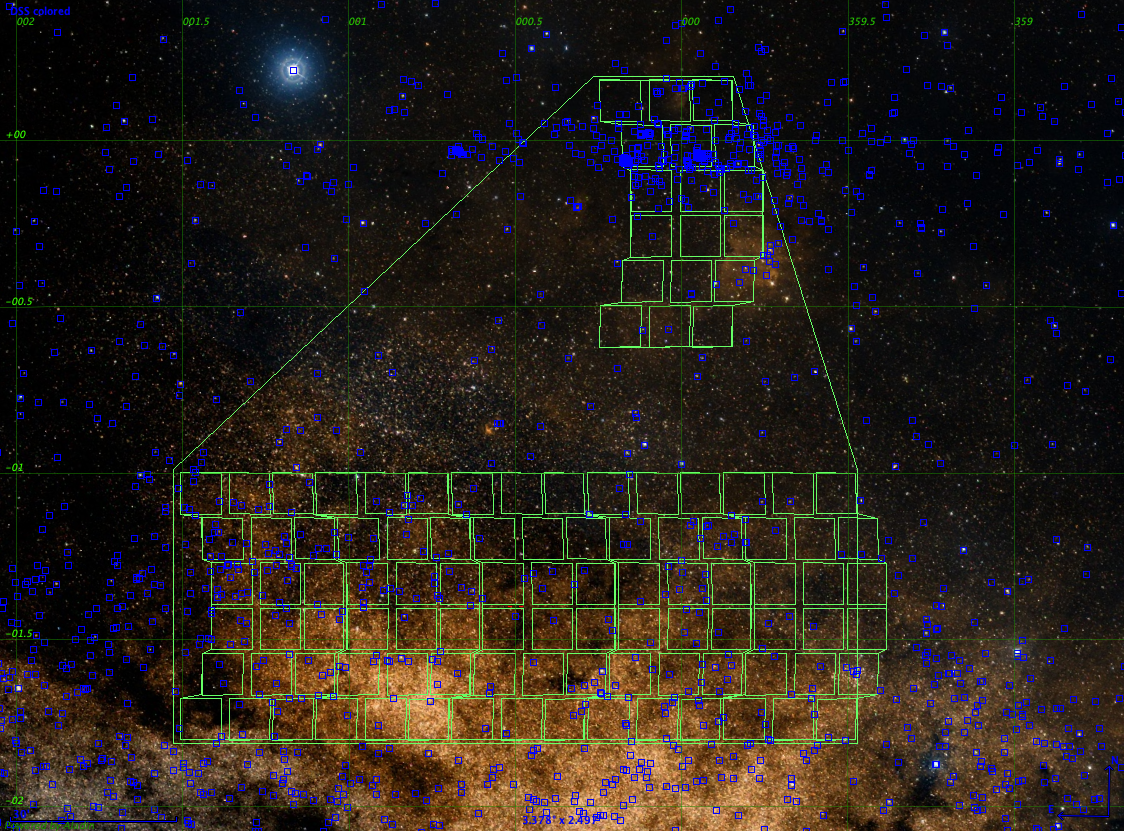
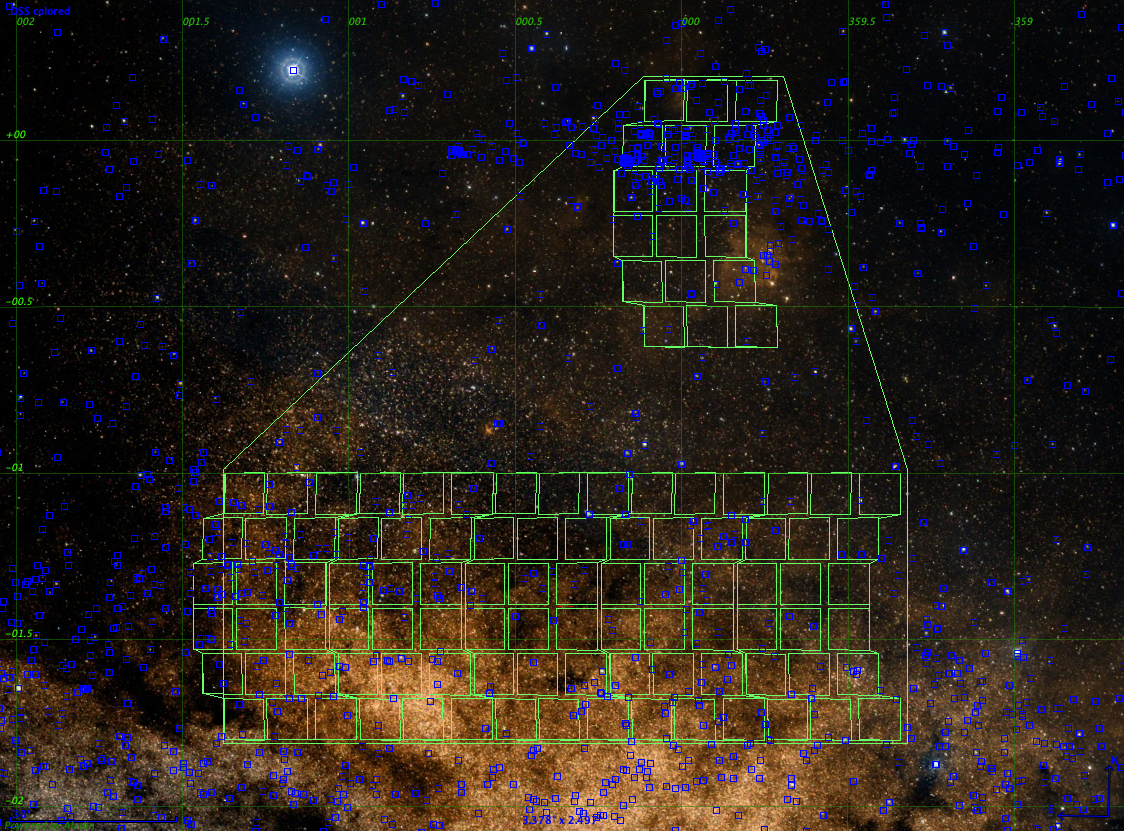
The GBTDS 6-tile mosaics (bright green) projected on the sky in the Aladin Visualization Tool within the Astronomer's Proposal Tool (APT) for the Spring Season (top) and Autumn Season (bottom). A Galactic coordinate grid is shown (dark green), which shows that the mid-line of the five contiguous tiles are at the desired galactic coordinates for spring (0.5, -1.4) and autumn (0.35, -1.4), and there is one non-contiguous tile at the Galactic Center. The spring mosaic (top) is oriented at 90.6 degrees and the autumn mosaic (bottom) is oriented at 270.6 degrees. A reference point or "crosshairs" (red) representing the Fixed Target coordinates for the center (tile 3) of the 5 contiguous tiles is shown. SIMBAD objects are included (blue squares) to confirm that key star clusters near the Galactic Center do not fall in detector gaps at either orientation (Sgr A*, the Young Nuclear Cluster, Quintuplet, Arches).
High-Cadence Seasons
The High-Cadence Seasons provide time-series photometry at the frequency needed to capture microlensing events from small, long-period planets and free-floating planets, and they enable asteroseismology of red giant stars. In each season, Photometric Snapshots (multiband imaging) probe long-term stellar variability and stellar population properties, while Spectroscopic Snapshots (grism) enable measurements of stellar atmospheric parameters (temperatures, metallicities, radial velocities). Approximately 97% of the total GBTDS observing time is devoted to high-cadence microlensing monitoring.
Observation Specifications
Seasonal Structure
The GBTDS observations are organized into observing sequences, repeated throughout each ~72-day bulge season. The sequences are nearly identical between seasons; the only difference is the mosaic orientation, 90° in one season and 270° in the next (see the GBTDS Field Locations section).
Snapshot Sequences: These are obtained near the start, middle, and end of each season. Each includes Photometric and Spectroscopic Snapshots.
Microlensing Sequences: These are ~2-day observing units that, in aggregate, span roughly two months. They constitute the bulk of each season and are planned for near-continuous microlensing coverage, with interruptions limited to Snapshot Passes, required calibration or engineering activities, and possibly high-priority GAS programs.
Extended Sequences: The Galactic Center tile sets before the five contiguous microlensing tiles. To maximize microlensing coverage, two-hour sequences that observe only the five microlensing tiles are implemented after the Galactic Center is no longer observable. Typically, less than one full day of the extended sequence observations are required to complete each season.
The GBTDS comprises six high-cadence observing seasons, three near the start and three near the end of the 5-year primary mission. Three Snapshot Sequences are obtained in each season. The first season includes two days for Galactic Plane Survey (GPS) pilot observations and may be shortened by commissioning activities. Even if shortened, it remains scientifically valuable as an early demonstration of microlensing performance.
Exposure Specifications
- High-cadence seasons are dominated by microlensing observations in the wide F146 filter. Each complete six-tile cycle in F146 takes 12.1 min (including slews, overheads, and exposures) and is repeated 12 times. The F087 and F213 filters are interleaved at lower cadence to provide color information; each filter repeats on a 6-hour cycle, staggered so that one or the other is obtained every 3 hours. The exposure time is the same for all three filters and is set to the time required to achieve S/N ~ 100 in F146 for a source with F146 = 21.2 magAB.
- Each iteration of the six-tile mosaic is offset relative to the previous one, emulating a dithering sequence. Both integer and subpixel shifts are included to mitigate bad pixels and improve PSF sampling without altering the microlensing cadence. A set of 36 custom mosaics are utilized in each high-cadence season to implement these small offsets. Similar custom mosaics are utilized for the season extenders.
- Imaging Snapshots use filters F062, F106, F129, F158, and F184, with exposure times chosen so that a source of F146 = 21.2 magAB reaches S/N ~ 100 in F106, F129, F158, and F184 and S/N ~ 10 in F062. The first photometric snapshot in each season occurs at the end of the first day of microlensing observations, and includes custom wide gap dithers to maximize symmetry between seasons. This allows the resulting images to serve as pre-imaging for the spectroscopic snapshots for the whole season. The second and third snapshots include subpixel dithers to improve PSF sampling (SUB4 for F062, SUB2 for all other observations).
- Spectroscopic Snapshots use the grism to obtain slitless spectra for stellar-atmosphere characterization. Exposure times are set to reach S/N > 100 for stars with KAB ~ 16 (the confusion limit) at 1.65 μm.
- The three spectroscopic snapshots are taken at different orientations spanning 10 degrees in total, where instead of simply rotating the rigid 6-tile mosaic, each tile is defined as a separate Fixed Target. This allows each tile to rotate separately. A 3-point line gap dither is included to maintain coverage of roughly the same field in both seasons at every orientation, and a 2-point subpixel dither is included to improve sampling.
- The exposure sequences are given in the GBTDS Overview Table.
Special Requirements
- Timing constraints define the structure of the six high-cadence bulge seasons and the time series for the Snapshot observations.
- Orientation constraints maintain the alignment of the mosaics with the Galactic Plane in both seasons, at 90° for spring and 270° for autumn. For the 2nd and 3rd spectroscopic snapshots, these orientations are altered by +/- 5 degrees to provide leverage in disentangling the resulting spectra.
- Fixed orientation within each season ensures stable photometric and astrometric baselines.
Low-Cadence Seasons
The Low-Cadence GBTDS seasons provide the extended time-series photometry needed to detect and characterize long-duration microlensing events, including those produced by stellar-mass black holes. They also enable the detection and characterization of a wide variety of variable sources, such as Cepheids, Miras, eclipsing binaries, and rare ultra–long-period Cepheids. As in the high-cadence phases, Photometric Snapshots (multiband imaging) probe long-term stellar variability and stellar population properties, while Spectroscopic Snapshots (grism) enable measurements of stellar atmospheric parameters, including temperatures, metallicities, and radial velocities.
Observation Specifications
Seasonal Structure
Observations are organized into smaller observing sequences during each low-cadence season. Each season lasts about 72 days, following the same alternating spring and autumn sequence as the high-cadence seasons, with mosaics rotated 90° and 270°, respectively, to align along the Galactic Plane.
Microlensing Sequences: These are comprised of ~1.5 hour observing units that are repeated every five days. These sequences provide consistent, long-term coverage to detect and monitor long-duration microlensing events.
Snapshot Sequences: Photometric and Spectroscopic Snapshots are scheduled as separate observations, near the beginning, middle, and end of each season, to provide complementary multiband and spectroscopic coverage.
The GBTDS includes four low-cadence seasons, spanning approximately two years in the middle of the 5-year primary mission. Three Snapshot Sequences are obtained in each season.
Exposure Specifications
- Each six-tile cycle in F146 takes 12.1 minutes (including slews, overheads, and exposure time) and is repeated five times. Observations using two additional filters, F087 and F213, are interleaved at a lower cadence to provide color information. Exposure details are summarized in the GBTDS Overview Table. The exposure time is the same for all three filters and is set to the time required to achieve S/N ~ 100 in F146 for a source with F146 = 21.2 magAB.
- Each iteration of the six-tile mosaic is offset relative to the previous one, emulating a dithering sequence as described for the high-cadence seasons.
Imaging Snapshots use filters F062, F106, F129, F158, and F184, with exposure times chosen so that a source of F146 = 21.2 magAB reaches S/N ~ 100 in F106, F129, F158, and F184 and S/N ~ 10 in F062. The first photometric snapshot in each season includes custom wide gap dithers so the resulting images can also serve as pre-imaging for the spectroscopic snapshots for the whole season. The 2nd and 3rd snapshots include subpixel dithers to improve PSF sampling (SUB4 for F062, SUB2 for all other observations).
Spectroscopic Snapshots use the grism to obtain slitless spectra for stellar-atmosphere characterization. Exposure times are set to reach S/N > 100 for stars with KAB ~ 16 (the confusion limit) at 1.65 μm. The three spectroscopic snapshots are taken at different orientations spanning 10 degrees in total, where instead of simply rotating the rigid 6-tile mosaic, each tile is defined as a separate Fixed Target. This allows each tile to rotate separately. A 3-point line gap dither is included to maintain coverage of roughly the same field in both seasons at every orientation, and a 2-point subpixel dither is included to improve sampling.
- The exposure sequences are given in the GBTDS Overview Table.
Special Requirements
Timing constraints define the structure of the four low-cadence bulge seasons and their five-day observing rhythm.
- Orientation constraints maintain the alignment of the mosaics with the Galactic Plane in both seasons, at 90° for spring and 270° for autumn. For the 2nd and 3rd spectroscopic snapshots, these orientations are altered by +/- 5 degrees to provide leverage in disentangling the resulting spectra.
Fixed orientation within each season ensures stable photometric and astrometric baselines.
Figure of GBTDS spring snapshots
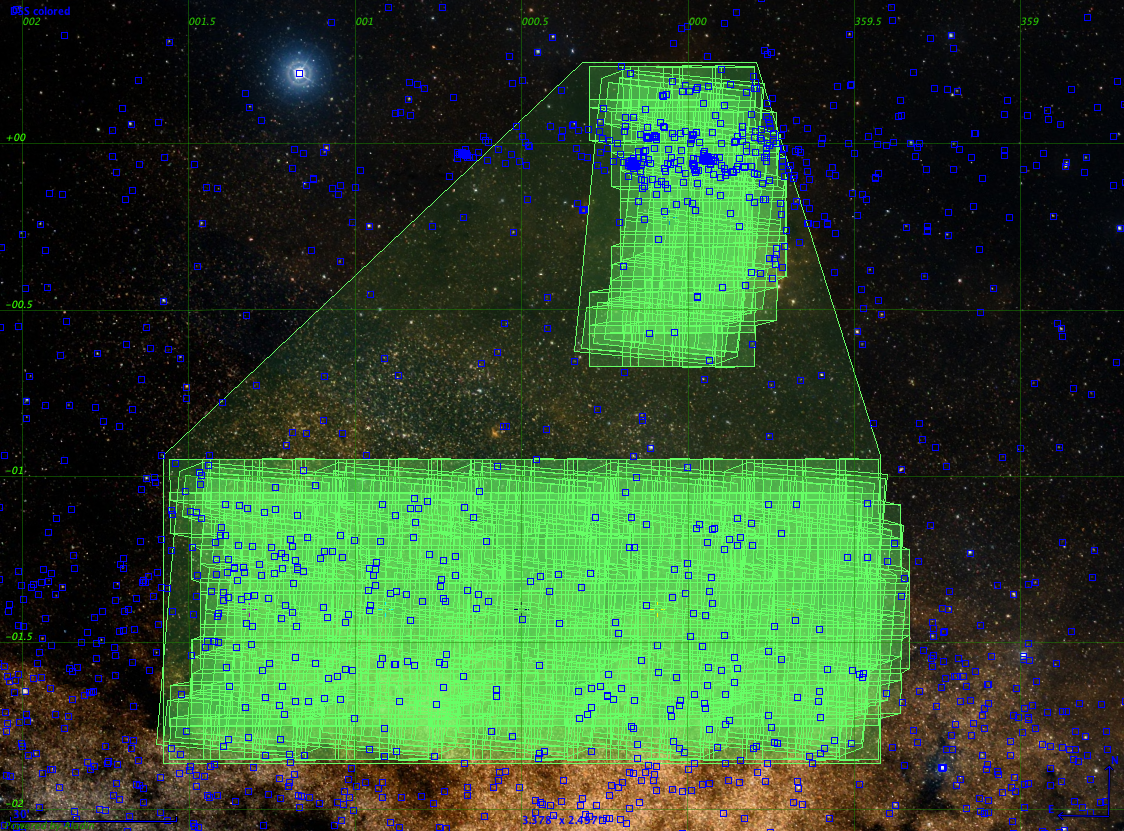
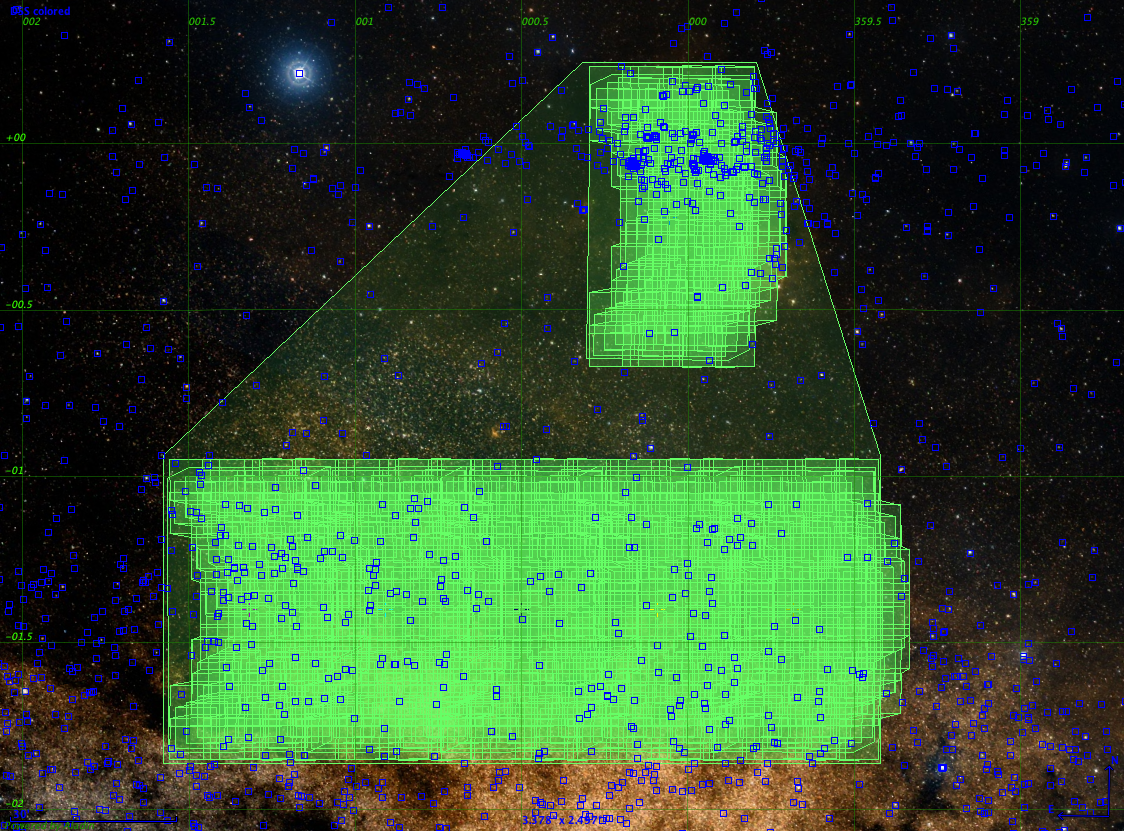
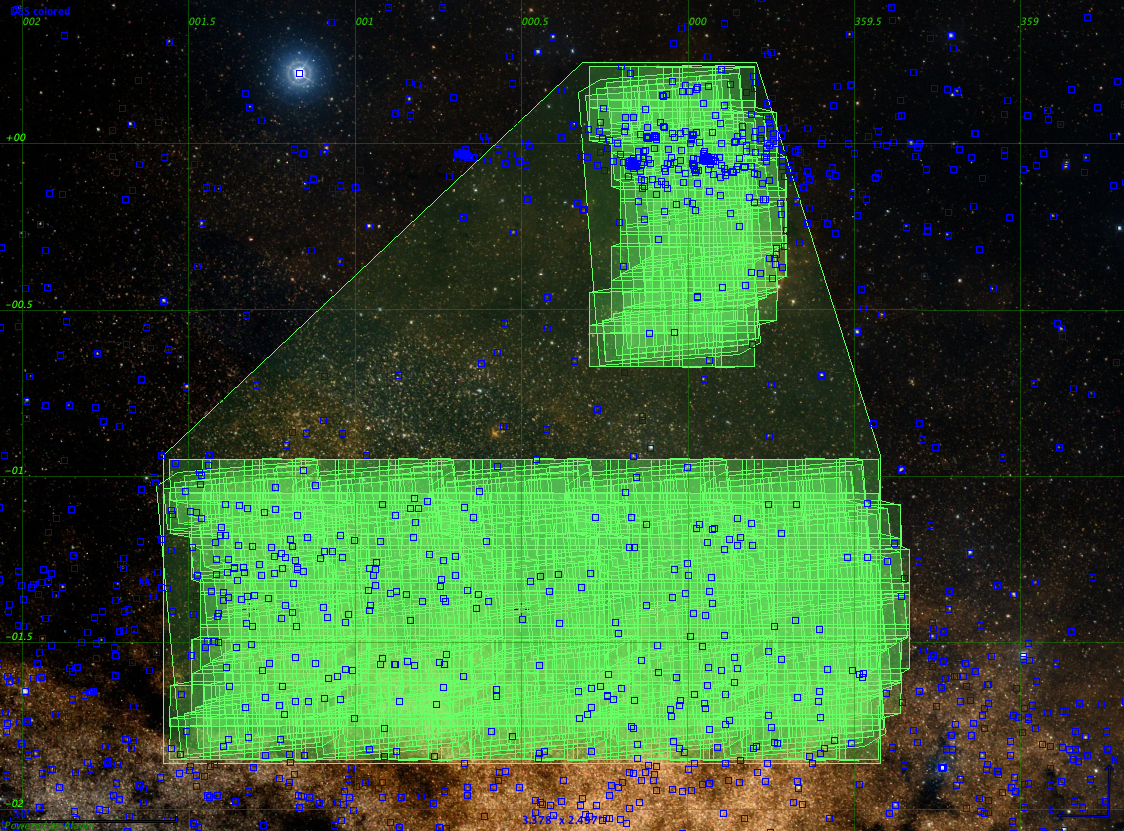
The GBTDS 6-tile pre-imaging photometric mosaic (with wide gap dither, the outer edge in all 3 plots) projected on the sky in Aladin within APT for the Spring Season at 90 deg, along with the spectroscopic mosaics (with line gap dithers) at 85 degrees (first), 90 degrees (second), and 95 degrees (third) orientation. SIMBAD objects are included (blue squares) to illustrate how the gap dithers ensure uniform field coverage at each orientation. Click to enlarge and compare this complex set of overlaid pointings. The corresponding autumn season is similar but not included here.
Scheduling of the Observations
- The first GBTDS season will begin in the first available window after commissioning. Its exact start date and duration depend on the launch date and the length of commissioning. An early start maximizes the astrometric baseline for proper-motion measurements.
- Microlensing monitoring in the High-Cadence Seasons is generally allocated 70.5 days within the ~72-day visibility window. The first season is the exception: its allocation is reduced by 2 days to obtain early Galactic Plane Survey observations across the bulge, establishing an early epoch for proper-motion measurements. The ROTAC report recommends using the full visibility window each season to maximize the photometric baseline; in practice, season lengths can differ by ~1 day, slightly affecting the total baseline. Some interruptions will occur for necessary calibrations and station-keeping activities.
- The Low-Cadence Seasons follow a 5-day time series, matching the cadence of the HLTDS and optimizing time available for GAS programs during the middle two years of the primary mission.
Scheduling to be Finalized
The detailed scheduling of Roman’s observations will be determined by the start of science operations, the selection of General Astrophysics Surveys, and target choices and timing within the coronagraph allocation. This page will be updated as more information becomes available.
Although the community-defined surveys are fully specified, the exact scheduling of observations has yet to be finalized. The timing depends on several factors, including the start of Roman’s science operations, the selection of General Astrophysics Surveys, and target choices and timing within the coronagraph instrument allocation. Even so, much is already understood about how Roman observations will be scheduled. A summary is available in the Roman Observations in the First Two Years of Science Observations article.
Future Evaluation of the Survey Implementation
Implementation of the GBTDS will be reassessed after Roman’s on-orbit performance is characterized, initial survey data are in hand, and as warranted by emerging science results from Roman or other surveys. The GBTDS Definition Committee has identified three performance metrics to evaluate once initial data are available: (1) photometric precision for semi-saturated and saturated stars in F146, (2) guiding performance during slitless spectroscopy, and (3) updated estimates of the microlensing planet yield. These metrics are discussed in Section 6 of the GBTDS Definition Committee Report (Appendix C.3; ROTAC, 2025). The evaluation will incorporate input from, and discussion with, the science community. Any recommended changes will be reviewed by a committee of community members with broad, GBTDS-relevant expertise and must be approved by the NASA Project Science Office.
Additional Resources
To explore the community-defined surveys and their scientific capabilities in more detail, please see Additional Resources for Community-defined Surveys.
For additional questions not answered in this article, please contact the Roman Help Desk.
References
- "Roman Observations Time Allocation Committee: Final Report and Recommendations", Roman Observations Time Allocation Committee and Core Community Survey Definition Committees, arXiv:2505.10574, 2025. doi:10.48550/arXiv.2505.10574.
- Roman's Core Community Surveys Are Now Defined, Gilbert, STScI Newsletter Volume 42 Issue 01, 2025.