High-Latitude Time-Domain Survey

Roman’s High-Latitude Time-Domain Survey (HLTDS) provides time-series photometry and slitless spectroscopy at HST-like resolution and sensitivity across tens of deg2, obtaining multi-band color information and spectroscopy on a 5-day cadence. Most observations will occur over a two-year window in the middle of Roman’s five-year primary mission.
The HLTDS will monitor fields in both hemispheres, with observations optimized to detect and characterize Type Ia supernovae (SNe Ia) over redshifts from ~0.5 to > 2.5. As one of Roman’s Core Community Surveys, the HLTDS is central to meeting the mission’s science requirements: by using SNe Ia to trace the expansion history of the Universe, it will probe the origin of cosmic acceleration and the nature of dark energy. Beyond SNe Ia, the HLTDS will chart the transient near-infrared sky, enabling the detection and characterization of rare, high-redshift events, core-collapse SNe, tidal disruption events, super-luminous SNe, kilonovae, pair-instability SNe, active galactic nuclei, dust-extinguished sources, and cool, red objects. The survey will also deliver deep, co-added imaging and slitless spectroscopic data, enabling studies of faint and distant galaxy populations.
The survey was designed through a community process. The Roman Observations Time Allocation Committee's (ROTAC) Final Report (hereafter “ROTAC, 2025”) discusses the rationale for the chosen implementation, expected source yields (see also Rose et al., 2025), and an overview of anticipated science investigations.
This article summarizes the major scientific drivers and describes the survey implementation in the Astronomer’s Proposal Tool (APT) for Roman.
Technical Implementation to be Finalized
The detailed scheduling of Roman’s observations will depend on the start of science operations, the selection of General Astrophysics Surveys, and target choices and timing within the coronagraph allocation. This page will be updated as more information becomes available.
HLTDS Overview Figure
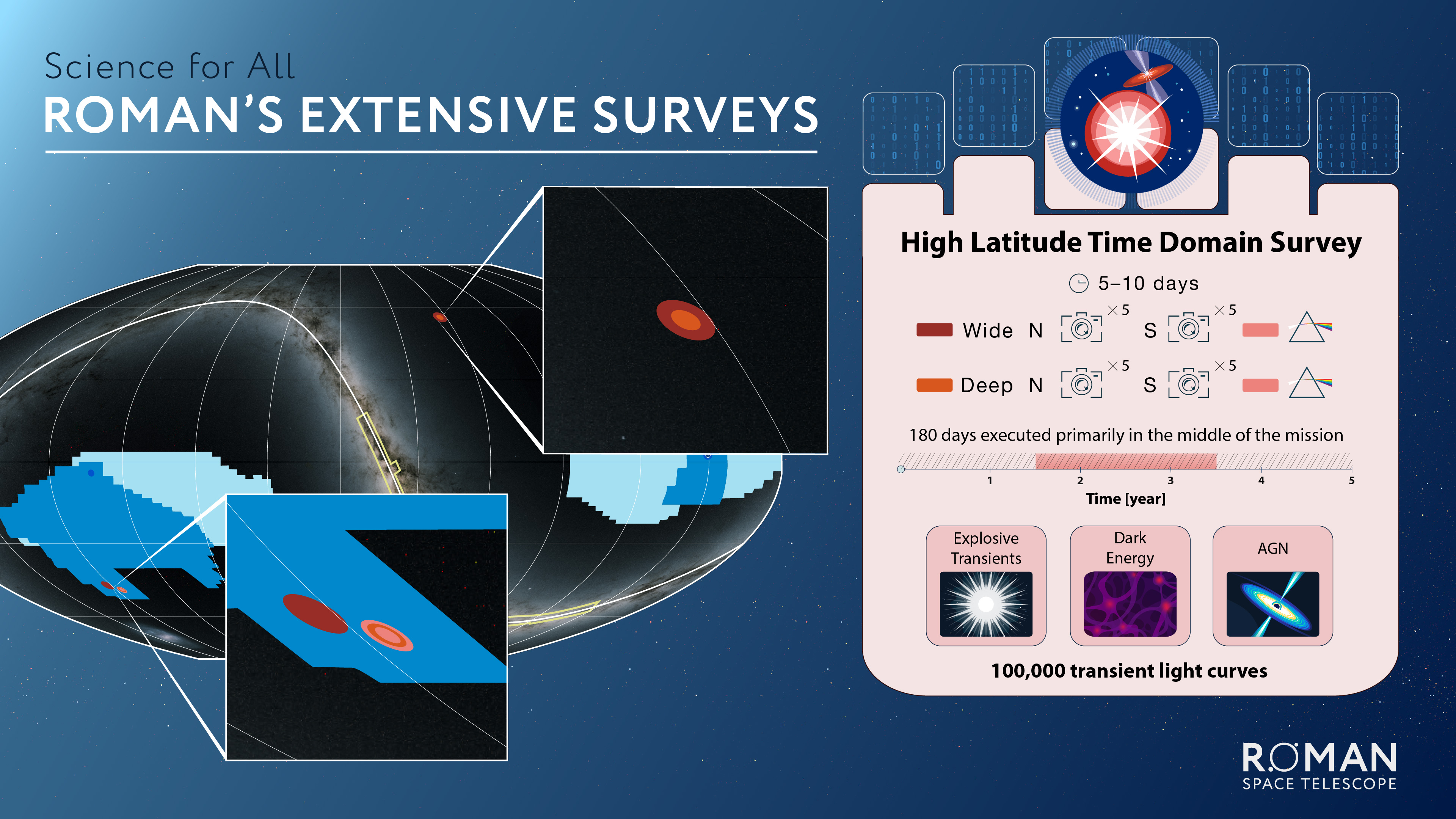
Summary figure showing Roman's High Latitude Time Domain Survey: Wide and Deep tiers are shown in different shades of red. Detailed descriptions of the implementation of each tier can be found in the corresponding sections below. The detailed science rationale for each tier can be found in the ROTAC report (ROTAC, 2025).
Image Composition: J. Olmsted, J. Kang, and C. Nieves (STScI). Background sky image: ESA/Gaia/DPAC. Acknowledgment: Javier Sanchez (STScI)
HLTDS Overview
The HLTDS will monitor one northern and one southern field over the course of Roman's primary five-year mission, with the primary survey observations obtained over a two-year span. In the southern field, spectroscopy will be obtained in wide and deep tiers optimized to characterize SNe Ia in two distinct redshift ranges. Similarly, imaging in both the northern and southern fields will be carried out in wide and deep tiers, with filter sets and exposure times optimized for the SN Ia characterization in two different redshift ranges. The wide and deep imaging tiers are optimized to reach a signal-to-noise ratio of 20 at average maximum light for SNe Ia at z ~ 0.9 and z ~ 1.7, respectively, and the two tiers will have substantial overlap in the resulting SN Ia redshift distributions. The spectroscopic tiers will provide redshifts and classifications for a subset of the transient sources. The many imaging and spectroscopy epochs will yield deep, coadded datasets with areas approximately 100x and 30x those of the large HST Treasury programs CANDELS (Grogin et al., 2011; Koekemoer et al., 2011) and 3D-HST (Brammer et al., 2012), respectively.
The survey is organized into three Components (Core, Pilot, and Extended) executed across the five-year prime mission (see Schematic of HLTDS Component Timing). Each Component sets the overall cadence and sequencing of observations. Within each Component, observation sequences are carried out in four Tiers: Wide Imaging, Deep Imaging, Wide Spectroscopy, and Deep Spectroscopy. The Summary Table of HLTDS Tiers lists the observation specifications for each Tier.
The HLTDS is allocated 180 days of execution time, including exposure times and overheads relating to consecutive slews, filter changes, and settle times. The Core Component (88% of the allocation) constitutes the primary survey observations and is planned over two years in the middle of Roman’s five-year mission. The Pilot Component (8%) consists of early observations executed as soon as possible in the mission. The Extended Component (4%) comprises a small number of additional Deep Imaging Tier observations at much longer cadence, scheduled both before and after the primary observations.
Schematic of HLTDS Component Timing
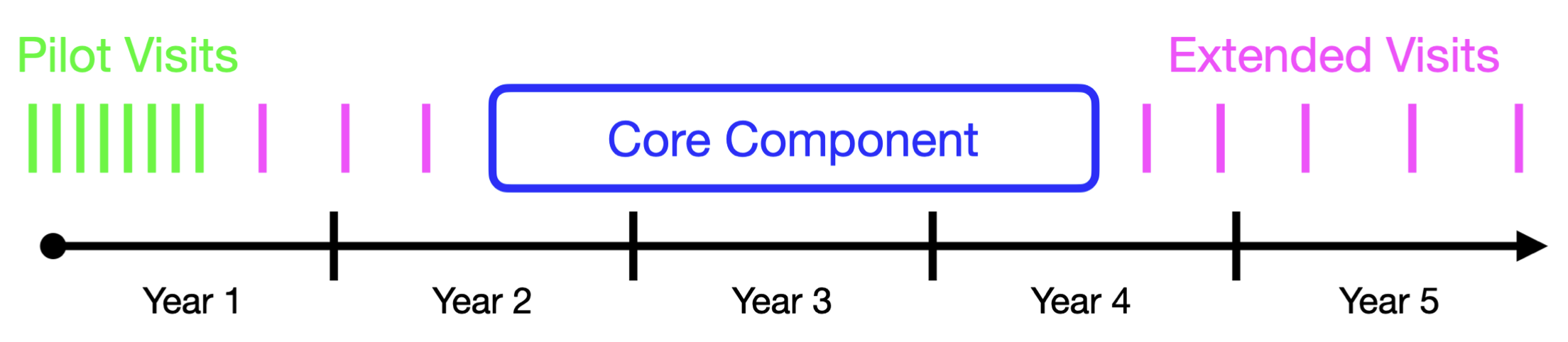
Cartoon schematic of the different components of the HLTDS. Taken from Figure 1 of the HLTDS Definition Committee's report (Appendix C.2; ROTAC, 2025).
Summary Table of HLTDS Tiers
| Tier | Optical Elements | Cadence Core Component (days) | North | South | ||||
|---|---|---|---|---|---|---|---|---|
Area per epoch (deg2) | Area with 90% epoch overlap (deg2) | Area with 100% epoch overlap (deg2) | Area per epoch (deg2) | Area with 90% epoch overlap (deg2) | Area with 100% epoch overlap (deg2) | |||
| Wide Imaging | F062 | 5 | 14.6* (38 pointings) | 12.1* | 10* | 9.3 (27 pointings) | 8 | 7 |
F087, F106, F129, F158 | 10 | |||||||
| Deep Imaging | F087 | 5 | 2.5 (7 pointings) | 1.8 | 1.6 | 5.5 (16 pointings) | 4.5 | 4 |
F106, F129, F158, F184 | 10 | |||||||
Wide | PRISM | 5 | N/A | N/A | N/A | 5.5* (14 pointings) | 4.5* | 4* |
Deep | PRISM | 5 | N/A | N/A | N/A | 0.8 (2 pointings) | 0.6 | 0.5 |
Areas in this table are determined using the region covered by all filters and pointings within each execution of the Tier.
* These areas include the Deep Tier fields, which lie at the core of the mosaic pattern.
Field Selection
The HLTDS fields must lie within Roman's Continuous Viewing Zone (CVZ) to enable a 5-day cadence throughout the two years of the Core Component observations. Field selection also considered: testing cosmic variance; minimizing foreground extinction to maximize transient discovery; leveraging existing and planned contemporaneous multi-wavelength datasets; and ensuring year-round visibility with ground-based facilities. These requirements led to two HLTDS fields, one in the north and one in the south, well separated in right ascension.
The northern field is ELAIS-N1 (Oliver et al., 2000), which will be observed with imaging only.
The southern field is the Euclid Deep Field South (EDFS), which will be observed with both imaging and slitless spectroscopy.
Properties of both fields are given in Summary Table of Survey Fields, and their locations are shown in the Figure of HLTDS Fields. A discussion of the full considerations for the field selection is provided in the HLTDS Definition Committee's report (Appendix C.2; ROTAC, 2025).
Roll Angles and Temporal Coverage
For each target within the field of regard, Roman's spacecraft attitude roll angle can be adjusted by up to ±15° about the nominal roll angle, imposing strict scheduling limits on allowable position angles, even in CVZ fields like those targeted by the HLTDS. As the observatory orbits the Sun, the roll angle for HLTDS observations changes by roughly 1° per day, so each epoch has a slightly different position angle. To mitigate position-angle variations, the survey adopts near-circular mosaics that maximize inter-epoch overlap. However, due to the WFI focal-plane geometry, no mosaic can be perfectly circular; therefore, overlap is highest in the mosaic core, which attains full coverage each epoch ("Area with 100% epoch overlap" in the Summary Table of HLTDS Tiers), and tapers toward the exterior, which is revisited only a handful of times per year. As a useful collateral benefit, varying the roll angle at each epoch distributes the field of interest across different regions of the focal plane, reducing the impact of detector artifacts.
To make this concrete, consider the Wide Imaging Tier in the Southern field. Each epoch maps 9.3 deg2, but with a 5-day cadence only 7 deg2 are revisited every epoch; by contrast, about 13 deg² receive coverage at least once over the year. See Figure of Cumulative Area Covered by Different Numbers of Epochs, which shows the pseudo-dithered mosaic (left) and the cumulative area as a function of the number of epochs when revisiting every 5 days for a year (72 total epochs; right). In this context, a pseudo-dither is a small offset applied between filters to mitigate detector artifacts while not observing with an actual dither pattern. A practical “effective area” for the survey is the region covered by ≥90% of the 5-day-cadence epochs; this value ("Area with 90% epoch overlap") is reported in the Summary Table of HLTDS Tiers.
Figure of Cumulative Area Covered by Different Numbers of Epochs
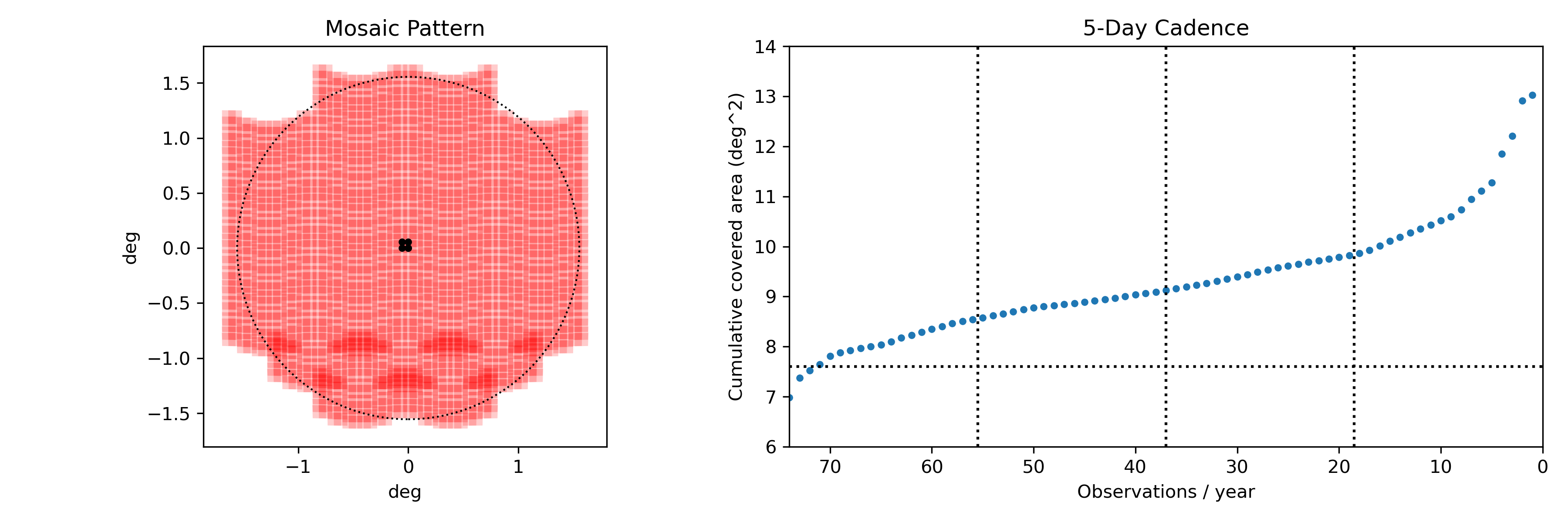
Left: pseudo-dithered mosaic pattern used in the southern field. Right: cumulative area of regions covered as a function of the number of epochs when revisiting every 5 days over one year (72 total epochs). The horizontal dotted line in the right panel marks the area with 90% epoch overlap and is the same area that is enclosed by the dotted circle in the left panel.
Summary Table of Survey Fields
| Field | RA (J2000) | Dec (J2000) | Tiers |
|---|---|---|---|
Northern Hemisphere | |||
| ELAIS-N1 | 16 10 1.0 | +54 30 36.0 |
|
Southern Hemisphere | |||
| Euclid Deep Field South_a (EDFS_a) | 03 55 36.0 | -49 19 12.0 |
|
| Euclid Deep Field South_b (EDFS_b) | 04 14 24.0 | -47 36 0.0 |
|
Figure of HLTDS Fields
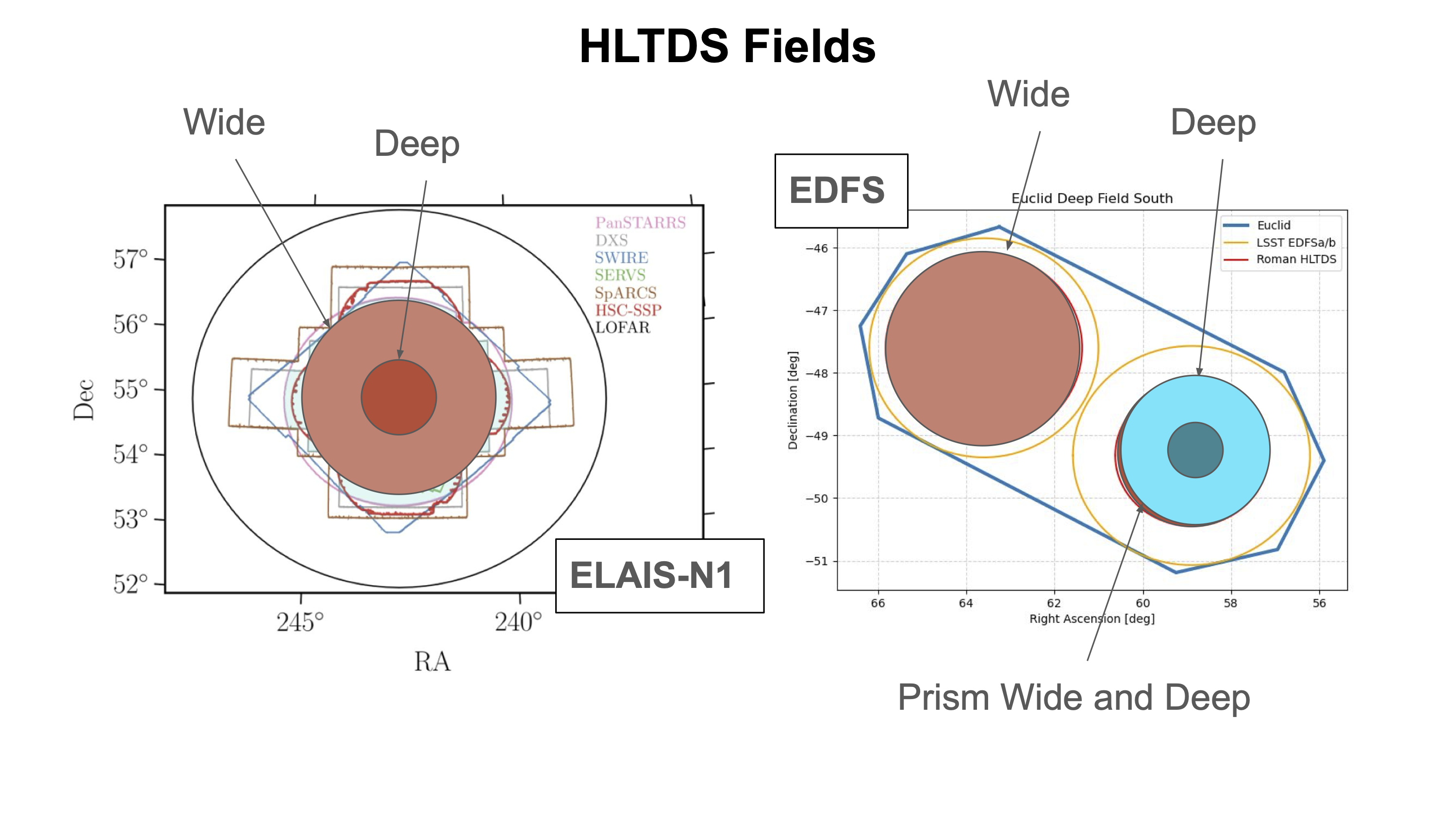
Visual approximation of HLTDS coverage: the northern field, ELAIS-N1 (left), and the southern fields, EDFS_a and EDFS_b (right). The panels also show coverage from other observatories.
Northern Field: ELIAS-N1
The northern HLTDS field, ELAIS-N1 (Oliver et al., 2000) will be observed with imaging only. It has extensive multi-wavelength coverage across X-ray, the near- and far-ultraviolet, deep optical and infrared imaging, and radio observations, and is well positioned for imaging with northern ground-based facilities. The Wide Imaging Tier in this field will span ~10 deg2, while the Deep Imaging Tier covers the innermost ~2 deg2 of the Wide Imaging Tier. The Figure of HLTDS Fields shows the approximate HLTDS footprint for the Wide Imaging and Deep Imaging Tiers, compared to the multi-wavelength coverage from other observatories.
Implementation
The Wide Imaging Tier uses 38 pointings arranged in a torus. The Deep Imaging Tier fills the center region with 7 pointings, providing ~2.5 deg2 per epoch. In this design, the Wide Imaging Tier mosaic deliberately omits the center, already imaged by the Deep Imaging Tier, so its pointings can be pushed outward to expand the Wide Imaging Tier area. Taken together, the Wide and Deep Imaging Tiers cover ~14.5 deg2 per epoch, with the central area imaged exclusively by the Deep Imaging Tier. The mosaic pattern is shown in the Figure of HLTDS Mosaic Patterns.
Southern Field: EDFS
The southern HLTDS field, the Euclid Deep Field South (EDFS), will be observed with both imaging and slitless spectroscopy. Roman observations in this region will reach approximately half the cumulative depth of the Large Survey of Space and Time (LSST) Deep Drilling Fields, providing a powerful combination of cadence and wavelength coverage for a broad range of science investigations.
The EDFS is divided into two components, EDFS_a and EDFS_b, both covered by the southern HLTDS. The Wide Imaging Tier is centered on EDFS_b, covering approximately ~7 deg2, while the Deep Imaging and Deep Spectroscopy Tiers are centered on EDFS_a. Unlike in the northern field, the Deep Imaging Tier (~4 deg2) is not contained within the Wide Imaging Tier but is spatially offset from it. All spectroscopic observations are centered on the EDFS_a field. The Wide Spectroscopy Tier (~4 deg2) largely overlaps the Deep Imaging Tier area, and the Deep Spectroscopy Tier covers the innermost ~0.5 deg2 of that same region. The Figure of HLTDS Fields shows the approximate area covered by the Wide and Deep Imaging and Spectroscopy Tiers in the HLTDS, compared to the Euclid and LSST coverage.
Implementation
In the southern field, the Wide and Deep Imaging Tiers are implemented as two independent mosaics. The wide imaging mosaic consists of 27 pointings, covering ~9 deg2 per epoch, while the deep imaging mosaic comprises 16 pointings, covering ~5 deg2 per epoch. Both of the Wide and Deep Spectroscopy Tiers overlap the deep imaging region: the wide spectroscopy mosaic includes the outer 14 pointings, and the deep spectroscopy mosaic consists of the central two, covering ~0.5 deg2 per epoch. The full spectroscopic footprint covers ~5 deg2 per epoch at differing depths, with the central region observed only by the deep tier. The mosaic patterns are shown in the Figure of HLTDS Mosaic Patterns.
Figure of HLTDS Mosaic Patterns
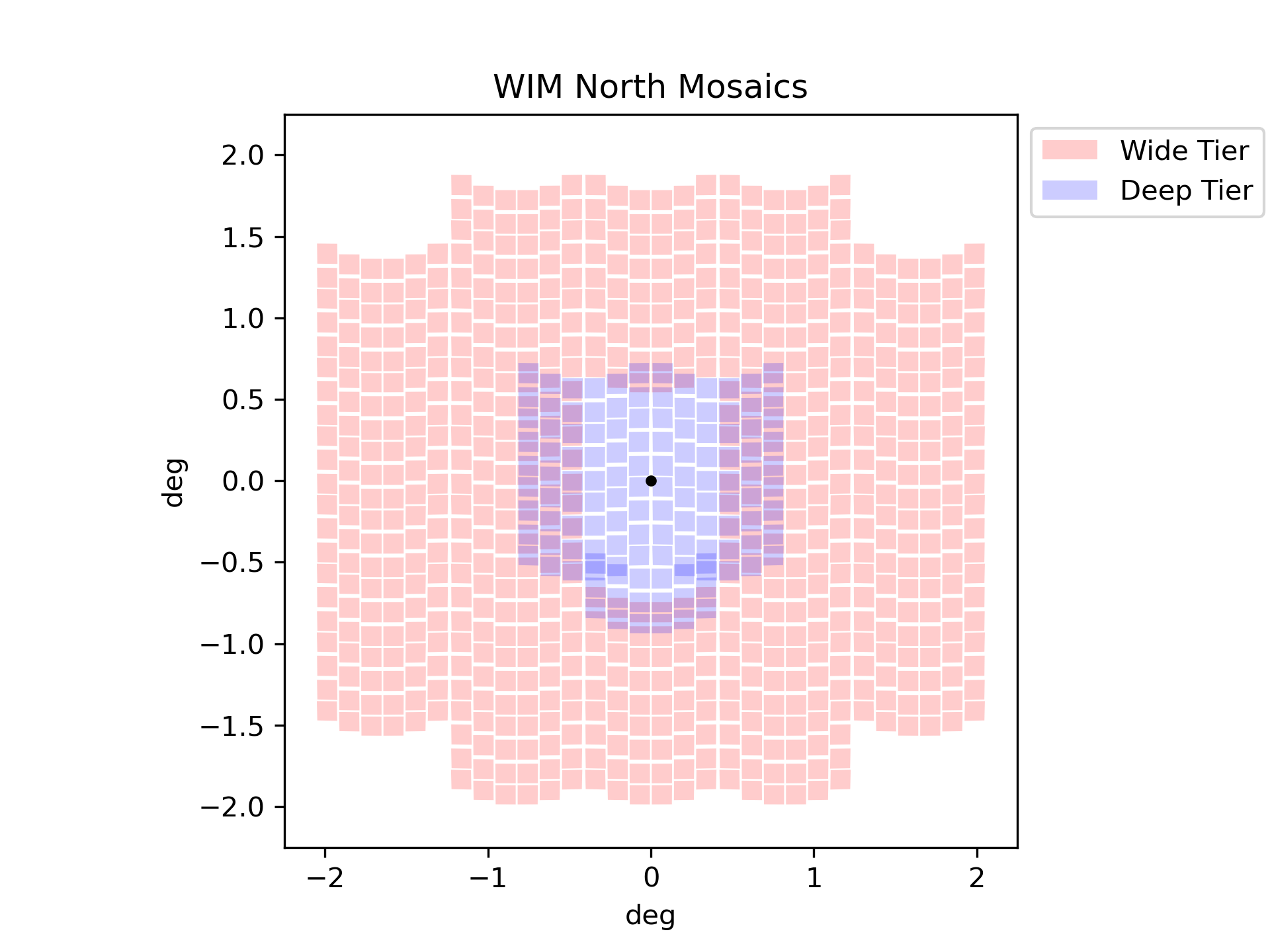
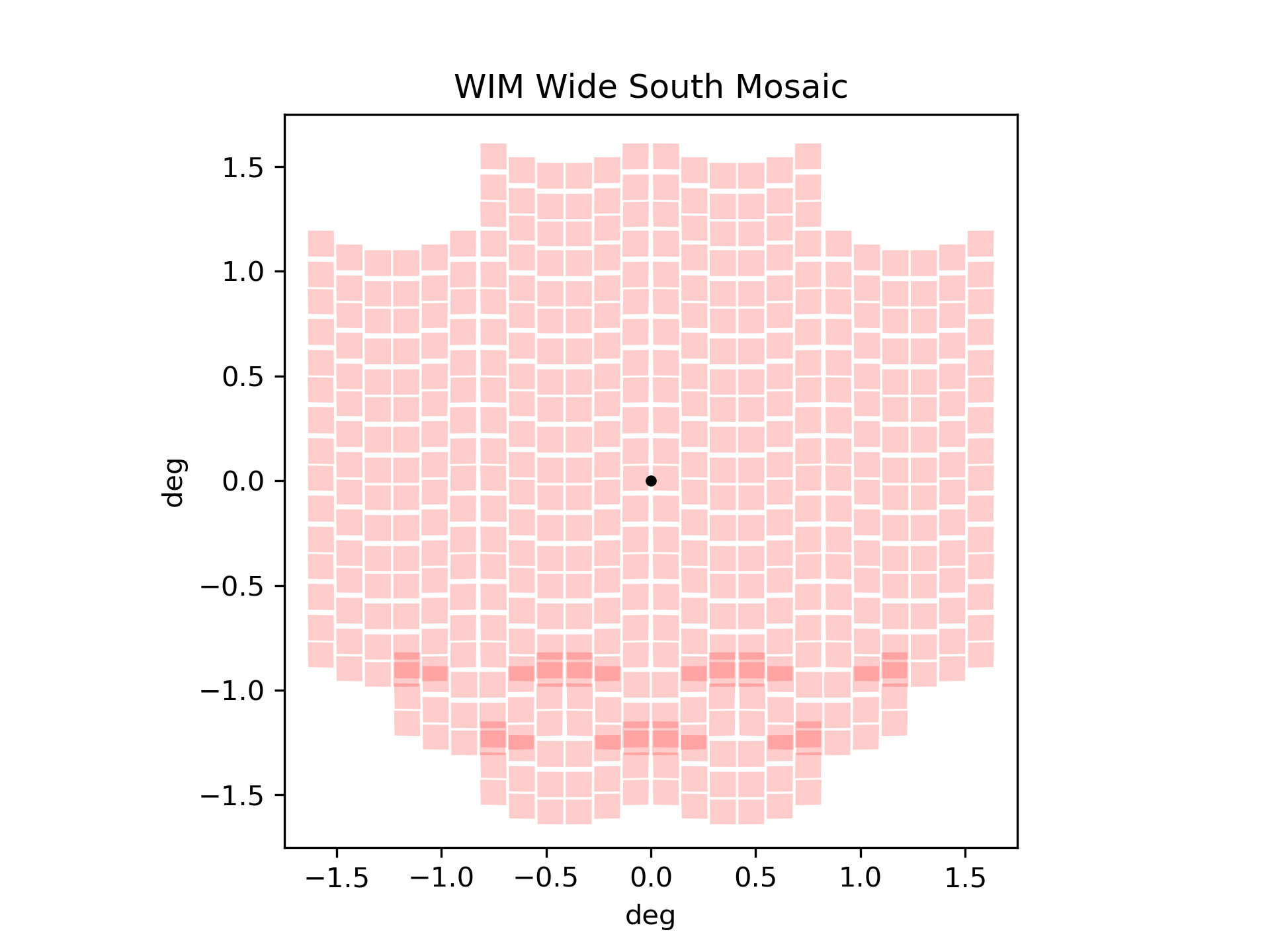
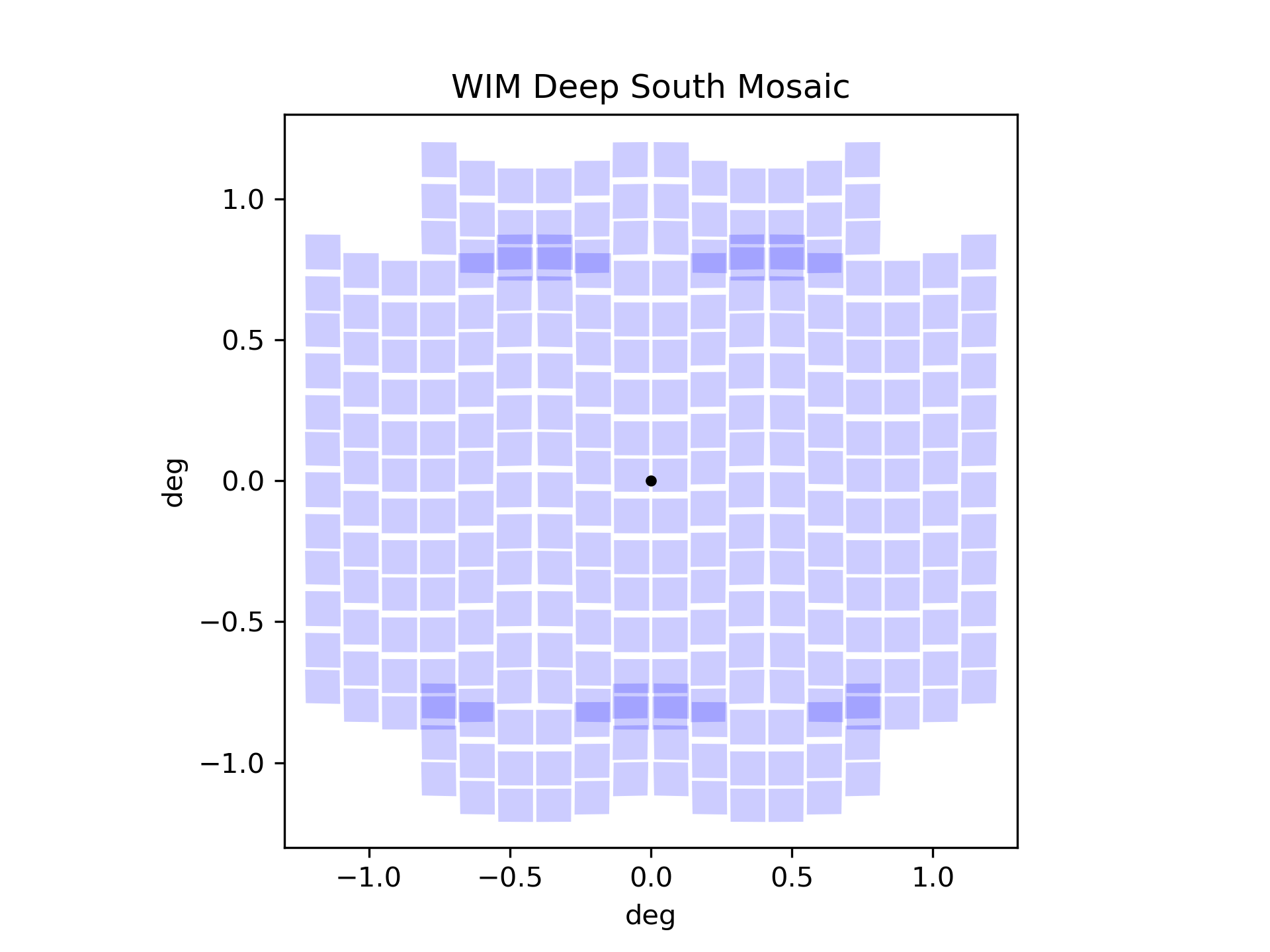
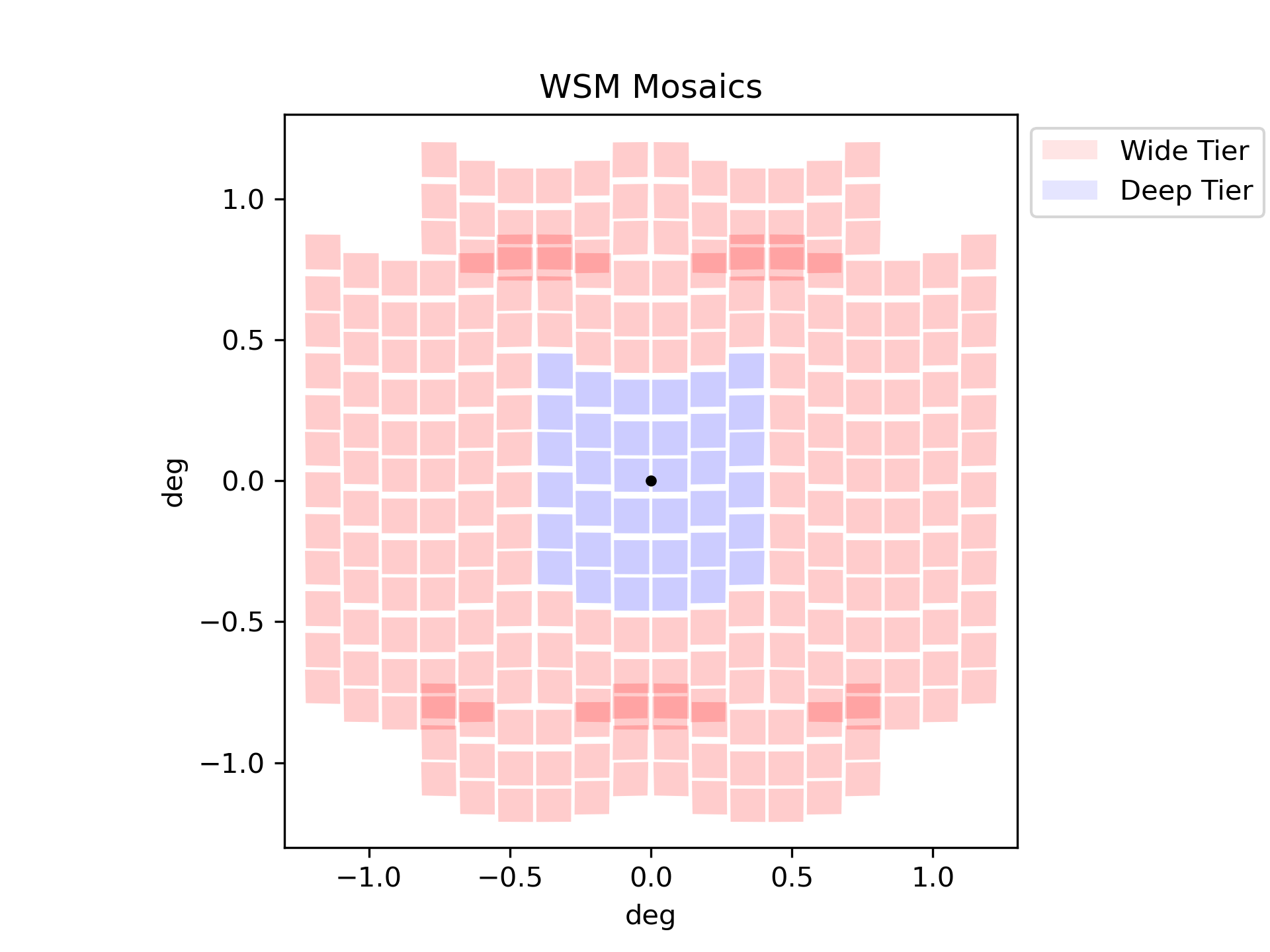
All six mosaic patterns used in the HLTDS with Wide Imaging and Spectroscopy Tier mosaics in red and Deep Imaging and Spectroscopy Tier mosaics in blue for both the WFI Imaging Mode (WIM) and WFI Spectroscopy Mode (WSM) observations. Overlapping mosaics with the same imaging mode are over-plotted.
Observational Specifications
The same exposure times are typically used for each epoch of the Wide and Deep Tiers, regardless of survey component (Core, Pilot, or Extended), to ensure uniform depth in every filter within each tier. The F062 and F087 observations in the Pilot Component are the exception to this rule. These filters have longer exposure times in the Pilot Component to mimic how the higher cadence of these filters will increase the total exposure time (see the observation cadence of all filters in the Summary Table of HLTDS Tiers).
To meet the survey’s supernova requirements, observations shorter than 500 seconds of total exposure time are not dithered. Simulations showed that adding dithers at these durations would introduce sufficient overhead to reduce areal coverage and cadence, lowering the expected supernova yield below requirements (Appendix C.2; ROTAC, 2025). Accordingly, observations with total exposure times shorter than 500 seconds use single pointings. For observations with total exposure times longer than 500 seconds, dithering becomes favorable because (1) the 20-second slew and settle overhead is less than 4% of the total execution time, and (2) a larger fraction of pixels benefit from cosmic ray rejection, improving the effective depth. For these longer observations, standard APT dither patterns are used (see the Summary Table of Exposure Time and Depth), and the co-added dithered exposures achieve the target depth.
For short observations (<500 seconds total exposure time), where no dithers are used, small offsets are applied when changing filters so the same source does not fall on the same pixels, mitigating the impact of bad pixels and detector artifacts. Offsets follow the same step size and direction as in the four-point gap-filling dither BOXGAP4_1, but are implemented as equatorial (RA/Dec) target shifts.
With this scheme, a single filter in an epoch may not completely fill the gaps between the WFI detectors, but the combined pass across all filters fills those gaps, delivering complete area coverage for the epoch.
The specific selections for each Tier, including MultiAccum (MA) Tables and dither patterns, are given in the subsections below and summarized in the Summary Table of Exposure Time and Depth.
Summary Table of Exposure Time and Depth
| Optical Element | Total Exposure Time (s) | MultiAccum (MA) Table | Dither Pattern |
|---|---|---|---|
Wide Imaging Tier | |||
| F062 | 60 (85)* | IM_60_6_S (IM_85_7)* | N/A |
| F087 | 85 | IM_85_7 | N/A |
| F106 | 95 | IM_95_7 | N/A |
| F129 | 152 | IM_152_9 | N/A |
| F158 | 294 | IM_294_16 | N/A |
| Deep Imaging Tier | |||
| F087 | 193 (360)* | IM_193_11 (IM_360_16)* | N/A |
| F106 | 294 | IM_294_16 | N/A |
| F129 | 307 | IM_307_16 | N/A |
| F158 | 420 | IM_420_16 | N/A |
| F184 | 1636 | IM_409_16 | BOXGAP4_1 |
| Wide Spectroscopic Tier | |||
| PRISM | 900 | SP_450_16 | LINEGAP2_1 |
| Deep Spectroscopic Tier | |||
| PRISM | 3600 | SP_450_16 | BOXGAP8_1 |
* The total exposure times and MultiAccum (MA) tables in parentheses are used for the Pilot Component
Core Component
Most HLTDS observations occur over two years in the middle of Roman's five-year primary mission. These data provide the primary discovery and characterization set for most transients and variable sources. Although spectral elements and exposure times are largely optimized for SN Ia discovery and precise measurements of their light curves, the Wide and Deep Imaging Tier filter sets support photometric classification of a broad range of transients.
Both fields are visited with a 5-day cadence, with the northern and southern schedules decoupled to maximize scheduling flexibility. In the south, the Spectroscopy Tiers are observed at every epoch. For the Imaging Tiers, only the bluest filter in each tier is repeated at every epoch: F062 and F087 for the Wide and Deep Imaging Tiers, respectively. The remaining four filters in each Tier are each observed with a 10-day cadence. However, they are observed in alternating pairs, with one pair observed every 5 days, resulting in color information being obtained every 5 days. Filter pairs were chosen to (1) ensure full wavelength coverage at each epoch and (2) minimize motion of the Element Wheel Assembly (EWA):
Wide Imaging Tier pairs: (F106, F158) and (F087, F129)
Deep Imaging Tier pairs: (F106, F158) and (F129, F184)
To further reduce EWA movement, interleaved Wide and Deep epochs using similar filters are combined, yielding two four-filter sets that alternate every 5 days:
F062 (Wide), F087 (Wide + Deep), F129 (Wide + Deep), F184 (Deep)
F062 (Wide), F087 (Deep), F106 (Wide + Deep), F158 (Wide + Deep)
Pilot Component
Early in the mission, HLTDS will obtain an initial set of observations in each survey field to prepare for the Core Component data. Specifically, eight observations per field, covering all Tiers will:
- enable the generation of deep template images for difference imaging
- collect reference slitless spectroscopy to support modeling and subtraction of the host galaxy component
- provide an empirical estimate of the SNe Ia rate at z >~ 1 to inform the survey implementation review (see Future Evaluation)
To interlace with the other CCS programs, the first two epochs of the Pilot Component are planned to occur before the first Galactic Bulge Time-Domain Survey (GBTDS) season with a ~20-day cadence. The remaining 6 epochs are planned to occur between the first and second GBTDS seasons at a ~20-day cadence. Although the cadence is the same, southern and northern sequences may be fully decoupled to minimize scheduling constraints.
Since all the filters are observed once per epoch in the Pilot Component, the bluest filters in each Tier (F062 and F087 in the Wide and Deep Tiers, respectively) use extended exposure times to replicate the repeated observations of those filters during the Core Component.
Extended Component
The HLTDS will also extend the temporal baseline of the Deep Imaging Tier beyond the two-year Core Component. A total of eight additional observations, covering both the northern and southern deep imaging area, will provide temporal coverage across the full five-year span of Roman's primary mission. Three of these observations will occur between the Pilot Component and the Core Component observations, spaced approximately 65 ± 5 days apart and concluding ~35 days before the start of the Core Component. The remaining five epochs will be obtained after the Core Component ends, beginning ~35 days after the final Core Component observations and spaced by ~85 ± 10 days, avoiding overlap with the Galactic Bulge seasons and maximizing temporal coverage through the remainder of the mission. This extended program will enable the discovery and characterization of long-duration, high-redshift transients, including superluminous and pair-instability SNe at redshifts up to z ~ 5.
Scheduling of the Observations
Pilot Component observations are recommended as early as possible, ideally within the first year of the mission. However, their timing depends on the first Galactic Bulge season, Coronagraph observations, scheduling of early High-Latitude Wide-Area Survey (HLWAS) observations, and the Cycle 1 General Astrophysics Surveys program selections. These, in turn, depend on Roman's actual launch date and commissioning timeline. Similarly, the start of the Core Component observations depends on the interplay with Roman's other surveys, particularly on the timing of the third Galactic Bulge season (see Galactic Bulge Time-Domain Survey for more details). The Core Component will not begin until after the third high-cadence bulge season has completed.
For the Core Component, the goal is to revisit each field on a 5-day cadence. The current implementation targets a per-field cadence of 5 ± 1 day, with the option to relax to ±2 days if needed to ease scheduling pressure. Regardless of the adopted tolerance, epochs will be planned such that the average cadence during the Core Component is as close to 5 days as possible. At present, north and south passes are interleaved, yielding HLTDS epochs every 2.5 days overall, though the passes could be decoupled if uneven interleaving better satisfies scheduling. Within each field, the Wide and Deep Imaging Tiers are coupled to minimize slews and reduce EWA rotations.
Scheduling to be Finalized
The detailed scheduling of Roman’s observations will be dependent on the start of science operations, the selection of General Astrophysics Surveys, and target choices and timing within the Coronagraph allocation. This page will be updated as more information becomes available.
Although the community-defined surveys are fully specified, the exact scheduling of observations has yet to be finalized. The timing depends on several factors, including the start of Roman’s science operations, the selection of General Astrophysics Surveys, and target choices and timing within the Coronagraph allocation. Even so, much is already understood about how Roman observations will be scheduled. A summary is available in the Roman Observations in the First Two Years of Science Operations article.
Future Evaluation of the Survey Implementation
Implementation of the HLTDS will be reassessed after Roman's on-orbit performance is characterized, initial survey data are in hand, and as warranted by emerging science results from Roman or other surveys. The HLTDS definition committee has identified astrophysical and technical performance metrics to be evaluated after the Pilot Component is executed. These include an estimate of the high redshift SNe Ia rate, performance of cosmic ray rejection for non-dithered exposures, and the utility of the prism data. These metrics are detailed in the "Technical Checkpoints from Pilot Survey" section in the HLTDS Definition Committee Report (Appendix C.2; ROTAC, 2025). The evaluation will incorporate input from, and discussion with, the science community. Any recommended changes will be reviewed by a committee of community members with broad, HLTDS-relevant expertise and must be approved by the NASA Roman Project Science Office.
Additional Resources
To explore the community-defined surveys and their scientific capabilities in more detail, please see Additional Resources for Community-defined Surveys.
For additional questions not answered in this article, please contact the Roman Help Desk.
References
- Core Community Surveys: Overview and Definitions, maintained by NASA GSFC, accessed 19 September 2025.
- "Roman Observations Time Allocation Committee: Final Report and Recommendations", Roman Observations Time Allocation Committee and Core Community Survey Definition Committees, arXiv:2505.10574, 2025. doi:10.48550/arXiv.2505.10574.
- Roman's Core Community Surveys Are Now Defined, Gilbert, STScI Newsletter Volume 42 Issue 01, 2025.
- The Hourglass Simulation: A Catalog for the Roman High-latitude Time-domain Core Community Survey, Rose et al., arXiv:2506.05161, 2025.
- Brammer et al., 2012, ApJS, 200, 13, https://doi.org/10.1088/0067-0049/200/2/13
- Grogin et al., 2011, ApJS, 197, 35, https://doi.org/10.1088/0067-0049/197/2/35
- Koekemoer et al., 2011, ApJS, 197, 36, https://doi.org/10.1088/0067-0049/197/2/36