Astrometric Field

Roman's Astrometric Touchstone field is used to characterize the effective PSF and solve for geometric distortion of the Wide Field Instrument (WFI). This article describes the properties of the field and the observing strategy employed during the prime mission.
Introduction
The Astrometry Touchstone Field is used to achieve high astrometric precision across the full focal plane of the Wide Field Instrument (WFI) over Roman's mission lifetime. The Astrometry Touchstone field is used to derive a filter-dependent, high-precision geometric distortion solution for all 18 WFI detectors, in all imaging filters. Additionally, these observations will enable accurate and self-consistent effective PSF (ePSF) modeling, which is tightly coupled to the distortion solution. The collected data will meet Roman’s stringent science requirements for both relative and absolute astrometry, which are significantly more demanding than those of HST or JWST (down to sub-milliarcsecond precision).
The community process recommended a field in the Large Magellanic Cloud (LMC) referred to as the LMC Astrometric Field centered at (RA, DEC) = (05:22:00, -69:30:00). This field was selected based on analysis by the Roman Astrometry Working Group. In particular, simulations showed that the selected LMC field provides an ideal balance, e.g., a “Goldilocks” field, of source density and uniformity. In this field, an astrometric precision of ~0.01 pixels (~ 1 mas) can be achieved on single exposures (Bellini et al. 2024, Roman Technical Report).
The Large Magellanic Cloud Astrometric Field
A field in the bar of the LMC is the primary astrometric calibration field. As shown in Placement of the LMC Astrometric Field, the Roman Astrometric field overlaps the JWST astrometric calibration field (Anderson et al. 2021). The LMC field contains a large number of red-clump stars that are ideal astrometric references due to their uniform brightness, color, and relative-isolation (e.g., not clustered); the source density with color and color-magnitude diagrams for the field are shown in the Figure of Stellar Density and Properties in the LMC Field. Over a region of approximately 1.5 × 0.9 square degrees (equivalent to 2x2 barely overlapping WFI pointings), these red clump stars have a uniform stellar density that enable measurements across the full WFI field-of-view. The density of red clump stars varies from roughly 2,000 to 10,000 sources per detector which is sufficient for analysis without needing to have additional terms for crowding. The red clump stars are of sufficient brightness to reach high signal-to-noise, e.g., greater than 100 and ideally at least 250, with modest individual exposure times. The LMC field has relatively low extinction and uniform reddening, which minimizes the impact of color-dependent systematics. Lastly, the LMC is in Roman’s Continuous Viewing Zone (CVZ), enabling observations at any time during the mission.
Placement of the LMC Astrometric Field
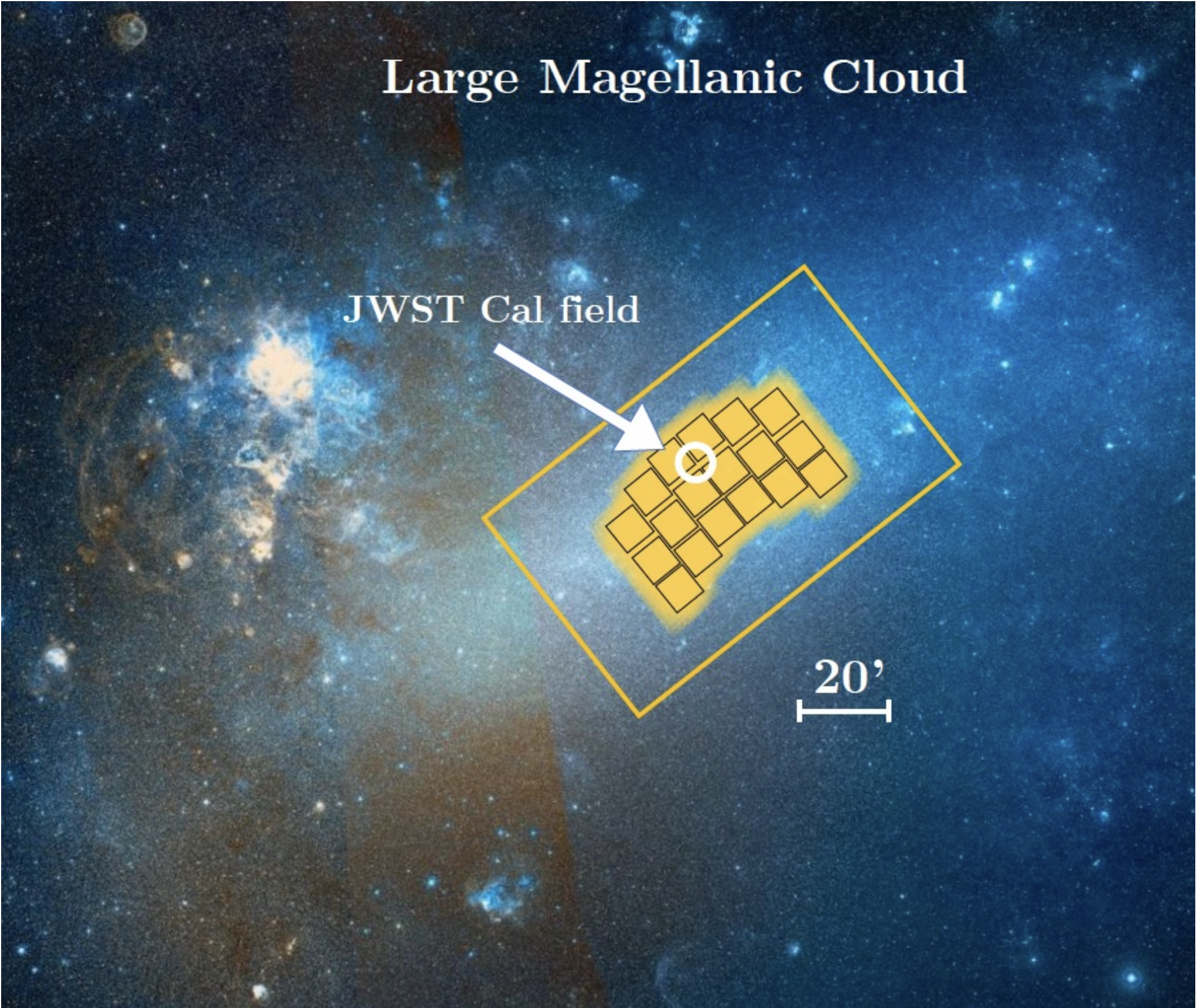
The LMC Astrometric Field is shown by the WFI outline on this LMC wide-field image, highlighted in a yellow box. Note that the actual position angle depends on the timing of commissioning. The field selection takes advantage of the JWST Astrometric Calibration Field that is overlaid as a white circle (Anderson et al. 2021). The yellow overlays show the impact of the small and large dithers (see Observing Strategy). Figure from the Touchstone Field Report (Presentation by Casertano 2025).
Figure of Stellar Density and Properties in the LMC Field
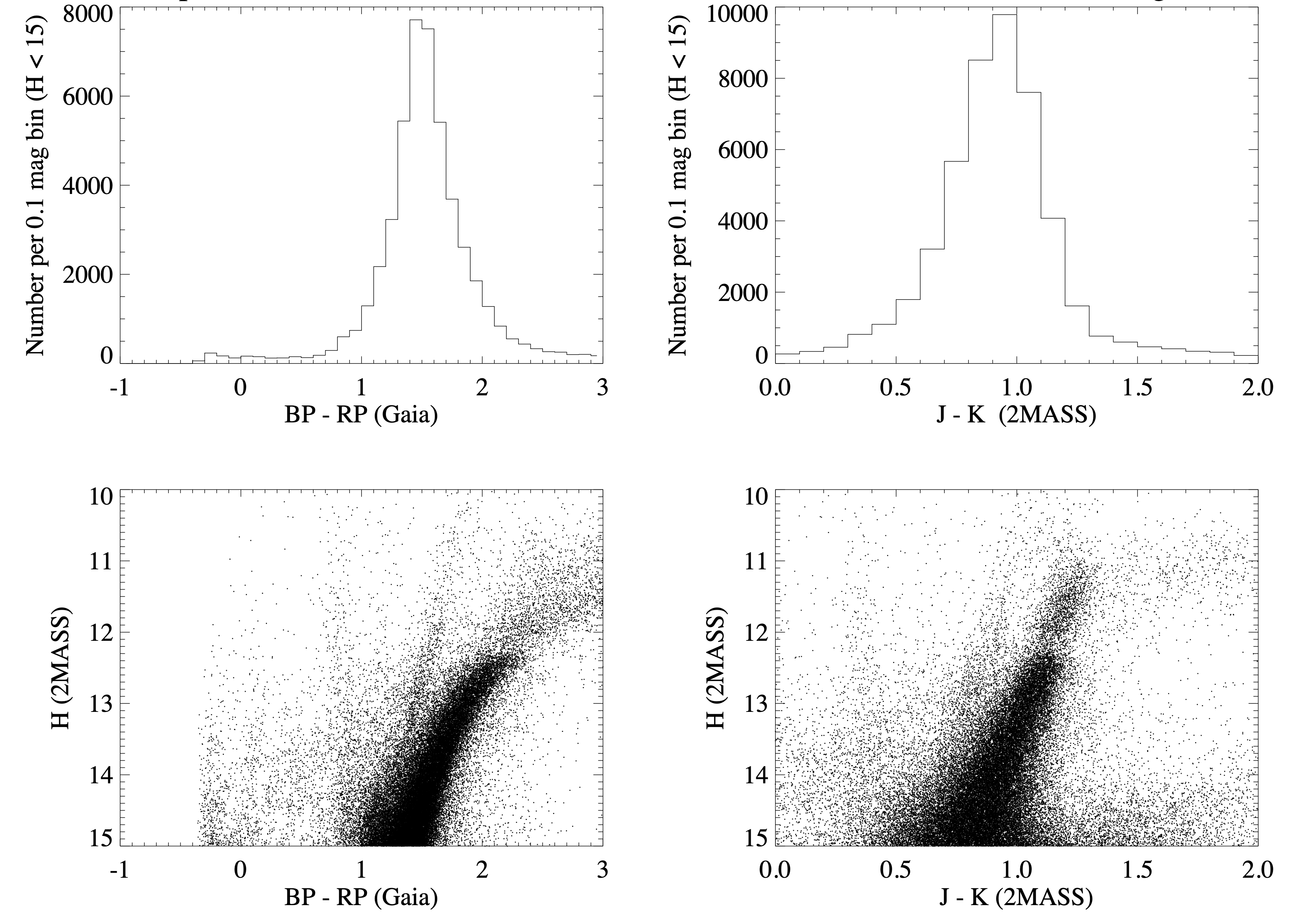
Properties of the sources in the LMC Astrometric Field. The top panels shows a marginal distribution of source color in the Gaia (left) and 2MASS (right) catalogs. The lower panels show color-magnitude diagrams (CMDs) of the field from Gaia (left) and 2MASS (right). Figure from the Wide Field Instrument Calibration Touchstone Field Recommendations (Williams 2025).
Astrometric Touchstone Observing Strategy
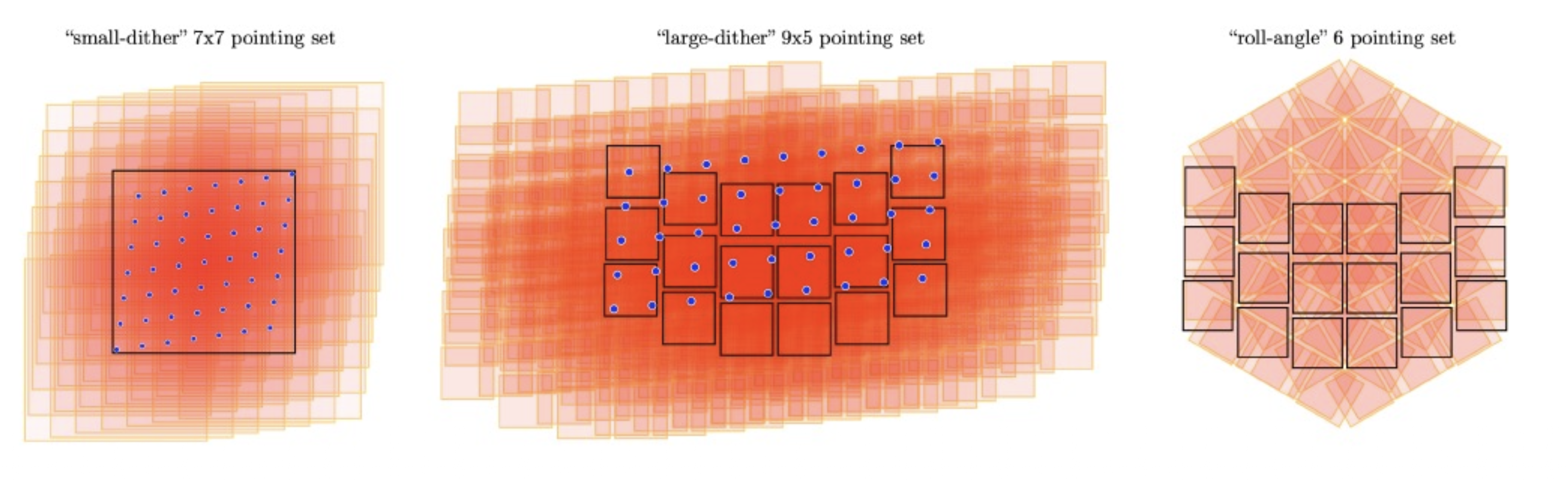
The observing strategy for the Astrometric Touchstone Field consists of:
- Small dithers to characterize the geometric distortion within individual detectors (7 x 7 mosaic, covering a detector from corner to corner);
- Large dithers to link the distortion solutions across all 18 WFI detectors (5 x 9 mosaic, covering the full WFI from corner to corner);
- Multiple roll angles of one pointing to constrain the skew terms of the distortion.
A conceptualization of the dither strategy is shown in the Figure of Astrometric Observing Strategy. Each exposure will be 60 seconds to 66 seconds and the dithering pattern produces 49 (small dithers), 44 (large dithers), and 6 (multiple rolls) exposures. This observational sequence will be repeated at least once per year to derive the effective PSF (ePSF) and geometric distortion reference data. The stellar tracers (red clump stars) have a uniform distribution that allow the corner‑to‑corner dithering that is critical for the self-calibration technique used to solve for the geometric distortion of the WFI. Moreover, the short side of the field (0.9 degrees) is large enough to allow for the pointings of the roll-angle set of observations to be fully within the field. All pointings will be intentionally offset to avoid repeating the same detector coordinates.
Figure of Astrometric Observing Strategy
For additional questions not answered in this article, please contact the Roman Help Desk.
References
- Bellini et al., "Achieving sub 0.01-pixel astrometric precision with the Wide-Field Instrument", Roman Technical report, Space Telescope Science Institute, 2024
- Anderson, J., Fall, M., and the Astrometric Working Group, "The JWST Calibration Field: Absolute Astrometry and Proper Motions with GAIA and a Second HST Epoch", JWST Technical Report
- "Touchstone Field Report" presentation at the Roman Community Forum on February 26, 2025 by S. Casertano on behalf of the Calibration Working Group
- "Nancy Grace Roman Space Telescope: Wide Field Instrument Calibration Touchstone Field Recommendations" delivered March 31, 2025 by Williams et al. on behalf of the Calibration Working Group