WFI MultiAccum (MA) Tables

The Roman Wide Field Instrument (WFI) uses a set of pre-defined MultiAccum Tables to sample the detector within an exposure. These tables are described in this article. For guidance on how the choice of MultiAccum Table influences sensitivity, saturation, and exposure-time trade-offs in Roman WFI observations, see Understanding Roman WFI Sensitivity, Saturation, and Exposure Time.
Changes to the technical details and other specifications presented here are expected as a part of commissioning and early operations. This includes modifications to the Multi Accumulation tables.
Multi-Accum (MA) Tables
The multi-accumulation (sometimes abbreviated multi-accum or MA) tables describe the sequence of individual reads (or samples) that comprise the up-the-ramp sampling during a single exposure of the Wide Field Instrument (WFI) detectors. Onboard the spacecraft, reads are averaged into resultants (called groups in JWST) using an unweighted arithmetic mean. The resultants are downlinked to the ground system as science data. Note that the WFI supports unevenly-spaced resultants, characterized by a variable number of reads within a resultant and/or a variable number of skipped reads between resultants over the Exposure. The Figure of Reads and Resultants over Time provides an example visualization of an MA Table for Roman to demonstrate the important elements.
In addition to the science reads, MA tables can include three other types of reads: reset reads, a reference read (referred to as frame zero in JWST terminology), and reset / reference reads (where the reset and the reference read are the same read).
The reset read(s) flush accumulated signal from the pixels before the integration begins. During operations, several reset reads are included at the start of each MA table.
The reference read is an additional read that is subtracted from all subsequent reads before they are accumulated and averaged into resultants. The primary purpose of the reference read is to improve the efficiency of the science data compression prior to downlink to the ground system.
The reset / reference read is a single read that is both a reset and used as a reference read; the signal is subtracted from all subsequent reads.
The reset reads and reference reads are not user-configurable parameters. At present, neither the reset read(s) nor the reference read are included in the science data downlinked from the spacecraft to the ground system; therefore, these reads are not accessible to users.
Users select MA Tables in the Pass Plans component of the Astronomer's Proposal Tool (APT). The basic properties of the Imaging Mode MA Tables and the Spectroscopy Mode MA Tables are summarized in separate tables in this article, each of which includes links to more detailed information on individual MA tables.
Detailed descriptions of the imaging and spectroscopic MA tables are provided in the Imaging Mode MA Tables and Spectroscopy Mode MA Tables articles, respectively. Information on MA tables used in engineering modes is available in the Engineering MultiAccum Tables article; note that these tables are restricted for nearly all users.
Figure of Reads and Resultants over Time
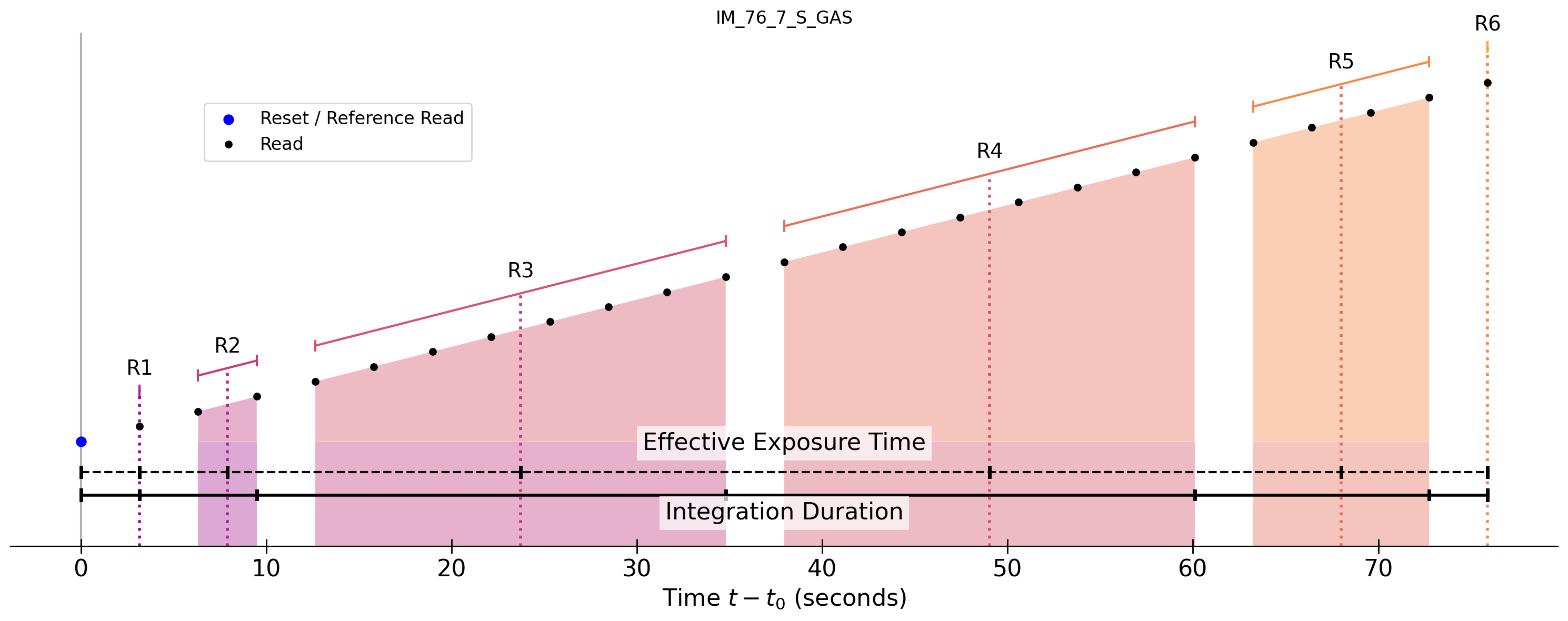
This figure shows MA Table IM_76_7_S. The dashed vertical lines represent the midpoint time of each resultant, though they are vertically offset to aid in visibility, while the colored ranges around each dashed vertical line show the resultant duration. Note that the resultants contain differing numbers of reads from each other, which demonstrates the uneven sampling capability of the WFI. The integration duration is the time between the start of the reset / reference read and the end of the final read in the MA table. The effective exposure time is the difference between the start of the reset / reference read and the midpoint time of the last resultants. The integration duration and effective exposure time shown correspond to the execution of the full MA table.
MultiAccum (MA) tables Specifications
The Imaging MultiAccum Tables and Spectroscopy MultiAccum Tables articles provide detailed information about each MA table in three complementary formats: (1) a general summary table, (2) a figure similar to the Figure of Reads and Resultants over Time, customized for each MA Table, and (3) a table listing the properties of each resultant. Definitions of the terms used in these tables and figures are given below.
Terms in the General Properties Table
- Resultants: Number of resultants defined for the MA Table.
- WFI Observing Mode: Observing mode associated with the MA table, imaging (WIM) or spectroscopy (WSM).
- Science Read Time: Time between successive science reads; this value is fixed for a given WFI observing mode.
- Number of Reset Reads: The number of reset reads included in the MA Table.
- Reset Read Time: Read time applied to the reset read.
- Subtract Reference Read: Boolean indicating whether the reference read is subtracted prior to downlink.
- Reference Read Time: Read time associated with the reference read.
- MA Table Number: Unique numerical identifier for the MA Table.
- MA Table ID: Unique alphanumeric identifier for the MA Table.
- MA Table Description: Short description of the MA Table.
Terms in the Figure
- Effective Exposure Time: Total time in the MA Table that contributes to the science data.
- Integration duration: Time span between the start of the integration (including any reset / reference read) and the end of the final science read.
Terms in the Resultant Table
The resultant tables list the cumulative properties of each of the resultants within a MultiAccum Table. For clarity, the terms used in these tables are defined below.
- Resultant Number: Integer index identifying the science resultant within the MA table.
- Number of skips: The number of skipped reads that occur before the resultant. For example, if the first resultant has two skips, two reads are skipped between the reference read and the first read of the first resultant. If the second read has two skips, two reads are skipped between the final read of the first resultant and the first read of the second resultant. Skips do not occur within a resultant.
- Number of science reads: Number of individual detector samples (science reads) that are averaged and downlinked to form the resultant.
- Resultant duration: Time span between the start of the first read and the end of the final read within the same resultant.
- Integration duration: Time span between the start of the integration (including any reset reads and the reference read) and the end of the current resultant.
- Accumulated exposure time: Time elapsed between the start of the first science read or skip in the MA table and the final science read in the current resultant.
- Effective exposure time: Difference between the start of the integration and the midpoint time of the current resultant.
The MA tables described below correspond to "Rev H".
Table of Imaging Mode MA Tables
For detailed information on each MA Table listed below, click the corresponding link to view the full description in the Imaging MultiAccum Tables article.
| MA Table Name | MA Table Number | Number of Resultants | Exposure Time (seconds) | Additional Notes |
|---|---|---|---|---|
| IM_60_5 | 1051 | 4 | 60 | --- |
| IM_60_6_S_V2 | 1048 | 5 | 60 | Sparse fields only. This is the second version of this table, consisting of updated read patterns. |
| IM_66_6_V2 | 1049 | 5 | 66 | This is the second version of this table, consisting of updated read patterns. |
| IM_76_7_S | 1003 | 6 | 76 | Sparse fields only. |
| IM_85_7 | 1004 | 6 | 85 | --- |
| IM_95_7 | 1005 | 6 | 95 | --- |
| IM_101_7 | 1006 | 6 | 101 | --- |
| IM_107_7 | 1007 | 6 | 107 | --- |
| IM_107_8_S_V2 | 1050 | 7 | 107 | Sparse fields only. This is the second version of this table, consisting of updated read patterns. |
| IM_120_8 | 1009 | 7 | 120 | --- |
| IM_135_8 | 1010 | 7 | 135 | --- |
| IM_152_9 | 1011 | 8 | 152 | --- |
| IM_171_10 | 1012 | 9 | 171 | --- |
| IM_193_11 | 1013 | 10 | 193 | --- |
| IM_193_14_S | 1014 | 13 | 193 | Sparse fields only |
| IM_225_13 | 1015 | 12 | 225 | --- |
| IM_250_14 | 1016 | 13 | 250 | --- |
| IM_284_14 | 1017 | 13 | 284 | --- |
| IM_294_16 | 1018 | 15 | 294 | --- |
| IM_294_16_V2 | 1052 | 15 | 294 | This is the second version of this table, consisting of updated read patterns. |
| IM_307_16 | 1019 | 15 | 307 | --- |
| IM_360_16 | 1020 | 15 | 360 | --- |
| IM_409_16 | 1021 | 15 | 409 | --- |
| IM_420_16 | 1022 | 15 | 420 | --- |
| IM_460_16 | 1023 | 15 | 460 | --- |
| IM_500_16 | 1024 | 15 | 500 | --- |
| IM_550_16 | 1025 | 15 | 550 | --- |
| IM_600_16 | 1026 | 15 | 600 | --- |
| IM_650_16 | 1027 | 15 | 650 | --- |
| IM_700_16 | 1028 | 15 | 700 | --- |
| IM_750_16 | 1029 | 15 | 750 | --- |
| IM_800_16 | 1030 | 15 | 800 | --- |
| IM_900_16 | 1031 | 15 | 900 | --- |
| IM_950_16 | 1032 | 15 | 950 | --- |
| IM_1000_16 | 1033 | 15 | 1000 | --- |
Table of Spectroscopy Mode MA Tables
For detailed information on each MA Table listed below, click the corresponding link to view the full description in the Spectroscopy MultiAccum Tables article.
| MA Table Name | MA Table Number | Number of Resultants | Exposure Time (seconds) |
|---|---|---|---|
| SP_98_14_B | 1053 | 13 | 98 |
| 1034 | 5 | 100 | |
| SP_150_9 | 1035 | 8 | 150 |
| SP_190_12 | 1036 | 11 | 190 |
| SP_250_13 | 1037 | 12 | 250 |
| SP_300_16 | 1038 | 15 | 300 |
| SP_350_16 | 1039 | 15 | 350 |
| SP_400_16 | 1040 | 15 | 400 |
| SP_450_16 | 1041 | 15 | 450 |
| SP_500_16 | 1042 | 15 | 500 |
| SP_600_16 | 1043 | 15 | 600 |
| SP_700_16 | 1044 | 15 | 700 |
| SP_800_16 | 1045 | 15 | 800 |
| SP_900_16 | 1046 | 15 | 900 |
| SP_1000_16 | 1047 | 15 | 1000 |
For additional questions not answered in this article, please contact the Roman Help Desk.