High-Latitude Wide-Area Survey
The HLWAS is a multi‑tiered imaging and spectroscopic program that will map ~4,900 deg2, or about 12% of the sky. As one of Roman’s Core Community Surveys, it plays a leading role in meeting the mission’s science requirements. The HLWAS enables comprehensive, multi‑probe constraints on dark energy and dark matter, leveraging weak lensing, baryon acoustic oscillations, redshift‑space distortions, galaxy clustering, and strong gravitational lensing. The HLWAS will also enable a variety of scientific investigations across astrophysical scales, including solar system objects, stars in the Milky Way and nearby galaxies, and galaxies and quasars from the nearby universe to the epoch of reionization.
The HLWAS was defined through an open community process. The Roman Observations Time Allocation Committee's (ROTAC) Final Report (hereafter “ROTAC, 2025”) details the rationale for the adopted implementation, expected source yields, and key science use cases and anticipated investigations.
This article summarizes the principal scientific drivers and documents the survey’s implementation in the Astronomer’s Proposal Tool (APT) for Roman.
Technical Implementation to be Finalized
The detailed scheduling of Roman’s observations will depend on the start of science operations, the selection of General Astrophysics Surveys, and target choices and timing within the coronagraph allocation. This page will be updated as more information becomes available.
Nominal High-Latitude Wide-Area Survey footprint

Summary figure showing Roman's HLWAS fields highlighted in different shades of blue, from lighter to darker: Wide tier, Medium tier, and Deep tier. Detailed descriptions of the implementation of each tier can be found in the corresponding sections below. The detailed science rationale for each tier can be found in the ROTAC report (ROTAC 2025). Image Composition: J. Olmsted, J. Kang, and C. Nieves (STScI). Background sky image: ESA/Gaia/DPAC. Acknowledgement: Javier Sanchez (STScI).
HLWAS Overview
The HLWAS consists of four tiers: Wide Tier, Medium Tier, Deep Tier, and Ultra-Deep Tier. Their footprints are shown in the Figure Nominal High-Latitude Wide-Area Survey footprint, and a compact summary appears in the Overview Table of HLWAS Tiers.
- Wide Tier - 2,500 deg2 of single‑band imaging (F158) to a depth of ~26.2 AB mag.
- Medium Tier - Represents the core of the HLWAS. It consists of multi‑band imaging (F106, F129, F158) and slitless grism spectroscopy (low‑resolution) over ~2,350 deg2. The imaging component is designed to reach a depth of ~26.5 AB mag, while the spectroscopy is characterized by a limiting line flux of 1.5 × 10⁻¹⁶ erg s-1 cm-2. Together, the Wide and Medium tiers will deliver ~4,850 deg2 of H‑band imaging, enabling ~600 million galaxy shape measurements. The spectroscopy is expected to yield ~19 million galaxy redshifts, including ~9.3 million at 1 < z < 2 and ~1.7 million at 2 < z < 3.
- Deep Tier - Two fields totaling ~19 deg2 with imaging in F087, F106, F129, F146, F158, F184, and F213, plus slitless grism spectroscopy. It is expected to obtain near‑infrared imaging ~0.5 mag deeper than CANDELS and spectroscopy with a flux limit comparable to 3D‑HST, over areas ~86× and ~100× larger, respectively. Beyond cosmology, this tier enables a diverse set of astrophysical investigations: its depth and area support studies of the physical properties of faint, distant galaxies, while the dense time sampling of the deep observations enables Solar System and broader time‑domain science.
- Ultra-Deep Tier (within Deep) - 5.5 deg2 of deeper imaging in F106, F129, F158. The Ultra‑Deep component is expected to reach near‑IR depths comparable to the Hubble Ultra Deep Field over an area ~1,900× larger. The Deep and Ultra‑Deep Tiers are designed to provide critical calibration for photometric‑redshift and galaxy‑shape measurements.
The HLWAS is allocated 520 days, including exposure times and overheads relating to consecutive slews, filter changes and settle times. Within the allocated 520 days, 71% of the time is allocated to the Medium tier, 15% to the Wide tier, and 11% to the Deep tier (including the Ultra-Deep component). HLWAS observations are planned to be distributed throughout Roman's primary five-year mission, except for the Deep tier which will be executed early in the mission (within ~1 year).
While areas with significant reddening cannot be entirely avoided, the majority of the HLWAS footprint (90%) has low reddening of E(B− V ) < 0.05 (Schlegel et al., 1998), while 100% of the footprint has E(B− V ) < 0.1 magnitudes.
Overview Table of HLWAS tiers
Tier | Total Area | |
|---|---|---|
2525 | F158 | |
2356 | F106, F129, F158 | |
Grism | ||
19.2 | F087, F106, F129, F146, F158, F184, F213 | |
Grism | ||
5 | F106, F129, F158 |
Observation Specifications: HLWAS Dithering Strategy
All HLWAS observing tiers use the same dithering strategies: three diagonal dithers (LINEGAP3) for broadband imaging, and two diagonal dithers (LINEGAP2) for grism observations. A schematic is shown in the Figure of the Dither Patterns used in the HLWAS Program. The HLWAS dither patterns were designed to minimize area lost to detector gaps. Note that the 3-step dither pattern uses non-uniform step sizes, which is particularly important for the Y-axis (science reference frame) to mitigate the increased noise in the WFI's bottom row.
Dither Patterns used in the HLWAS program
Dithering strategy for the imaging portions of the HLWAS |
Dithering strategy for the grism portion of the HLWAS |
|---|


The left panel is an example of a three-point LINEGAP3 dither. This is the nominal dither strategy for the Medium and Wide tier imaging. The right panel shows an example of a two-point LINEGAP2 dither, which is the nominal strategy for the grism passes on the Medium tier. The specific location and pointing orientations used in these figures are for visualization purposes only.
Wide Tier
The Wide Tier obtains imaging in a single band (F158) with the same exposure time as the Medium Tier, covering an additional ~2,500 deg². This results in a characteristic depth that is slightly shallower than the Medium Tier, due to a higher average zodiacal background over the Wide Tier footprint.
The Wide Tier will yield a similar number of weak lensing shape measurements as the Medium Tier; adding these data is expected to increase the cosmological figure of merit by a commensurate amount, assuming the analysis is statistics-limited.
Field Selection
Several criteria were taken into account in defining the Wide Tier footprint. A complete list of considerations is provided in Table 6 of the HLWAS Definition Committee's report (Appendix C.1; ROTAC, 2025). The primary factors include:
- Rubin/LSST coverage and northern accessibility – The area covered by the Wide Tier lies entirely within the Rubin/LSST survey area and encompasses the majority of the equatorial region that will have Rubin/LSST coverage and be accessible from the northern hemisphere to support coordinated ground-based follow-up observations.
DESI overlap – The Wide Tier footprint significantly increases overlap of the HLWAS with the Dark Energy Spectroscopic Instrument (DESI) spectroscopic galaxy survey (DESI Collaboration et al., 2016).
Euclid overlap – There is approximately 470 deg² of overlap between Euclid’s primary survey and the HLWAS Wide Tier.
X-ray and CMB coverage – The Wide Tier area also overlaps with X-ray maps from eROSITA (Merloni et al., 2024) and with lensing and Sunyaev–Zeldovich maps from CMB surveys.
- Medium Tier location – The Wide Tier is primarily located near the ecliptic, since regions far from the ecliptic and the Galactic Plane were prioritized for the Medium Tier.
Observation specifications
The observing strategy is the same for the Wide and Medium tiers (see summary in the Table Details of Wide Tier Observations).
Survey Area and Location
Two fields covering approximately 2,500 deg2. The outline of these fields is shown as the orange lines in Figure Outline of Medium and Wide tier.
Exposure Specifications
Optical element: F158.
Exposure time - Broadband imaging: ~107 seconds, using MA table IM_107_7 (7 unequally spaced resultants).
Mosaic and Dither Strategy
The footprint is divided into rectangular 6 × 3 mosaics. Each pointing is dithered three times using a diagonal dither (LINEGAP3). An example of the resulting survey segment is shown in the left panel of Figure Single segments for the Medium tier.
The Wide Tier is imaged twice (2 passes) at different roll angles, with a relative roll angle of ~167° (±5°) between them.
There is no enforced survey sequencing; filter and tile choices remain flexible to increase schedulability windows.
Special Requirements
All tiers in the HLWAS will be scheduled when the expected astronomical background (zodiacal light, thermal backgrounds, etc.) is within 25% of the minimum possible background at that pointing position throughout the year.
The Medium and Wide tiers are recommended to be interlaced for simpler calibration and science analyses (see Scheduling of the Observations section)
Outline of Medium and Wide Tiers
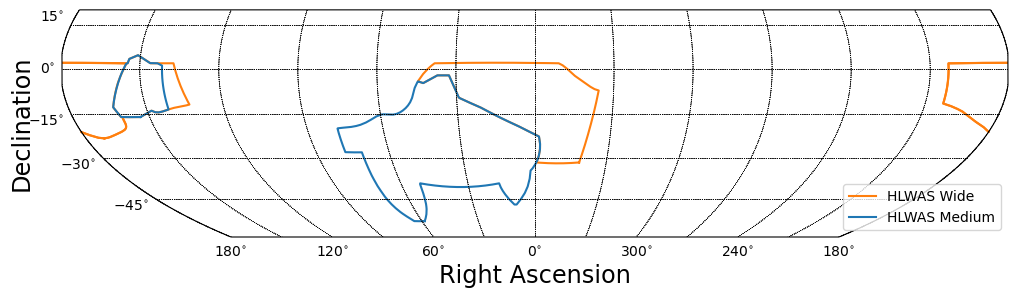
Outlines of the planned survey footprints for the Medium (blue) and Wide (orange) HLWAS tiers. The Medium tier fields at right ascensions of ~150° and ~45° are elsewhere referred to as Medium Field 1 and Medium Field 2, respectively.
Details of Wide Tier Observations
| Optical element | Exposure Time per Dither (s) | Number of Dithers | Number of Passes | Estimated Depth/Line Flux per Dither (AB mag) | Estimated Depth/Line Flux per Pass (AB mag) | Total Depth/Line Flux Limit 5σ Point-Source (AB mag) |
|---|---|---|---|---|---|---|
| F158 | 107 | 3 | 2 | 25.5 | 26.0 | 26.2 |
Medium Tier Observations
The Medium Tier is designed to obtain imaging in three filters, F106, F129, and F158, to characteristic depths of approximately 26.5 AB mag (in F106) and 26.4 AB mag (in F129 and F158) for a 5σ point source. It also includes slitless spectroscopy reaching a limiting line flux of 1.5 × 10⁻¹⁶ erg cm-2 s-1 (5σ emission-line integrated flux limit).
The multi-band imaging enables precision control of weak lensing systematics and provides robust discrimination of contaminants in the spectroscopic analysis. It also supports investigations of astrophysical sources over a wide range of redshifts.
Field Selection
The Medium Tier footprint (see blue contours in the Figure Outline of Medium and Wide tier) was chosen to optimize depth, image quality, and overlap with complementary surveys. Locations were prioritized based on the following criteria:
Low dust and crowding – Fields were selected far from the Galactic Plane to minimize dust extinction and stellar density.
Rubin/LSST overlap – The footprint overlaps the Rubin/LSST survey area, providing optical band measurements (see Rubin’s Survey Cadence Optimization Committee's Phase 2 Recommendations). The combination of optical (Rubin/LSST) and near-IR (Roman) colors enables the mitigation of chromatic PSF biases and the definition of accurate photometric redshift bins.
Low zodiacal background – Regions far from the ecliptic were chosen to minimize sky brightness.
Northern hemisphere accessibility – Portions of the footprint are observable from northern facilities, supporting coordinated follow-up.
Cross-survey and deep field overlap – The Medium Tier includes the LSST Deep Drilling Fields (Chandra Deep Field South (CDF-S), European Large-Area ISO Survey-S1 (ELAIS-S1)), as well as the COSMOS and XMM-LSS fields also used in the Deep Tier, and the Euclid Deep Field–South.
Additional details on the Medium Tier footprint are summarized in Table 6 of the HLWAS Definition Committee's report (Appendix C.1; ROTAC, 2025).
Single Segments for the Medium Tier
Single mosaic segment for the Medium and Wide tier imaging | 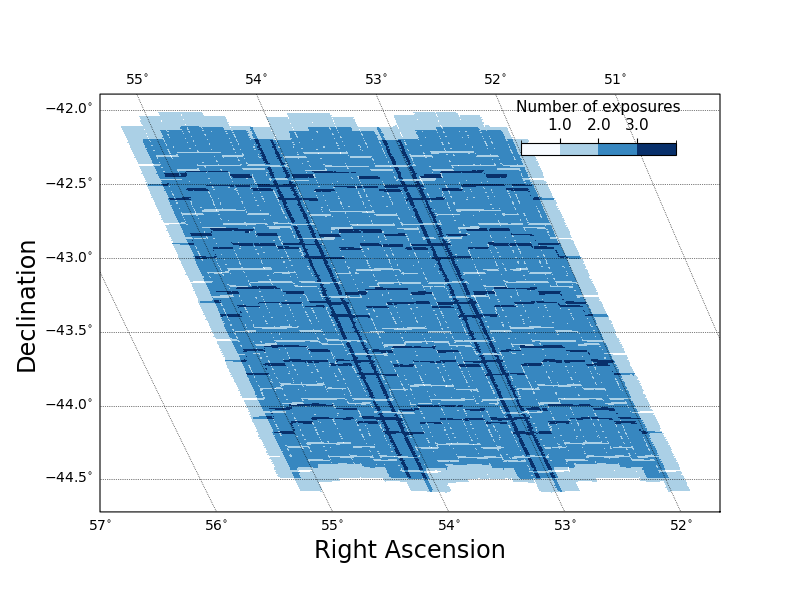 Single mosaic segment for the Medium tier |
|---|
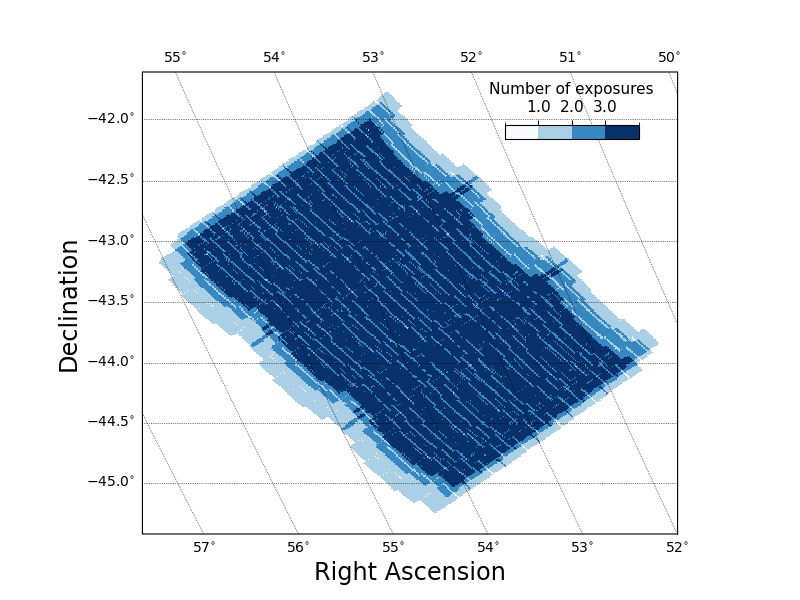
Example of mosaic segments, which are the building blocks that tile the overall footprint for the Medium and Wide tier. The left panel shows a mosaic segment for a 3-point LINEGAP3 dither, which are the nominal segments for the Medium and Wide tier imaging. The right panel shows a mosaic segment for a 2-point LINEGAP2 dither, which are the nominal segments for the Grism passes on the Medium tier. The location and pointing orientations are arbitrarily chosen.
Observation Specifications
The observing strategy is the same for the Wide and Medium tiers (see summary in the Table Details of Medium Tier Observations).
Survey Area and Location
The Medium Tier consists of two fields totaling approximately 2,350 deg2. The outlines of these fields are shown as the blue lines in Figure Outline of Medium and Wide tier. Each Deep Tier field is fully contained within one of the Medium Tier fields.
Exposure Specifications
Optical elements: F106, F129, F158, Grism.
Exposure time - Broadband imaging: 107 s, MA table IM_107_7 (7 unequally spaced resultants).
Exposure time - Slitless spectroscopy: 190 s, MA table SP_190_12 (12 unequally spaced resultants).
Mosaic and Dither Strategy
The footprint is divided into rectangular 6 × 3 mosaics. Each imaging pointing is dithered three times using a diagonal dither (LINEGAP3), while the spectroscopic pointings are dithered twice (LINEGAP2). Examples of the resulting survey segments are shown in the Figure Single segments for the Medium tier.
The Medium Tier is imaged twice (2 passes) at different roll angles, with a relative roll angle of ~167° (±5°) between them. Spectroscopic observations are obtained at four roll angles (4 passes).
Imaging observations with the F158 filter are given priority to go first for a given mosaic segment. Otherwise, there is no enforced survey sequencing; filter and tile choices remain flexible to increase schedulability windows.
Special Requirements
All tiers in the HLWAS will be scheduled when the expected astronomical background (zodiacal light, thermal backgrounds, etc.) is within 25% of the minimum possible background at that pointing position throughout the year.
The Medium and Wide tiers are recommended to be interlaced for simpler calibration and science analyses (see Scheduling of the Observations section).
Details of Medium Tier Observations
| Optical element | Exposure Time per Dither (s) | Number of Dithers | Number of Passes | Estimated Depth/Line Flux per Dither (AB mag) | Estimated Depth/Line Flux per Pass (AB mag) | Total Depth/Line Flux Limit 5σ Point-Source (AB mag) |
|---|---|---|---|---|---|---|
| F106 | 107 | 3 | 2 | 25.6 | 26.1 | 26.5 |
| F129 | 107 | 3 | 2 | 25.5 | 26.0 | 26.4 |
| F158 | 107 | 3 | 2 | 25.5 | 26.0 | 26.4 |
| Grism | 190 | 2 | 4 | 4.4x10⁻¹⁶ erg cm-2 s-1 | 3.1x10⁻¹⁶ erg cm-2 s-1 | 1.5x10⁻¹⁶ erg cm-2 s-1 |
Deep Tier Observations
The Deep Tier sits within the HLWAS Medium Tier footprint and provides the calibration data required to meet the mission science requirements for cosmological precision. Its footprint comprises two fields, COSMOS and XMM-LSS, totaling ~19 deg2, located near the equator to enable access from both hemispheres. Within COSMOS, an embedded Ultra-Deep Tier field (~5.5 deg2) provides additional depth for calibration and transient studies.
The Deep Tier is designed to reach a depth equivalent to 10x the exposure time at the median ecliptic latitude of the Medium tier, for both imaging and spectroscopy. It obtains observations in all Roman imaging filters plus the grism; for optical elements observed in both the Medium and Deep tiers, the Deep Tier reaches ~1.2 mag deeper in imaging, and the spectroscopic line-flux limit is ~2.5× deeper.
The imaging component is used to calibrate photometric redshifts, while the spectroscopic component spans a wider range of roll angles to diagnose potential biases from spectroscopic decontamination.
Field Selection
The Deep Tier fields were selected to provide the calibration and depth necessary for high-precision cosmological analyses and to ensure strong synergy with complementary multiwavelength datasets. The primary considerations were:
Medium Tier overlap - The Deep Tier is located entirely within the HLWAS Medium Tier footprint, enabling direct cross-calibration between tiers.
Rubin/LSST overlap - Both Deep Tier fields coincide with the Rubin/LSST Deep Drilling Fields, providing optical-infrared color information critical for calibration and joint analyses.
Field choice - The selected fields are COSMOS and XMM-LSS, each covering ~9.5 deg2 (~19 deg2 total). Within the COSMOS field lies the Ultra-Deep field (~5.5 deg2), which provides additional depth for calibration and transient studies.
Accessibility - Both fields are located near the celestial equator, allowing observations from both the northern and southern hemispheres and facilitating coordinated ground-based follow-up.
Additional information on the Deep Tier footprint is summarized in Table 6 of the Table 6 of the HLWAS Definition Committee's report (Appendix C.1; ROTAC, 2025).
Observation Specifications
The observing strategy follows the same general framework as the Medium and Wide tiers, with deeper exposures and additional survey steps (see summary in the Table Details of Deep Tier Observations).
Survey Area and Location
The Deep Tier consists of two fields, both overlapping with the Medium Tier:
COSMOS (RA = 10h00m24.00s, Dec = +02°10′55.00″)
XMM-LSS (RA = 02h22m50.00s, Dec = –04°45′00.00″)
Each field covers ~9.5 deg2, for a total of ~19 deg2, overlapping the Rubin/LSST Deep Drilling Fields at these locations.
Within the COSMOS field lies the Ultra-Deep field (~5.5 deg2), providing additional depth for calibration and transient studies.
- Both the XMM-LSS and COSMOS targets are observable approximately every six months, with each visibility season providing spacecraft orientations about 180° apart. The Deep Tier observations are divided roughly equally between the two seasons to provide a range of orientations.
Exposure Specifications
Optical elements: F087, F106, F129, F146, F158, F184, F213, Grism.
Exposure time - Broadband imaging: 294 s, MA table IM_294_16 (16 unequally spaced resultants). Note: the structure of the resultants in the first 107 seconds of the IM_294_16 table is identical to the IM_107_7 table.
Exposure time - Slitless spectroscopy: 190 s, MA table SP_190_12 (12 unequally spaced resultants).
Mosaic and Dither Strategy
The footprint is divided into of 4 × 8 mosaics. Each imaging pointing is dithered three times using a diagonal dither (LINEGAP3), while the spectroscopic pointings are dithered twice (LINEGAP2). The resulting footprints for the COSMOS field are shown in the Deep and Ultra Deep Strategy Figure.
Special Requirements
The COSMOS field must be observed to full depth during the first year of operations.
The Deep Tier is observed in five imaging passes (six for F146) and 36 grism passes, and the imaging filters are sequenced differently for the XMM-LSS and COSMOS targets:
- XMM-LSS: About half of the imaging passes are observed in one season, with relative orientation offsets of 8–20°. The remaining passes follow the same sequence but in the other season.
- COSMOS: To enable time-series observations of Solar System targets, the COSMOS imaging passes are acquired in pairs with the same orientation; each pair is repeated 1–3 weeks later with an orientation offset of 8–20°, as illustrated in the Deep tier roll angle schematic. About half of the filters are executed in this sequence in one season, and the remaining filters in the other season.
- The grism passes are evenly divided between the two seasons, with relative orientation offsets of 1.5–2° within each season.
All tiers in the HLWAS will be scheduled when the expected astronomical background (zodiacal light, thermal backgrounds, etc.) is within 25% of the minimum possible background at that pointing position throughout the year.
Deep Tier Roll Angle Schematic
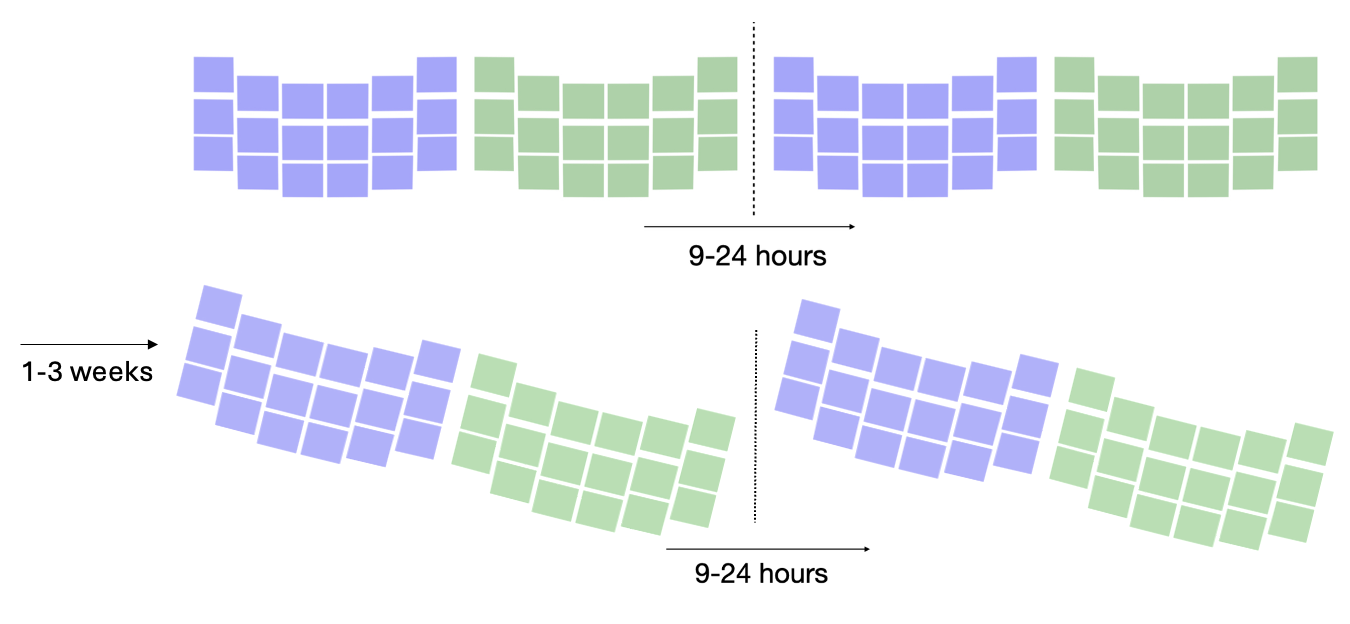
Imaging strategy for the Deep Tier COSMOS field. Each survey step acquires two filters within 9–24 hours at the same roll angle. The next sequence, using the same filters, follows 1–3 weeks later with a roll angle offset of 8–20°. Other filters are repeated in the same fashion, maintaining a balance between “North up” and “South up.” Color assignments in the figure are arbitrary.
Details of Deep tier Observations
| Optical element | Exposure Time per Dither (s) | Number of Dithers | Number of Passes | Estimated Depth/Line Flux per Dither (AB mag) | Estimated Depth/Line Flux per Pass (AB mag) | Total Depth/Line Flux Limit 5σ Point-Source (AB mag) |
|---|---|---|---|---|---|---|
| F087 | 294 | 3 | 5 | 26.3 | 26.8 | 27.7 |
| F106 | 294 | 3 | 5 | 26.3 | 26.8 | 27.7 |
| F129 | 294 | 3 | 5 | 26.2 | 26.7 | 27.6 |
| F158 | 294 | 3 | 5 | 26.1 | 26.6 | 27.5 |
| F184 | 294 | 3 | 5 | 25.6 | 26.1 | 27.0 |
| F213 | 294 | 3 | 5 | 23.6 | 25.0 | 25.9 |
| F146 | 294 | 3 | 6 | 26.8 | 27.4 | 28.3 |
| Grism | 190 | 2 | 36 | 5.2x10⁻¹⁶ erg cm-2 s-1 | 3.7x10⁻¹⁶ erg cm-2 s-1 | 6.2x10⁻¹⁷ erg cm-2 s-1 |
Ultra-Deep Tier Observations
The Ultra-Deep observations, obtained within the HLWAS Deep Tier, provide additional imaging and spectroscopic calibration data required to meet mission science requirements for cosmological precision. They use the same imaging filters as the Medium Tier and are designed to reach 30× the effective exposure time of the HLWAS Medium Tier imaging observations.
The Ultra-Deep will be taken within the COSMOS Rubin/LSST Deep Drilling Field, covering ~5.5 deg² (~25% of the Deep Tier area), and providing imaging ~0.5 mag deeper than the Deep Tier and ~1.7 mag deeper than the Medium Tier. The increased depth enables investigation of noise biases in weak-lensing shape measurements and delivers NICMOS Hubble Ultra Deep Field-equivalent depth (Thompson et al., 2005) over an area ~1900× larger.
Field Selection
Location: Within the COSMOS Rubin/LSST Deep Drilling Field, aligned within the HLWAS Deep Tier footprint.
Observation Specifications
The observing strategy is summarized in the Table Details of Ultra-deep Tier Observations.
Survey Area and Layout
- One field covering ~5.5 deg2 within the COSMOS Rubin/LSST Deep Drilling Field, aligned within the HLWAS Deep Tier footprint.
Exposure Specifications
Optical elements: F106, F129, F158.
- Exposure time - Broadband imaging: 294 s, MA table IM_294_16 (16 unequally spaced resultants), replicating the structure of the Medium and Wide tier MA table (IM_107_7) for the first 107 seconds
Mosaic and Angle Strategy
- The footprint is divided into 3 × 6 mosaics. Each imaging pointing is dithered three times using a diagonal dither (LINEGAP3), while the spectroscopic pointings are dithered twice (LINEGAP2). The resulting footprints are shown in the left panel of the Deep and Ultra Deep Strategy Figure.
Special Requirements
The Ultra-Deep Tier is imaged in ten passes, sequenced as in the COSMOS Deep Tier to enable time-series observations of Solar System targets.
During the first two years, half of the imaging passes are acquired in paired orientations; each pair is repeated 1-3 weeks later with an orientation offset of 8–20°. The remaining passes are obtained later in the mission.
- All tiers in the HLWAS will be scheduled when the expected astronomical background (zodiacal light, thermal backgrounds, etc.) is within 25% of the minimum possible background at that pointing position throughout the year.
Deep and Ultra Deep Strategy
Number of Grism exposures in the HLWAS Deep Cosmos field |
Number of exposures using the F158 filter in the Deep field |
|---|


Left: Number of grism exposures in the HLWAS Deep COSMOS field. Right: Deep and Ultra Deep COSMOS field number of exposures using the F158 filter. The color scale shows the number of exposures in each section of the sky. The specific roll angles shown are preliminary and subject to change.
Details of Ultra Deep Observations
| Optical element | Exposure Time per Dither (s) | Number of Dithers | Number of Passes | Estimated Depth/Line Flux per Dither (AB mag) | Estimated Depth/Line Flux per Pass (AB mag) | Total Depth/Line Flux Limit 5σ Point-Source (AB mag) |
|---|---|---|---|---|---|---|
| F106 | 294 | 3 | 10 | 26.3 | 26.8 | 28.2 |
| F129 | 294 | 3 | 10 | 26.2 | 26.7 | 28.2 |
| F158 | 294 | 3 | 10 | 26.1 | 26.6 | 28.1 |
Scheduling of the Observations
HLWAS observations are expected to span Roman’s primary five-year mission. The HLWAS Definition Committee recommends a preferred sequencing of tiers, guided by operational and scientific considerations. In particular, they advise:
- Acquiring a subset of Deep-tier data very early to validate the survey strategy and enable course corrections, with coverage in all spectral elements of the Deep tier within Year 1 and at least half of the Ultra-Deep depth achieved by the end of Year 2.
- Obtaining most (but not all) Medium-tier observations before the Wide tier, and, within the Medium tier, securing at least one imaging pass in a region before observing that region with the grism. These preferences will be weighed heavily in mission planning.
- Imposing a latitude-dependent minimum Sun-angle constraint, implemented operationally as an upper limit on the allowable sky background (zodiacal plus thermal) for any observation.
- Sequencing the Deep tier as discussed in the Deep Tier Observations section and Illustrated in the Deep tier roll angle schematic.
Scheduling to be Finalized
The detailed scheduling of Roman’s observations will depend on the start of science operations, the selection of General Astrophysics Surveys, and target choices and timing within the coronagraph allocation. This page will be updated as more information becomes available.
Although the community-defined surveys are fully specified, the exact scheduling of observations has yet to be finalized. The timing depends on several factors, including the start of Roman’s science operations, the selection of General Astrophysics Surveys, and target choices and timing within the coronagraph instrument allocation. Even so, much is already understood about how Roman observations will be scheduled. A summary is available on the observation plan for the first two years page.
Future Evaluation of the Survey Implementation
Implementation of the HLWAS will be reassessed after Roman’s on-orbit performance is characterized and initial survey data is in hand, and as warranted by science results from Roman or other surveys. The HLWAS Definition Committee identified astrophysical and technical performance metrics to be evaluated after initial data is obtained; these are detailed in Section 7 of the HLWAS Definition Committee Report (Appendix C.1; ROTAC, 2025). The evaluation will incorporate input from, and discussion with, the science community. Any recommended changes will be reviewed by a committee of community members with broad, HLWAS-relevant expertise and must be approved by the NASA Project Science Office.
Additional Resources
To explore the community-defined surveys and their scientific capabilities in more detail, please see Additional Resources for Community-defined Surveys.
For additional questions not answered in this article, please contact the Roman Help Desk.
References
"Roman Observations Time Allocation Committee: Final Report and Recommendations," Roman Observations Time Allocation Committee and Core Community Survey Definition Committees, arXiv:2505.10574, 2025. doi:10.48550/arXiv.2505.10574.
- "Survey Cadence Optimization Committee’s Phase 2 Recommendations," Rubin’s Survey Cadence Optimization Committee, Revision 2023-02-02.
- Brammer et al., 2012, ApJS, 200, 13, https://doi.org/10.1088/0067-0049/200/2/13
- Grogin et al., 2011, ApJS, 197, 35, https://doi.org/10.1088/0067-0049/197/2/35
- Koekemoer et al., 2011, ApJS, 197, 36, https://doi.org/10.1088/0067-0049/197/2/36
- Merloni et al., 2024, A&A, 682, A34, https://doi.org/10.1051/0004-6361/202347165
- Schlegel et al., 1998, ApJ, 500, 525, https://doi.org/10.1086/305772